


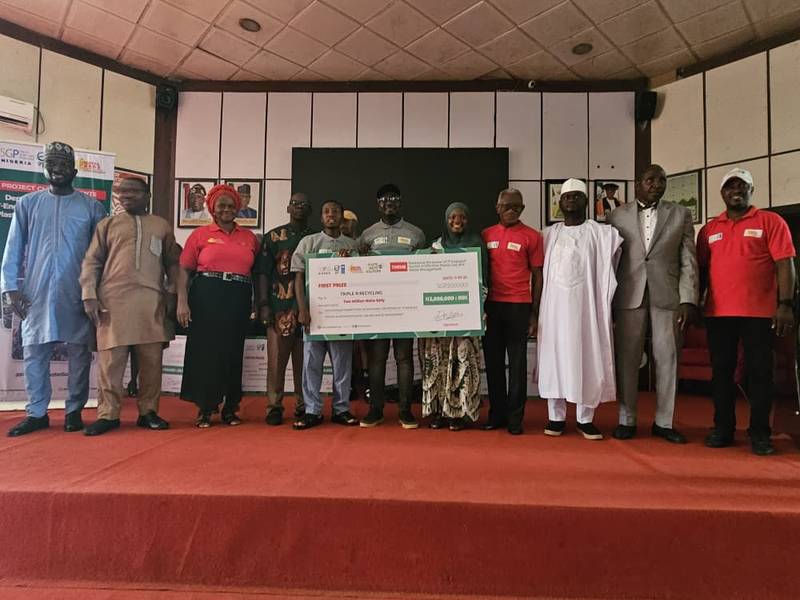
The UN Development Programme-Global Environment Facility Small Grants Programme (UNDP-GEF SGP) and Digital Peers International (DPI) have rewarded young innovators in plastic waste management with millions of naira in cash prizes and an all-expense-paid study trip to China.
The rewards were presented at the closing ceremony of the DPI-SGP 2.0 project on Friday in Nasarawa State.
The initiative, themed “Deploying the Power of IT-Engaged Youth in Effective Plastic Use and Plastic Waste Management 2.0”, sought to equip young Nigerians with digital, entrepreneurial and technological skills to tackle plastic pollution while creating sustainable businesses.
Dr Ibukun Odusote, Executive Officer of DPI, said the grant provided an opportunity to demonstrate how community-driven innovation and digital technology could offer practical solutions to Nigeria’s plastic pollution challenges.
Odusote said the project went beyond awareness creation by adopting a comprehensive approach focused on capacity building, innovation, enterprise development, community engagement, digital transformation and sustainability.
She said the innovation challenge produced a pool of talented young innovators whose ideas required continued support beyond the grant period.
“Our goal is not simply to celebrate innovation but to see it deployed for societal benefit. We will continue to work with participating teams to refine promising ideas, strengthen their technical capacity, facilitate mentorship and build partnerships that will support implementation and commercialisation,” she said.
She disclosed that the winning teams had earlier embarked on a study visit to China to gain exposure to advanced plastic waste management systems, recycling technologies and market opportunities.
Similarly, Dr Ibironke Olubamise, National Coordinator of UNDP-GEF SGP Nigeria, said the solutions presented by participants demonstrated the creativity and determination of young Nigerians to address environmental challenges.
Olubamise said the project aligned with the programme’s vision of supporting community-driven initiatives that deliver environmental benefits, improve livelihoods and reduce plastic pollution.
She added that sustainability measures, including continued support for innovations, environmental sensitisation and digital platforms such as the Green Genius Academy and EcoTrade Hub, would help extend the project’s impact.
She urged the innovators to continue improving their ideas and building partnerships capable of transforming their solutions into scalable businesses and lasting environmental interventions.
Representing the Minister of Environment, Balarabe Lawal, Mr Umaru Murtala, Senior Scientific Officer in the ministry, said the project was nurturing a new generation of young Nigerians with digital and circular economy skills.
He said the Federal Government’s National Policy on Plastic Waste Management and the Extended Producer Responsibility (EPR) framework were designed to ensure manufacturers take responsibility for plastic waste generated from their products.
Mr Francis Agbarakwe, Chief Civil Engineer of the Abuja Environmental Protection Board (AEPB), said the project’s success would ultimately be measured by the behavioural change it inspired, the businesses created and the environmental legacy established.
Agbarakwe urged participants to become ambassadors of responsible plastic use by leveraging technology to educate communities, promote recycling and support sustainability.
Prof. Sa’adatu Liman, Vice-Chancellor of Nasarawa State University, Keffi, described plastic pollution as a growing national concern that had negatively affected the country’s environmental image.
Liman, represented by Prof. Kitso Ngagu, Deputy Vice-Chancellor, Research, Linkages and Innovation, said Nigeria deserved cleaner cities and more sustainable approaches to environmental management.
The overall winner of the innovation challenge, Mr Abdullahi Sulaiman-Ezhin, Founder of Triple R Recycling Limited, said his team developed a technology that converts discarded plastic waste into durable interlocking paving stones.
He said the innovation addressed two national challenges by reducing plastic pollution while providing stronger road construction materials capable of lasting more than 20 years.
“We saw bad roads and plastic waste everywhere, so we decided to turn the waste into stronger interlocking paving stones that can help solve both problems,” he said.
The event also featured the presentation of awards to outstanding youth innovators, donation of plastic waste receptacles to Nasarawa State University, Keffi, and the official close-out of the DPI-SGP 2.0 project.
The overall winning team received N2 million, while the first and second runners-up, Uptex Limited and Apex Recycling Nigeria, received N1.6 million and N1.2 million respectively. Other outstanding teams received N800,000 and N400,000 cash prizes.
