


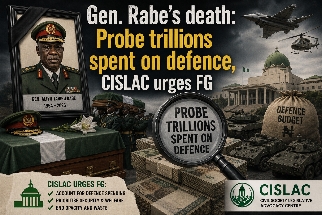
The Civil Society Legislative Advocacy Centre (CISLAC) has urged the Federal Government to declare a national emergency on insecurity and launch an independent audit of defence spending, saying the death of retired Major General Rabe Abubakar in captivity exposes a deepening collapse of Nigeria’s security architecture.
In a statement signed by Executive Director Auwal Musa Rafsanjani, CISLAC described the killing of the senior military officer while held by bandits as “a tragic symbol” of how far the security crisis has spread — noting that if a decorated general can be taken and killed, ordinary Nigerians are at even greater risk.
“The death of a retired Major General in captivity is not only a personal tragedy but a national one that reflects the alarming state of insecurity in the country,” Rafsanjani said.
He warned that senior officers, traditional rulers, community leaders and civilians continue to fall victim to kidnappers, bandits and terrorists across multiple regions.
Citing President Bola Tinubu’s disclosure that the 2026 budget commits N5.41 trillion to defence and security — the largest security allocation in Nigeria’s history, CISLAC said the massive spending has not translated into improved protection for citizens.
Rafsanjani called for a comprehensive, independent audit of defence expenditure and security votes at federal and state levels to determine whether public resources are being effectively used.
He also highlighted rising school kidnappings and attacks on rural communities, referencing an April 2026 Amnesty International report that at least 1,100 people were abducted between January and April 2026 in northern Nigeria, especially in rural areas and IDP camps. He warned the wave of abductions is eroding public confidence and discouraging school attendance in affected areas.
Criticising what he called an alarming lack of urgency among some officials, Rafsanjani singled out comments attributed to the Minister of State for Defence, Bello Muhammad, that “only God can ultimately bring an end to insecurity,” saying such remarks are inappropriate from public officers charged with protecting lives and property. “Leadership requires action, not excuses,” he said.
He also challenged defence ministerial explanations that global conflicts have hampered procurement of military hardware, quoting remarks by retired General Christopher Musa that countries engaged in wars are making large advance payments, complicating purchases.
“Criminal groups operating across Nigeria do not appear to be suffering from shortages of weapons,” Rafsanjani said. “Nigerians deserve answers about how terrorists, bandits and kidnappers continue to access arms while citizens are told procurement challenges are responsible.”
The statement pointed to systemic failures in intelligence and coordination, questioning how criminal networks operate despite the presence of multiple intelligence agencies — the Office of the National Security Adviser, the Department of State Services, the National Intelligence Agency and the Defence Intelligence Agency.
CISLAC called for strengthened intelligence gathering, improved inter-agency coordination and dismantling of networks that support criminal activity.
Rafsanjani demanded greater transparency and accountability from the National Assembly, arguing lawmakers have not exercised sufficient oversight over security spending and outcomes.
He called for better welfare, training, equipment and measurable performance benchmarks for security personnel, and insisted that any move toward state policing be implemented with robust legal and accountability safeguards.
CISLAC concluded by reiterating its call for nationwide security-sector reforms, sustained political will, enhanced community engagement and immediate coordinated action to reverse what it described as an unacceptable and escalating national emergency.
The group urged the government to treat General Rabe’s death as a wake-up call and to take decisive steps to ensure no one — regardless of rank or status — is left vulnerable to criminal violence.
