


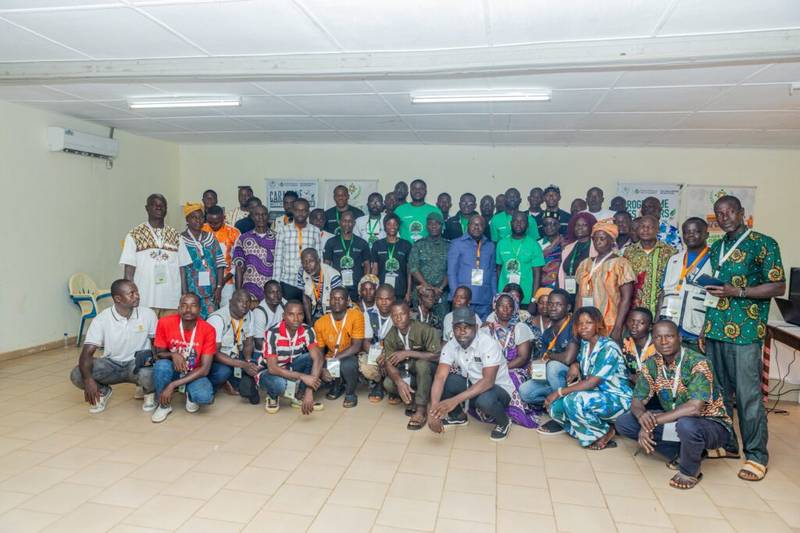
E LAFI SOU Foundation and People Planet and Peace Foundation (PPPF) have trained 100 indigenes of Djebonoua community on agroforestry to tackle climate change.
The training, held on Sunday in Djebonoua, central Côte d’Ivoire, aimed to equip participants with practical knowledge and skills to strengthen climate change mitigation and adaptation efforts.
The training also provided them with sustainable agricultural practices that promote environmental conservation and improved productivity.
Speaking at the event, President of E LAFI SOU Foundation, Mr. Koffi Matieu, said the program was designed to help participants understand the fundamentals of agroforestry and effectively apply the concepts in their communities.
According to him, the initiative seeks to enhance participants’ capacity to design and implement agroforestry systems that are adapted to local realities and environmental challenges.
A forest expert and guest speaker at the event, Mr. Kotne Arthur, described agroecology as an integrated approach that applies ecological principles to the design and sustainable management of agricultural systems.
He said agroecology optimizes interactions among plants, animals, humans, and the environment, thereby improving productivity, resilience, biodiversity, and sustainability.
Arthur noted that mitigation and adaptation remain two complementary strategies in addressing climate change.
“Mitigation focuses on addressing the causes of climate change, while adaptation focuses on responding to its consequences,” he said.
He urged participants to put the knowledge gained during the training into practice in their farming activities.
“The certificates you are receiving today belong to you, but applying what you have learned will benefit both you and your community in the fight against climate change,” he added.
In a related development, the Sub-Prefect of Djebonoua, Mrs. Karamoko Sinia, pledged to intensify advocacy against indiscriminate tree felling in the community during a visit by members of the Cross Border Business and Biodiversity Coalition (CBBC).
Sinia said Djebonoua remains the leading producer of tomatoes in Côte d’Ivoire but faces major challenges, including post-harvest losses and inadequate water supply for farming.
“Although we produce more tomatoes than other communities, our farmers earn little due to wastage. Water scarcity is also a major challenge affecting agricultural production,” she said.
Responding, CBBC Secretary in Nigeria, Miss Kumuyi Olabisi, assured the community of PPPF’s support in addressing some of the identified challenges.
She said the organization would assist in providing water reservoirs for irrigation and support initiatives in maternal and child healthcare.
Olabisi added that the foundation would explore ways to assist farmers with tomato preservation facilities to reduce post-harvest losses and improve incomes.
According to her, CBBC is a Pan-African, youth-led initiative committed to promoting climate justice, cross-border cooperation, and green economic transformation across the continent.
