


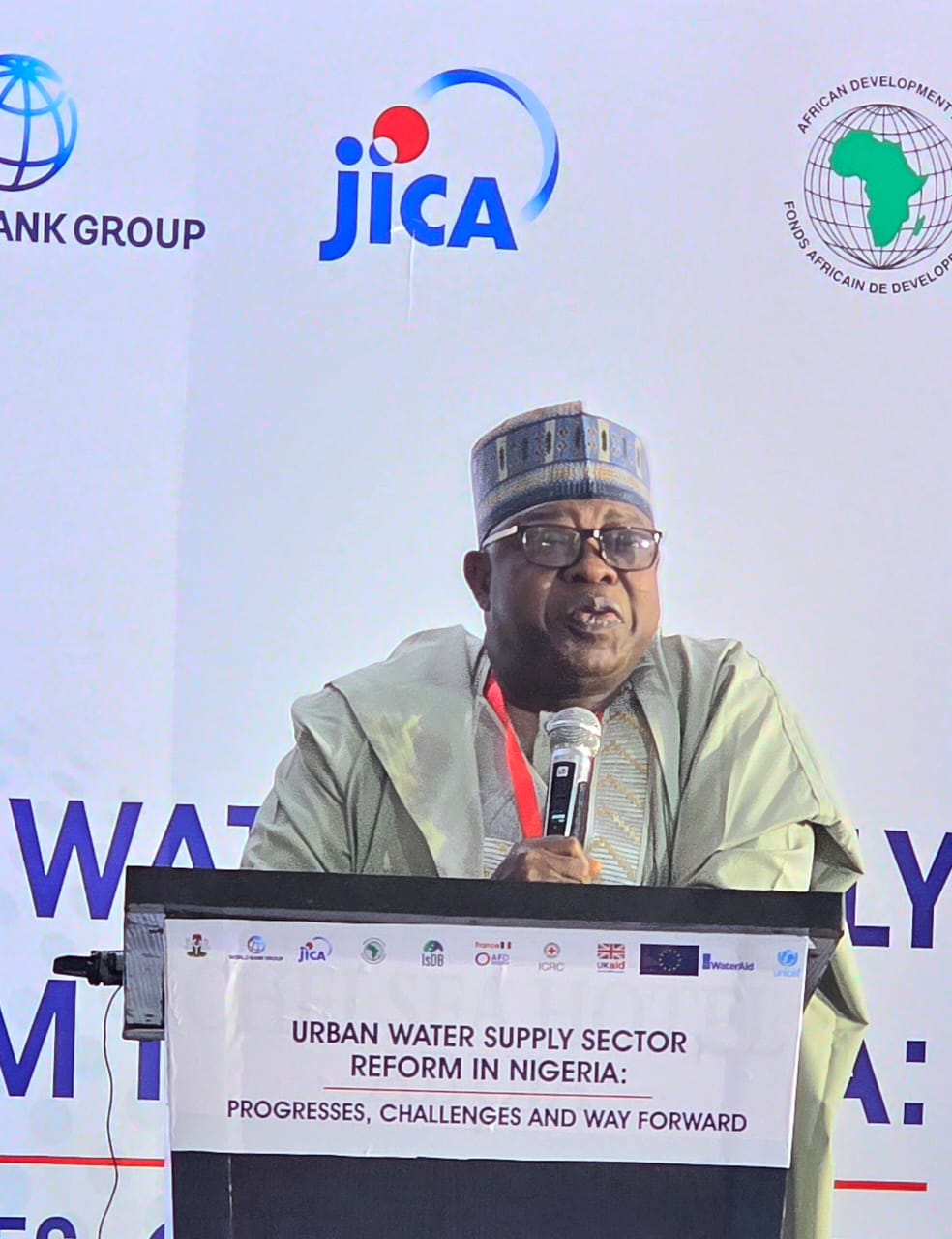
Stakeholders identified peer-to-peer utility partnerships, digitalisation, and stronger customer data systems as key drivers of improved service delivery and financial sustainability for water utilities.
They discussed this at the workshop on the Urban Water Supply Sector Report in Nigeria: Progress, Challenges, and the Way Forward in Abuja on Tuesday.
The WaterAid Utility Partnerships Senior Adviser, Ms. Lungi Biyela, said Sanitation and Water Operators’ Partnerships (SWOPs) are helping utilities strengthen technical capacity and improve operational efficiency through structured collaboration.
She explained that SWOPs connect experienced utilities with those seeking to enhance their operations, enabling sharing of expertise, skills, and practical solutions to common challenges.
She added that this model, which has existed for about two decades, is coordinated globally by the Global Water Operators’ Partnerships Alliance (GWOPA) under UN-Habitat, with WaterAid supporting implementation in several countries.
Biyela described the partnerships as non-profit, demand-driven, and results-oriented, noting that about 80 percent of activities focus on capacity strengthening and 20 percent on infrastructure support.
“The core is peer-to-peer learning, where utilities support each other to address operational challenges and improve service delivery,” she said.
She explained that WaterAid’s capacity-building approach operates at three levels: individual staff, utility organizations, and the wider Water, Sanitation, and Hygiene (WASH) system.
According to her, these partnerships enhance staff skills and confidence, improve utility systems and procedures, promote data-driven decision-making, and generate evidence to support sector-wide reforms.
Biyela emphasized that trust between partner utilities is vital to SWOPs’ success, as stronger relationships foster openness, knowledge sharing, and innovation.
She noted that WaterAid currently supports active partnerships in Uganda, Zambia, Madagascar, Malawi, and Nepal through both North-South and South-South collaborations.
Highlighting Uganda’s results, she said a partnership between the Eastern Umbrella for Water and Sanitation and Welsh Water helped digitise asset registers, improve maintenance management, and significantly reduce response times to equipment failures.
She also cited an ongoing partnership between Zambia’s Water and Sanitation Company and Northumbrian Water Group, which has supported district metered area establishment, staff training, hydraulic modelling, and customer engagement initiatives.
She explained that Zambia’s program is linked to a World Bank Programme-for-Results, which releases funding as utilities meet performance targets.
Biyela concluded that this model is helping to build more efficient and resilient utilities capable of delivering sustainable water services.
Additionally, Mr. Rainer Morel, Senior Manager of Strategy and Innovation at Veolia, said stronger customer data systems and end-to-end digitalisation are essential for improving revenue collection and overall utility performance.
Morel said successful reforms often start with comprehensive customer and asset inventories supported by digital mapping of all connection points within a utility’s service area.
He explained that this mapping helps utilities identify connected and unconnected properties, detect illegal connections, and establish accurate customer databases for planning, billing, and revenue assurance.
He noted that service quality directly influences customers’ willingness to pay for water.
“Where customers see improvement, they are more willing to pay. When service is poor, payment discipline declines,” he said.
Morel added that digital technologies are transforming customer management systems across Africa, including mobile money platforms and payment agents to improve accessibility and collection efficiency.
He stressed that accurate billing requires utilities to invest in properly calibrated meters and transparent meter-reading systems.
Many utilities now use smartphone-based meter-reading technologies that capture images of readings and automatically transmit data into billing systems, reducing human error, limiting estimated billing, and increasing transparency.
He noted that utilities with fully digitalised meter-reading and billing systems have reported major improvements in revenue collection and customer trust.
Achieving collection efficiency above 90 percent depends not only on enforcement but also on reliable service, transparent billing, and customer confidence that charges reflect actual consumption.
The workshop was organized by the Federal Ministry of Water Resources and Sanitation in partnership with the Development Partner Group.
