


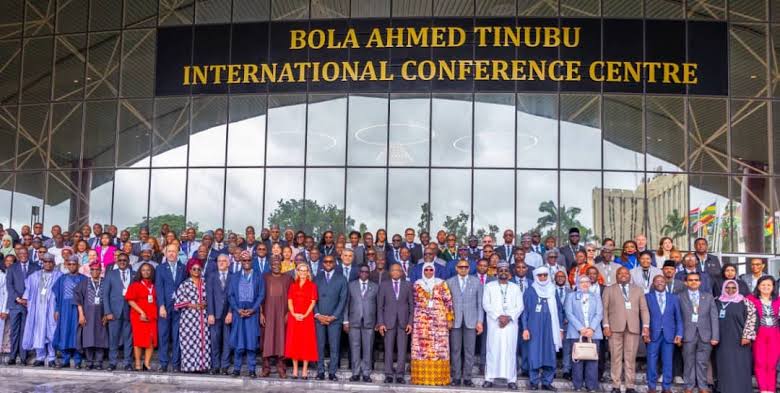
Nigeria and the International Telecommunication Union (ITU) have urged African countries to strengthen regional cooperation and adopt a common position on global digital governance.
They made the call on Thursday in Abuja at the opening of the 7th Ordinary Session of the African Telecommunications Union (ATU), ahead of the 2026 ITU Plenipotentiary Conference in Doha, Qatar.
Vice-President Kashim Shettima, represented by the Deputy Chief of Staff to the President, Sen. Ibrahim Hadejia, said Africa’s digital ambitions could only be achieved through collective action and stronger regional institutions.
Shettima said digital technologies had become the backbone of modern economies, making broadband infrastructure, artificial intelligence (AI), cloud computing, satellite communications and secure digital networks as essential as roads, railways and electricity.
He urged African countries to collaborate in expanding affordable broadband connectivity, strengthening cybersecurity, promoting responsible AI governance, harmonising standards, improving spectrum management and accelerating digital trade.
“No single nation, regardless of its size or resources, can fully realise Africa’s digital ambitions in isolation.
“Our future depends on collaboration and institutions such as the ATU to provide the platform through which Africa can coordinate its priorities and speak with greater influence on issues affecting our shared digital future,” he said.
According to the Vice-President, Africa must assume a stronger role in shaping global digital policies to ensure that its priorities and interests are adequately represented.
“This preparatory meeting provides us with an opportunity to build consensus ahead of the ITU Plenipotentiary Conference and strengthen Africa’s common positions on key policy issues.
“When Africa speaks with one voice, our influence is amplified, our priorities receive greater attention and our collective interests are better protected,” he said.
Shettima also urged member states to conduct a transparent and credible election of new ATU leadership, describing strong regional institutions as essential to Africa’s digital transformation.
In his remarks, the Minister of Communications, Innovation and Digital Economy, Dr Bosun Tijani, said the conference was an opportunity for Africa to chart a common course for the future of telecommunications and the digital economy.
Tijani said the continent must arrive at the 2026 ITU Plenipotentiary Conference united, technically prepared and ready to influence global digital policy decisions.
The minister, however, said more reforms, stronger partnerships and coordinated action were required to maximise Africa’s digital potential.
He described AI as one of the greatest opportunities for Africa’s transformation, adding that fewer than two per cent of African languages were currently supported by modern AI systems.
To address the gap, he announced the launch of the ATLAS Network, a continental initiative that will accelerate the development of African large language models.
He said the initiative would build on Nigeria’s N-ATLAS, Africa’s first government-backed open-source large language model, unveiled during the United Nations General Assembly in 2025.
“Our ambition is for the ATLAS Network to become a platform that accelerates the development of locally relevant large language models in Africa, by Africa and for Africa.
“It will bring together governments, researchers, innovators, academia and ecosystem partners to ensure Africa’s languages, cultures and knowledge systems are reflected in the AI technologies that will shape our future,” he said.
Also speaking, the Secretary-General of the ITU, Ms Doreen Bogdan-Martin, described Africa as a continent increasingly shaping the global digital future through innovation, entrepreneurship and a youthful population.
Bogdan-Martin said Africa was no longer merely a consumer of technology but had emerged as a creator, innovator, standard-setter and trusted global partner.
She commended the ATU for championing universal access and stronger connectivity across the continent and reaffirmed ITU’s commitment to supporting Africa’s digital transformation.
“Collaboration between ITU and ATU has yielded progress in spectrum management, telecommunications standards, school connectivity, digital capacity development and sustainable financing,” she said.
She urged African countries to maintain a united front at upcoming global telecommunications meetings, including the World Telecommunication/ICT Forum and the ITU Plenipotentiary Conference.
“Africa’s voice has never mattered more. Its experience, innovation and leadership will help shape the future of the ITU and also the future of digital cooperation worldwide,” she said.
The conference brought together ministers, regulators, policymakers, development partners and telecommunications industry stakeholders from across Africa to deliberate on regional priorities and strategies for advancing the continent’s digital economy.
