


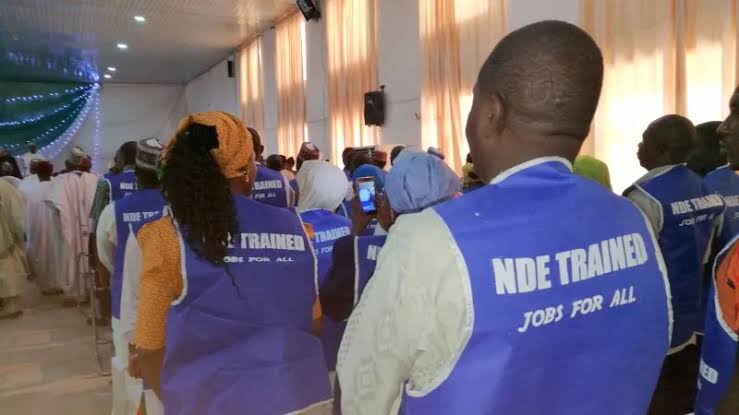
The National Directorate of Employment (NDE) has inaugurated the online registration portal for Phase III of the Renewed Hope Employment Initiative (RHEI), targeting the training of 26,961 unemployed Nigerians.
The Director-General of the NDE, Mr. Silas Agara, said in Abuja on Thursday that the initiative aligns with President Bola Tinubu’s Renewed Hope Agenda on job creation, human capital development, and poverty alleviation.
Agara said the programme would provide training in agriculture, entrepreneurship, Information and Communication Technology (ICT), technical and vocational skills, as well as special public works.
He said the upgraded digital portal would enhance transparency and accountability through applicant authentication using the National Identification Number (NIN). It would also enable automatic allocation of trainees to centres closest to their residences, eliminate multiple registrations, and promote the inclusion of persons with disabilities.
“Beneficiaries of Phases I and II will not be eligible for the new phase to ensure wider access for unemployed Nigerians,” he said.
Agara added that, upon completion of the training, more than 3,405 outstanding graduates and trainees would be resettled with start-up tools. Beneficiaries would also receive monthly stipends ranging from N25,000 to N50,000 for six months, depending on their skill areas.
“Nationwide training for Phase III will commence in August after the close of the registration exercise,” he said.
The NDE boss disclosed that under Phase I of the initiative in 2024, the directorate trained 32,886 unemployed Nigerians and resettled 4,683 beneficiaries with start-up tools and financial support to establish businesses.
He added that 33,692 persons were trained under Phase II but have yet to be resettled due to delays in the release of the 2025 capital budget.
“The budget constraint has also delayed the payment of stipends to 4,651 participants,” he said.
He appealed to affected beneficiaries to remain patient, assuring them that payment of outstanding stipends and resettlement of Phase II graduates would commence once the capital allocation is released.
Agara also announced that the NDE had concluded the development of a five-year strategic plan with technical support from the International Labour Organisation (ILO) to strengthen the implementation of employment generation programmes over the next five years.
Also speaking, the Minister of Labour and Employment, Muhammad Dingyadi, commended the NDE for the successes recorded under the first two phases of the initiative.
Dingyadi described the programme as a key Federal Government intervention aimed at tackling unemployment, promoting entrepreneurship, and expanding access to employable skills.
He said the initiative aligns with the National Employment Policy 2025 and the country’s broader goals of economic diversification, digital transformation, and inclusive growth.
The minister acknowledged delays in the payment of stipends and resettlement of some Phase II beneficiaries and assured that the ministry would work with the NDE to resolve the outstanding obligations.
He urged the directorate to continue prioritising digital technology, agribusiness, renewable energy, green jobs, and other emerging sectors with high employment potential.
Dingyadi reaffirmed the Federal Government’s commitment to supporting the NDE in delivering sustainable employment opportunities for Nigerians.
