


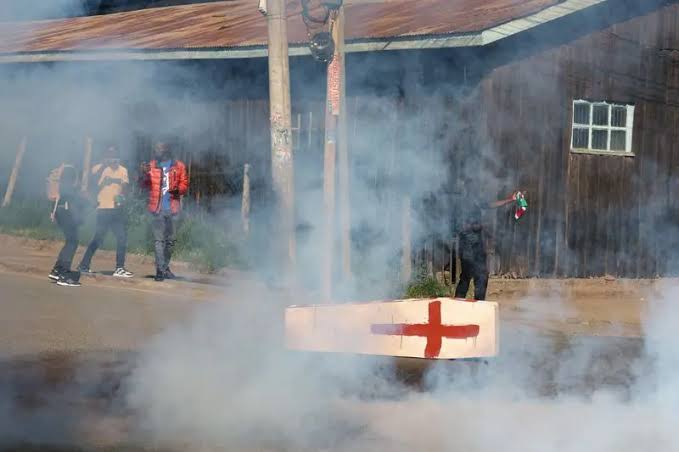
Kenyan police fired tear gas and water cannons on Tuesday at hundreds of protesters demonstrating against a quarantine center for Americans exposed to Ebola.
The U.S. has rushed to build the center despite Kenyan court orders prohibiting further work.
The proposed 50-bed facility at Laikipia Air Base has angered many Kenyans, who accuse the U.S. of offloading the burden of caring for those exposed to Ebola in eastern Democratic Republic of Congo and Uganda.
Earlier, two people were killed and over 10 others detained during protests in the central town of Nanyuki, where frustration has grown despite Kenyan and U.S. authorities reaffirming their commitment to the plan.
On Tuesday, police used tear gas to disperse hundreds of protesters gathered in different parts of the town, which is adjacent to the air force base. Some protesters waved Kenyan flags, and one carried a white cross with the phrase “Reject Ebola” in red.
A protester, Priscilla Imani, said the association of the area with the quarantine facility was scaring away tourists who usually visit for activities like climbing Mount Kenya or seeing rhinoceroses at a nearby conservancy.
“My message is this: Laikipia is not a dumping site, and our voices must be heard,” she told Reuters.
Several U.S. citizens have been exposed to Ebola in eastern Congo and Uganda, where more than 500 cases and 100 deaths have been confirmed since the outbreak was declared in May.
In May, six individuals, including one who tested positive for Ebola, were moved to medical facilities in Germany and the Czech Republic.
U.S. President Donald Trump’s administration has stated it “cannot and will not allow” Ebola cases to enter the U.S.
The Nanyuki facility is intended for Americans exposed to the virus but asymptomatic. Patients with symptoms would be transferred to other countries, U.S. officials have said.
A Kenyan High Court judge has issued two orders blocking the government from building or operating the site. Her latest order required the government to disclose all agreements and protocols related to the facility within one week.
Joshua Malidzo, a lawyer challenging the quarantine plan for the Katiba Institute, said the government did not comply with the court’s deadline, which expired on Monday.
A government spokesperson did not respond to requests for comment.
Many protesters directed their anger at President William Ruto, chanting “Ruto must go!” Ruto, however, said his administration was doing “the right thing” by establishing the center.
“Why would a government set up a facility to control a disease we don’t have when they can’t handle the ones we do?” Bethwel Onyango, 24, told Reuters.
U.S. military aircraft have continued transporting staff and equipment after the court orders, according to sources and flight data, with several expected to land this week.
Satellite images seen by Reuters show a buildup of white tents since late May on about 11 acres of the air base.
The U.S. has said it is aware of the court challenge and is “working with the Kenyan government to resolve any objections.”
Shortly after Kenya agreed to the quarantine plan, the U.S. announced it would provide $13.5 million to support Kenya’s Ebola preparedness efforts.
Kenyan officials said the facility would serve both Kenyans and foreign nationals, but U.S. officials have not confirmed this.
