


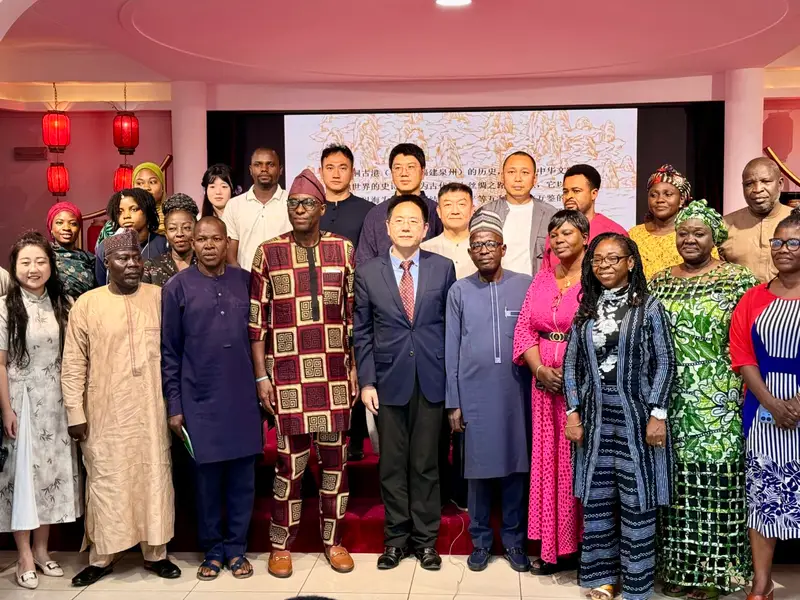
China and Nigeria deepened their cultural diplomacy and people-to-people exchanges on Wednesday through tea ceremonies, guqin performances, and traditional cultural displays at the 2026 Tea for Harmony Yaji Cultural Salon in Abuja.
The salon, themed “Maritime Silk Road Impressions: Immersive Salon of Intangible Cultural Heritage from Ancient Zayton Port,” featured four traditional Chinese arts aimed at fostering mutual understanding between the two countries.
Organized by the Embassy of the People’s Republic of China in Nigeria, the China Center of International Cultural Exchange and Tourism Promotion, and the China Cultural Centre in Nigeria, the event highlighted the enduring ties between China and Nigeria.
Mr. Zhou Hongyou, the Chinese Embassy Minister in Nigeria, described tea as a bridge for dialogue and mutual learning among civilizations. “Tea has become a bridge for dialogue and mutual learning between Chinese civilization and others worldwide,” he said. He noted that Chinese tea culture, originating about 5,000 years ago, spread globally via the Silk Road and Tea Road and has become part of daily life across the world.
He added that the ancient Maritime Silk Road symbolized peaceful cooperation, openness, inclusiveness, and mutual benefit among nations. “The Silk Road carried not only spices, silk, and porcelain but also the spirit of peaceful cooperation and mutual benefit,” he said. Zhou remarked that this spirit continues to guide China-Nigeria relations under the Belt and Road Initiative.
Mr. Abdulkarim Ibrahim, Permanent Secretary of Nigeria’s Federal Ministry of Art, Culture, Tourism, and Creative Economy, represented by Mr. Yohanna Evandu, described tea as a symbol of harmony and cultural exchange. “Tea is more than a beverage; it is a vessel of history and a medium of cultural dialogue,” he said. Ibrahim observed that Nigeria’s growing tea culture reflects its openness to global influences and intercultural exchange.
He reaffirmed the Nigerian government’s commitment to strengthening partnerships with China in tourism, the creative economy, and cultural exchange. Events like this cultural salon are vital for deepening friendship and fostering collaboration.
The event featured a live performance of the ancient Chinese guqin by Master Yang Chao, who explained its over 3,000-year history and cultural significance. Guests also enjoyed demonstrations of traditional incense ceremonies by Master Li Cha, ceramic art and porcelain displays by Master Ma Huiyuan, and Gongfu tea brewing and Pu’er tea tasting sessions by Master Liu Xintong.
