


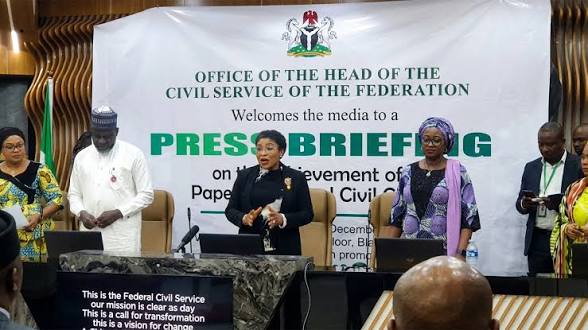
Nigeria’s Federal Civil Service has achieved a historic transition to a fully paperless and digital operation across all 38 Federal Ministries and Extra-Ministerial Departments, ahead of the December 31, 2025 deadline.
The Head of the Civil Service of the Federation (HoCSF), Dr. Didi Walson-Jack, made the announcement at the opening of the International Civil Service Conference (ICSC) 2026 on Wednesday in Abuja.
The conference, themed “Reforms, Resilience and Results,” attracted participants from 16 countries, including the United States, United Kingdom, Switzerland, Singapore and Ghana.
According to her, over 5,000 participants attended physically, while thousands joined virtually.
She said the conference was convened to deepen global collaboration and strengthen public sector reforms across participating countries.
“Eleven months ago, we stood on this ground and made a bold commitment to rejuvenate, innovate and accelerate the transformation of Nigeria’s Civil Service.
“Today, we return not to repeat ourselves, but to demonstrate progress, proof and renewed determination to go further,” she said.
Walson-Jack noted that the Federal Government’s Service Wise GPT platform — an Artificial Intelligence (AI)-powered tool developed to help civil servants navigate service rules and institutional processes — had recorded over 50,000 engagements.
She added that the government is advancing discussions on responsible AI adoption in governance.
“Our position is clear: AI must expand human capacity, not replace human judgment. It must serve citizens, especially the most vulnerable,” she said.
Walson-Jack attributed the achievements in the civil service reform agenda to the support and leadership of President Bola Tinubu.
She said the 2026 conference was structured around eight thematic stages: Aspire, Innovate, Activate, Accelerate, Accomplish, Rejuvenate, Transform and Impact. These stages, she explained, reflect the journey of reform from vision to implementation and sustainable results.
Three roundtable sessions will focus on the future of work in the public sector, partnerships and collaboration, and financing reforms amid fiscal constraints.
Walson-Jack described the “Deal Room” introduced at the conference as one of its most significant innovations. The initiative is designed to facilitate the signing of Memoranda of Understanding (MoUs) among stakeholders, with legal officers available to support negotiations and documentation.
“We want this conference to end with signatures, not just speeches,” she said.
In his goodwill message, the British High Commissioner to Nigeria, Richard Montgomery, commended Nigeria’s ongoing civil service reforms and growing international partnerships.
Montgomery noted that countries worldwide are grappling with global uncertainties, including conflicts, technological disruptions and shifting geopolitical realities. He said the United Kingdom is strengthening its partnership with Nigeria in support of the country’s reform efforts under the Renewed Hope Agenda.
According to him, the partnership has already yielded over $1.5 billion in new investments in agriculture and infrastructure.
Also speaking, the Head of the Civil Service of Ghana, Evans Aggrey-Darkoh, described the conference as a critical platform for idea-sharing and strengthening governance systems across Africa.
Aggrey-Darkoh praised Nigeria’s progress in digital transformation and paperless governance, saying such reforms improve service delivery and reduce corruption.
“The moment you remove a lot of the human interface, you improve quality and deal with issues of corruption,” he said.
He disclosed that Ghana has digitalised several public services, including passport issuance, driver licensing and port operations, while introducing a chip-embedded passport and a national identity management system.
Digitalisation, he added, has significantly increased revenue generation in some Ghanaian institutions.
“A number of areas have been digitalised and revenues in some institutions have more than quadrupled,” he said.
Aggrey-Darkoh, however, cautioned that increased digitalisation also exposes countries to cyber threats, stressing the need for stronger cybersecurity measures.
