


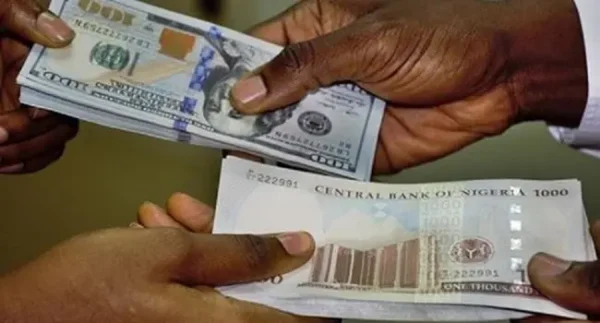
The naira recorded a slight decline against the United States dollar on Monday, closing at N1,375/$ at the official foreign exchange market amid heightened global uncertainty triggered by renewed tensions in the Middle East.
Data released by the Central Bank of Nigeria showed that the local currency weakened from Friday’s closing rate of N1,364/$ as the U.S. dollar maintained strength in the international market on concerns that prolonged geopolitical instability could sustain inflationary pressures and delay global interest rate cuts.
Market analysts said investors are closely watching developments in the Middle East, rising crude oil prices, global inflation trends, and Nigeria’s external reserve position for signals on the direction of the foreign exchange market.
According to CBN figures, intraday trading during Monday’s session ranged between N1,367/$ and N1,375/$, while the average exchange rate settled at N1,372.98/$.
Activity at the Nigerian Foreign Exchange Market (NFEM) also declined, with interbank turnover dropping to $51.17 million across 67 deals, compared to $78.15 million recorded in 91 deals on Friday.
In the global oil market, Brent crude futures climbed to $104.55 per barrel, while U.S. West Texas Intermediate traded near $98.17 per barrel amid fears that escalating Middle East tensions could disrupt global crude supply.
Meanwhile, the dollar index, which measures the greenback against six major global currencies, remained relatively firm at 97.98 as investors continued to shift toward safe-haven assets.
The latest depreciation follows weeks of relative stability for the naira, which had recorded gains through much of April and the early part of May.
Global financial markets remained cautious on Tuesday as diplomatic efforts aimed at easing the Middle East conflict showed limited progress. Investors also reacted to reports suggesting that the fragile ceasefire announced earlier in April may be under pressure.
U.S. President Donald Trump was reported to have described the ceasefire with Iran as being “on life support,” further fueling market concerns over prolonged geopolitical uncertainty and its implications for inflation and energy prices.
Analysts noted that while higher crude oil prices could boost Nigeria’s export earnings and support foreign exchange inflows, they could also worsen imported inflation and increase domestic energy costs.
Attention is also shifting to upcoming U.S. inflation data, which economists believe may influence the timing of interest rate cuts by the U.S. Federal Reserve. Higher U.S. interest rates typically strengthen the dollar and increase pressure on emerging market currencies, including the naira.
The exchange rate movement also comes amid a recent decline in Nigeria’s external reserves.
Nigeria’s gross external reserves reportedly dropped by about $855 million within five weeks, falling from $49.18 billion on April 1, 2026, to $48.33 billion as of May 7, 2026.
Before the foreign exchange reforms introduced under President Bola Ahmed Tinubu, Nigeria operated a tightly controlled exchange rate system in which the central bank played a dominant role in supplying foreign exchange and managing multiple exchange rate windows.
Despite the recent decline in reserves, the CBN has maintained a positive outlook, projecting that the country’s external reserves could rise to $51 billion by the end of 2026 as part of its broader macroeconomic stabilization and investor-confidence strategy.
