


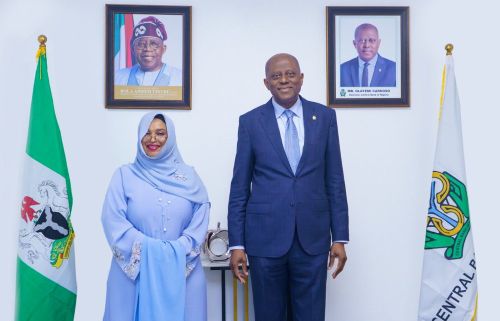
Governor of the Central Bank of Nigeria (CBN), Mr. Olayemi Cardoso, on Thursday, April 23, 2026, received the Chief Executive Officer of the Nigeria Financial Intelligence Unit (NFIU), Hafsat Abubakar Bakari, at the CBN Head Office in Abuja.
The closed-door engagement underscores the deepening partnership between Nigeria’s apex monetary authority and the premier financial intelligence agency, aimed at fortifying the nation’s defences against money laundering, terrorist financing, and other illicit financial flows.
During the meeting, both leaders reviewed progress on joint initiatives to enhance financial intelligence sharing, streamline regulatory oversight, and ensure robust compliance with Nigeria’s Anti-Money Laundering and Countering the Financing of Terrorism (AML/CFT) framework. Key discussions reportedly centred on leveraging real-time data analytics, capacity building for financial institutions, and aligning with international standards set by the Financial Action Task Force (FATF).
This collaboration comes at a critical juncture for Nigeria, which exited the FATF “grey list” in 2025 after sustained reforms but continues to face scrutiny over predicate crimes like corruption and cyber fraud. The NFIU, established under the Economic and Financial Crimes Commission (EFCC), plays a pivotal role in Suspicious Transaction Reports (STRs) processing—handling over 15,000 reports in 2025 alone—while the CBN enforces compliance across banks and fintechs.
Governor Cardoso, who assumed office in September 2023, has prioritized financial system stability amid naira volatility and digital payment surges. Mrs. Bakari, appointed NFIU CEO in early 2026, brings expertise from her background in intelligence and regulatory enforcement, positioning her to drive tech-driven intelligence reforms.
Official statements from both institutions highlight the meeting as a “milestone in sustained implementation” of national AML/CFT strategies, with commitments to joint workshops and policy harmonization in the coming months. Stakeholders anticipate these efforts will curb illicit flows estimated at $18 billion annually, bolstering investor confidence and economic resilience.
