


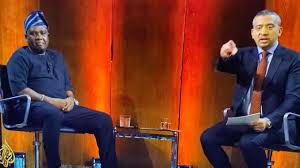
When Local Studio Swagger Meets the Global Arena – Last night’s Head-to-Head episode featuring Daniel Bwala and Mehdi Hasan was supposed to be a debate. Instead, it increasingly looked like a series of headbutts. What unfolded was a classic case of a local television performer suddenly finding himself on the Champions League pitch of global journalism.
00:02 – The early confidence
(In the military, we call it “Initial Gra Gra”)
In the opening minutes, Bwala tried to deploy the familiar talking points that usually work on domestic television panels on Channels Television and Arise TV News. But Mehdi Hasan’s style is different:
- fast
- forensic
- heavily sourced
- relentlessly persistent
Within minutes, the rhythm of the conversation changed. The usual loquacious flow many Nigerians have seen from Bwala on local TV suddenly slowed… then stalled. His famous rapid-fire talking style appeared suddenly arrested, as if someone had quietly switched off the oxygen supply to the argument.
00:10 – The “When did I say that? Defence
At several moments, Bwala resorted to the classic political fallback: “When did I say that?” “I didn’t say that.”
A line that often works in friendly studio environments. But on a programme like Head to Head, clips, tweets, and past statements have a habit of returning like ghosts at midnight. And when confronted with one’s own words on an international stage, denial quickly becomes a very lonely strategy.
00:15 – The glass of water episode
Perhaps the most memorable moment came when Bwala lifted a glass of water. For nearly three minutes, that glass became a symbolic refuge. He held it mid-air — not quite drinking, not quite putting it down — even though he was obviously very thirsty.
At that moment, one could almost imagine the silent prayer passing through his mind:
“Dear God, let there be a total national grid collapse in Nigeria so nobody sees this live broadcast.”
“Dear God, I pray PBAT, my principal, is fast asleep and not watching this.”
Unfortunately for him, electricity held steady. The glass of water became a temporary diplomatic haven for Bwala — the only neutral territory left in the studio.
Drink it? Drop it? Pour it on Mehdi’s face?
In the end, he simply held it there long enough for the water to practically evaporate.
00:18 – When even your own supporters laugh
At one response (“I don’t know about that.” “What were you researching before this interview?”), even members of his own support group in the studio burst into laughter.
Nothing is more brutal in politics than being laughed at by your own supporters. If your own cheering squad laughs at your answer, the referee might as well start the ten-count.
00:20 – When Mehdi smells blood
Anyone who has watched Mehdi Hasan knows his interviewing technique. Once he senses contradiction or hesitation, he does not retreat. He presses forward.
At that moment, the interview began to resemble a boxing match where the opponent has been pushed into the ropes.
Think Mike Tyson in his prime. When Tyson cornered a fighter, he didn’t throw one punch. He threw six combinations in ten seconds.
That is exactly how Mehdi conducts his cross-examination:
A quote. A follow-up. A contradiction. Another clip. Then the same question again.
Until the opponent realises there is no more ring left behind him.
00:22 – Losing direction
At one point, visibly rattled, Bwala even referred to Al Jazeera as “Western media.”
Which must have puzzled the producers sitting in Doha, Qatar.
By then, the debate had clearly taken its toll on him. He looked momentarily like a man who no longer knew where West or East was.
The recovery phase
Towards the end, Daniel Bwala went through a brief “recovery phase,” but by then the match had already been won and lost.
The bigger lessons for several Nigerian stakeholders
There are lessons to be learned by several stakeholders from Daniel Bwala’s misadventure. What we witnessed was not merely a bad media outing. It was a lesson in three things that cannot be improvised on international platforms:
Credibility
Once lost, it follows you into every interview. Politics may reward loyalty, but serious journalism rewards evidence. And when the two meet on the same stage, it is usually evidence that wins on points.
Consistency
Statements made yesterday will meet you again tomorrow.
Authenticity
Global audiences quickly detect when someone is arguing against positions they once passionately defended.
Lessons for Nigeria
For all Nigerian journalists and media houses:
Good journalism demands preparation, evidence, and memory.
For politicians:
Choose spokesmen with credibility that predates the appointment. Because on global platforms, the audience is not just Nigeria — it is the world.
Every government has the right to appoint a spokesman. But before sending someone onto an international platform, it may be wise to ask three questions:
- Does he have credibility?
- Does he have consistency?
- Can he survive ten uninterrupted minutes with Mehdi Hasan?
Because if the answer to the third question is no, then perhaps it is better to keep the interview within Nigerian studio limits.
My final thoughts
What we saw last night was like a talented local player suddenly thrown into the UEFA Champions League. The pace was different. The referees were stricter. The defenders were faster. And the mistakes were visible to the entire planet.
Last night was a reminder that there is a difference between dominating a neighbourhood five-a-side match and playing in the Champions League.
On local TV, you may dribble freely. On a programme like Head-to-Head, the defenders have video replays, statistics, and a long memory.
Daniel Bwala, buoyed by his local media ratings, went in thinking he had a plan. He even broadcast a short “Come and Watch Me” video clip showing him conducting research and preparing for the interview.
But as they say in boxing (often attributed to Mike Tyson):
“Everyone has a plan… until they get punched in the mouth.”
On Head-to-Head, the punches are not fists. They are facts.
