


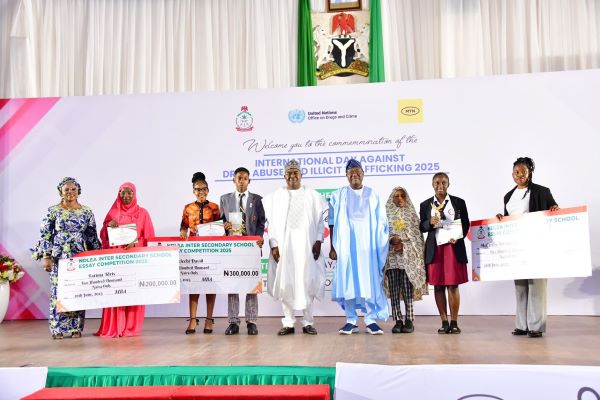
President Bola Ahmed Tinubu has commended the Chairman of the National Drug Law Enforcement Agency (NDLEA), retired General Buba Marwa, and the Agency’s operatives for arresting 66,085 illicit drug dealers, seizing 11.1 million kilograms of drugs, convicting 26,393 persons, and rehabilitating the same number over 53 months.
The President, at the Grand Finale of a weeklong programme to commemorate the 2025 World Drug Day, held at the Presidential Villa Conference Centre, Abuja, on Thursday, 26th June 2025, declared that the fight against substance abuse and illicit drug trafficking in Nigeria must be embraced by all as a national movement—not one left to governments alone.
“Let us also be clear: this fight is not for governments alone. It must be a national movement—driven by families, faith leaders, civil society organisations, youth groups, community leaders, businesses, and, crucially, people with lived experience. Their voices matter. Their stories inspire. Their leadership is essential.
“At the same time, we must not ignore the deeper roots of this crisis. Drug abuse is tied to poverty, inequality, violence, and conflict. To effectively tackle this problem, our approach must be comprehensive. We must foster peace. We must promote inclusive development. And we must uphold human rights every step of the way,” the President, who was represented by the Secretary to the Government of the Federation (SGF), Senator George Akume, stated.
He assured that Nigeria stands firmly with the global community in efforts to tackle drug abuse and its consequences.
“We are committed to working hand in hand with all nations to end this menace and tame the illicit trafficking of substances. Together, we can dismantle the systems that sustain this crisis. Together, we can build a future where prevention is strong, treatment is accessible, and recovery is not just possible—but celebrated.
“There is no doubt that in the past two years, this has been the focus of the Renewed Hope Agenda of our administration—breaking the burden of poverty, uplifting millions out of squalor, and caring for the needs of the masses, especially our youth population, through the student loan scheme and other empowerment initiatives.”
While commending “the great efforts of the NDLEA, its personnel and the leadership headed by Brig Gen Mohamed Buba Marwa (Rtd) for their globally acclaimed successes not only in the area of drug supply reduction but equally in drug demand reduction through aggressive nationwide sensitization aimed at prevention, treatment, rehabilitation, and reintegration of treated drug users back into their families and society,” President Tinubu noted that the efforts “have not only attracted commendations from international partners and western nations, but also increased support and collaboration with Nigeria in the global effort to curb the scourge of substance abuse and illicit drug trafficking.”
In his welcome remarks, the Chairman and Chief Executive Officer of NDLEA, Brig. Gen. Mohamed Buba Marwa (Rtd.), said there is no better time than now for Nigeria to take drug use prevention seriously.
“The reality around us is a strong indication—a wake-up call—for us as parents, guardians, and governments to step up preventive measures. For our nation, prevention is particularly critical, as we are already grappling with a serious challenge. Seven years ago, we came to the stark realisation that Nigeria had one of the highest drug abuse prevalence rates in the world.
“Today, with a population exceeding 230 million, it is both urgent and pragmatic to prevent new individuals from being drawn into the population of drug users. As parents, guardians, and leaders, we must be more vigilant and recognise that the issue of drug abuse is not distant—it is close to home. We must acknowledge that children are especially vulnerable, and we should not dismiss experimentation with illicit drugs as behaviour limited to a particular demographic.”
He said the NDLEA has continued to strengthen prevention strategies while being relentless in its drug supply reduction activities, adding that addressing the socio-economic drivers of drug abuse is also critical.
“The Renewed Hope Agenda of President Bola Ahmed Tinubu’s administration is providing leverage to tackle such critical factors as poverty and unemployment. Initiatives like NELFUND, which offers student loans, and programmes like the Three Million Technical Talent (3MTT) scheme, which enhances technical skills for the digital economy, along with improved national security, will reduce the factors that increase the likelihood of drug abuse.”
“In the final analysis, however, much responsibility rests on parenting. We should be looking at how to empower those entrusted with this responsibility. Through our War Against Drug Abuse (WADA) advocacy campaign, we work with parents, teachers, and leaders in communities, institutions, and associations to spread awareness and teach how to safeguard younger generations. Our family support advocacy emphasises that children don’t just need money—they need the presence and voice of their parents and guardians. Parents must ask questions, dig deeper, and instill values.
“Teachers also play a crucial role. They are deeply influential in shaping character and instilling values during the school years. The national curriculum now includes topics on drug abuse, and teachers are in a prime position to guide and protect young minds.”
“Our advocacy efforts under the WADA campaign continue to gain momentum. Every week, across Nigeria, our 36 state commands, including the FCT and 14 zonal commands, engage in WADA outreach—raising awareness in schools, offices, religious centres, communities, motor parks, and markets. We educate the public about the dangers of drug abuse and how to escape its grip.
“In recent years, many non-governmental organisations have joined NDLEA in partnership to broaden the reach of WADA advocacy. As a result, we have organised 11,123 sensitisation programmes in schools, workplaces, worship centres, markets, motor parks, and communities, while millions have been reached through our robust weekly media engagements. This is in addition to thousands more who have benefitted from the psychosocial support services provided through our 24/7 Call Centre via our toll-free helpline – 0800 102 030 40.”
“At the same time, we have ramped up treatment and rehabilitation efforts, with 30 centres currently active, where we have, in the past 53 months, counselled and rehabilitated 26,393 persons. Thanks to the support of Mr. President, seven new rehabilitation centres have now been approved and will be developed under the current year’s budget. That will broaden access to treatment.”
He added that prevention efforts must be complemented by cutting off access to illicit substances.
“Put simply, while we work strategically to prevent individuals from initiating drug use, we must also shut down the pipeline through which these harmful substances are distributed. We must remove traffickers from the equation. This is a task we have continued to pursue diligently, deploying every resource at our disposal.
“Over the past four and a half years, we have arrested 66,085 offenders—including 94 identified drug barons. Our Operation Offensive Action has yielded tangible results, including the seizure of 11,143,717.44kg of assorted illicit drugs, with life sentences now being secured in court, while a total of 12,201 offenders have bagged various jail terms within the same time frame.”
He expressed gratitude to individuals and institutions committed to helping stem the tide of drug abuse in Nigeria.
“We deeply appreciate the unwavering support of His Excellency, President Bola Ahmed Tinubu. His administration has provided the NDLEA with robust backing. We are also grateful to the National Assembly—particularly the chairmen and members of the Senate and House of Representatives Committees on Drugs and Narcotics—who have been steadfast allies of the Agency. Similarly, the Nigeria Governors Spouses’ Forum and the MTN Nigeria Foundation have proven to be valued partners in progress.
“To the UNODC, INL, DEA, UK Border Force, NCA, and the governments of the United States, United Kingdom, Germany, and France—thank you for your continued and meaningful support.”
In his remarks, the Attorney General of the Federation and Minister of Justice, Prince Lateef Fagbemi, SAN, said drug abuse is not just a public health crisis but a threat to national security, social stability, and economic development.
“Drug abuse and trafficking fuel organized crime, undermine the rule of law, and destroy the hope and future of our young people—our most precious national assets. Ladies and gentlemen, the evidence is indeed clear that investing in the prevention of illicit drug cultivation and trafficking works.”
He added:
“Prevention efforts must be integrated into our educational system, healthcare services, and criminal justice programmes. The federal government is committed to tackling the drug problem and has put in place several drug control frameworks and instruments, including action plans and strategies with the overall aim to significantly reduce the prevalence of the production, trafficking, sale, and use of illicit drugs and their attendant social, economic, and health implications.”
Also speaking, Senate President Senator Godswill Akpabio, represented by the Chairman of the Senate Committee on Drugs and Narcotics, Senator Ibrahim Dankwambo, stated:
“The fight against the drug scourge is not a war of convenience—it is a war of necessity. Every life lost to addiction is not just a tragedy; it is a failure of our collective will. Every young Nigerian drawn into this abyss is a call to arms.”
The Country Representative of the United Nations Office on Drugs and Crime (UNODC), Cheikh Ousmane Toure, emphasized:
“Prevention, treatment, and recovery must not be seen as luxuries. They are life-saving investments. Together we can break the vicious cycle of drug abuse, organized crime, and marginalization. Together we can build a safer, healthier, and more hopeful Nigeria.”
