

• Home
  • Agric
  • Sci & Tech
  • Health
  • Environment
  • Hausa News
  • More
    • Business/Banking & Finance
    • POLITICS
    • Entertainments & Sports
    • International
    • Investigation
    • Law & Human Rights
    • Africa
    • ACCOUNTABILITY/CORRUPTION
    • Hassan Gimba
    • Column
    • Prof. Jibrin Ibrahim
    • Prof. M.K. Othman
    • Defense/Security
    • Education
    • Energy/Electricity
    • Entertainment/Arts & Sports
    • Society and Lifestyle
    • Food & Agriculture
    • Health & Healthy Living
    • International News
    • Interviews
    • Investigation/Fact-Check
    • LAW & HUMAN RIGHTS
    • Oil & Gas/Mineral Resources
    • PRESS FREEDOM/JOURNALISM/PR
    • General News
    • Presidency
  • About Us
    • Contact Us
    • Board Of Advisory
    • Privacy Policy
    • Ethics Policy
    • Teamwork And Collaboration Policy
    • Fact-Checking Policy
    • Advertising
  • Media OutReach Newswire
    • Wire News
  • The Stories
Facebook Twitter Instagram
Trending
  • Wike: Abuja roads will be ready by December as Tinubu’s Christmas gift
  • Ireland fines Google €403m over location data
  • Vaccinate dogs regularly to prevent rabies – Vet
  • Lassa fever: Nigeria records 1,086 cases, 259 deaths in 2026
  • Tech can boost conflict prevention in Nigeria – Expert
  • Credit to government falls to N32.7trn, extends 3-month decline
  • CBN data rule could position Nigeria as Africa’s data hub — OADC CEO
  • Meta unveils petal subsea cable, set to preview camera-free AI glasses at Connect
Facebook Twitter Instagram YouTube
AsheNewsAsheNews
  • Home
  • Agric

    Enugu hires over 160 livestock professionals

    September 22, 2026

    Sebore farm, Gates foundation empower 279 dairy farmers

    September 22, 2026

    UI don says certified yam seed will boost production, exports

    September 21, 2026

    Kwara launches cattle AI programme

    September 21, 2026

    Lagos residents raise concerns over unsafe fufu preparation

    September 20, 2026
  • Sci & Tech

    Ireland fines Google €403m over location data

    September 22, 2026

    Tech can boost conflict prevention in Nigeria – Expert

    September 22, 2026

    Meta unveils petal subsea cable, set to preview camera-free AI glasses at Connect

    September 22, 2026

    Nwifuru woos auto investors as NADDC centre opens in Ebonyi

    September 19, 2026

    King Charles warns of AI risks

    September 17, 2026
  • Health

    Vaccinate dogs regularly to prevent rabies – Vet

    September 22, 2026

    Lassa fever: Nigeria records 1,086 cases, 259 deaths in 2026

    September 22, 2026

    Lions Clubs urge journalists to prioritise health checks

    September 22, 2026

    WHO advances talks on pathogen access system for pandemics

    September 21, 2026

    Fagbemi brings free healthcare to Ijagbo community

    September 21, 2026
  • Environment

    Wike: Abuja roads will be ready by December as Tinubu’s Christmas gift

    September 22, 2026

    Tinubu calls for end to Africa’s mineral exploitation

    September 22, 2026

    NSITF transforms operations through digitalisation, restructuring – MD

    September 22, 2026

    Fuel price hikes deepen hardship for FCT residents

    September 21, 2026

    Lagos directs residents to higher ground

    September 21, 2026
  • Hausa News

    UNA signs MoU to launch air Bissau in Guinea-Bissau

    June 15, 2026

    Otti plans 250-room 5-star hotel in Umuahia

    April 11, 2026

    Anti-quackery task force seals 4 fake hospitals in Rivers

    August 29, 2025

    [BIDIYO] Yadda na lashe gasa ta duniya a fannin Ingilishi – Rukayya ‘yar shekara 17

    August 6, 2025

    A Saka Baki, A Sasanta Saɓani Tsakanin ‘Yanjarida Da Liman, Daga Muhammad Sajo

    May 21, 2025
  • More
    1. Business/Banking & Finance
    2. POLITICS
    3. Entertainments & Sports
    4. International
    5. Investigation
    6. Law & Human Rights
    7. Africa
    8. ACCOUNTABILITY/CORRUPTION
    9. Hassan Gimba
    10. Column
    11. Prof. Jibrin Ibrahim
    12. Prof. M.K. Othman
    13. Defense/Security
    14. Education
    15. Energy/Electricity
    16. Entertainment/Arts & Sports
    17. Society and Lifestyle
    18. Food & Agriculture
    19. Health & Healthy Living
    20. International News
    21. Interviews
    22. Investigation/Fact-Check
    23. LAW & HUMAN RIGHTS
    24. Oil & Gas/Mineral Resources
    25. PRESS FREEDOM/JOURNALISM/PR
    26. General News
    27. Presidency
    Featured
    Recent

    Wike: Abuja roads will be ready by December as Tinubu’s Christmas gift

    September 22, 2026

    Ireland fines Google €403m over location data

    September 22, 2026

    Vaccinate dogs regularly to prevent rabies – Vet

    September 22, 2026
  • About Us
    1. Contact Us
    2. Board Of Advisory
    3. Privacy Policy
    4. Ethics Policy
    5. Teamwork And Collaboration Policy
    6. Fact-Checking Policy
    7. Advertising
    Featured
    Recent

    Wike: Abuja roads will be ready by December as Tinubu’s Christmas gift

    September 22, 2026

    Ireland fines Google €403m over location data

    September 22, 2026

    Vaccinate dogs regularly to prevent rabies – Vet

    September 22, 2026
  • Media OutReach Newswire
    • Wire News
  • The Stories
AsheNewsAsheNews
Home»Science/Tech & Innovation/R&D»NASA receives laser-beamed message from 10m miles away
Science/Tech & Innovation/R&D

NASA receives laser-beamed message from 10m miles away

NASA receives laser-beamed message from 10 million miles away
EditorBy EditorNovember 25, 2023Updated:November 25, 2023No Comments4 Mins Read
Share
Facebook Twitter LinkedIn Pinterest Email

An innovative experiment flying aboard NASA’s Psyche mission just hit its first major milestone by successfully carrying out the most distant demonstration of laser communications. The tech demo could one day help NASA missions probe deeper into space and uncover more discoveries about the origin of the universe.

Launched in mid-October, Psyche is currently en route to catch humanity’s first glimpse of a metal asteroid between the orbits of Mars and Jupiter. The spacecraft will spend the next six years traveling about 2.2 billion miles (3.6 billion kilometers) to reach its namesake, located in the outer part of the main asteroid belt.

Along for the ride is the Deep Space Optical Communications Technology demonstration, or DSOC, which is carrying out a mission of its own during the first two years of the journey.

The tech demo was designed to be the US space agency’s most distant experiment in high-bandwidth laser communications, testing the sending and receiving of data to and from Earth using an invisible near-infrared laser. The laser can send data at 10 to 100 times the speed of traditional radio wave systems NASA uses on other missions. If wholly successful over the next couple of years, this experiment could be the future basis of technology that is used to communicate with humans exploring Mars.

And DSOC recently achieved what engineers called “first light,” the feat of successfully sending and receiving its first data.

The experiment beamed a laser encoded with data from far beyond the moon for the first time. The test data was sent from nearly 10 million miles (16 million kilometers) away and reached the Hale Telescope at the California Institute of Technology’s Palomar Observatory in Pasadena, California.

The distance between DSOC and Hale was about 40 times farther than the moon is from Earth.

“Achieving first light is one of many critical DSOC milestones in the coming months, paving the way toward higher-data-rate communications capable of sending scientific information, high-definition imagery, and streaming video in support of humanity’s next giant leap: sending humans to Mars,” said Trudy Kortes, director of technology demonstrations for the Space Technology Mission Directorate at NASA, in a statement.

The first light, which occurred on November 14, happened as the flight laser transceiver instrument on Psyche received a laser beacon sent from the Optical Communications Telescope Laboratory at NASA’s Jet Propulsion Laboratory’s Table Mountain Facility near Wrightwood, California.

The initial beacon received by Psyche’s transceiver helped the instrument aim its laser to send data back to the Hale Telescope, which is located about 100 miles (160 kilometers) south of Table Mountain.

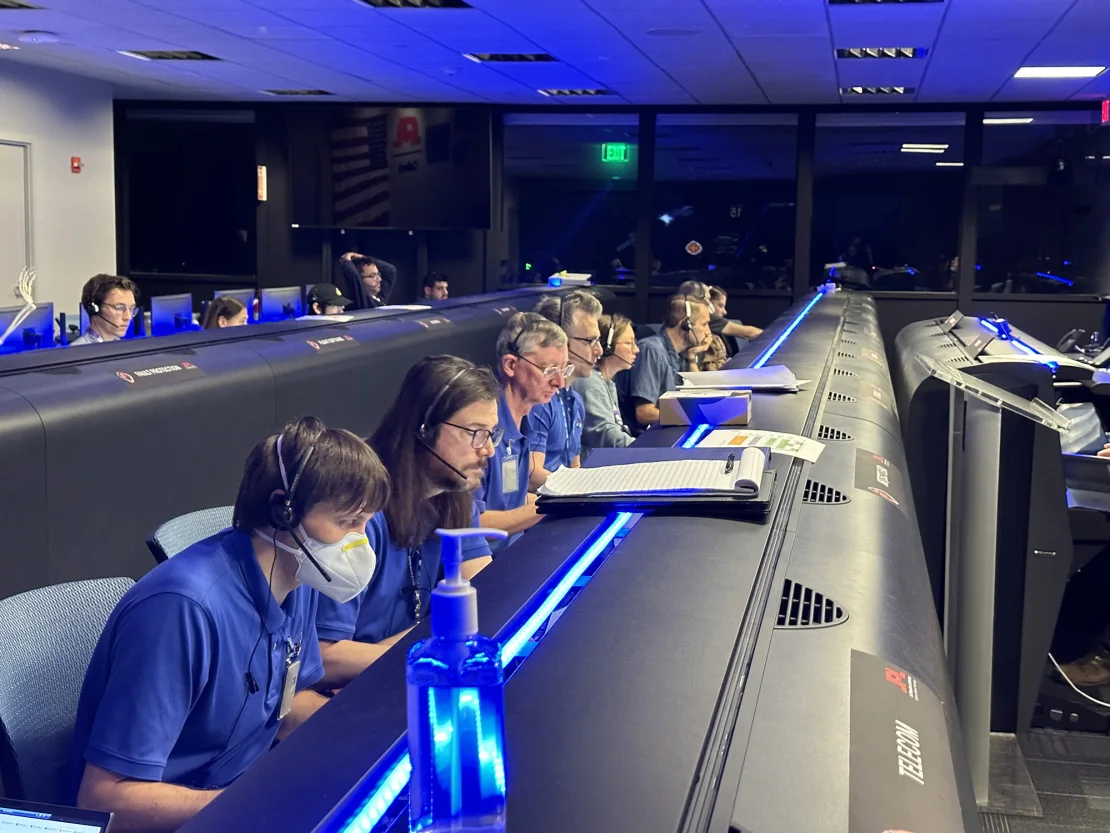
“(The November 14) test was the first to fully incorporate the ground assets and flight transceiver, requiring the DSOC and Psyche operations teams to work in tandem,” said Meera Srinivasan, operations lead for DSOC at JPL, located in Pasadena, California, in a statement. “It was a formidable challenge, and we have a lot more work to do, but for a short time, we were able to transmit, receive, and decode some data.”

It’s not the first time laser communications have been tested in space. The first test of two-way laser communication occurred in December 2021 when NASA’s Laser Communications Relay Demonstration launched and went into orbit about 22,000 miles (35,406 kilometers) from Earth.

Since then, experiments have sent optical communications from low-Earth orbit to the moon. And the Artemis II spacecraft will use laser communications to return high-definition video of a crewed journey around the moon. But DSOC marks the first time laser communications have been sent across deep space, which requires incredibly precise aim and pointing over millions of miles.

The initial test of the tech demo’s capabilities will allow the team to work on refining the systems used in the laser’s pointing accuracy. Once the team has checked that box, DSOC will be ready to send and receive data to the Hale Telescope as the spacecraft travels farther from Earth.

While DSOC won’t actually send scientific data collected by the Psyche spacecraft because it’s an experiment, the laser will be used to send bits of test data encoded in the laser’s photons, or quantum light particles.

Detector arrays on Earth can pick up the signal from Psyche and extract the data from the photons. This kind of optical communication could change the way NASA sends and receives data from its missions across deep space.

“Optical communication is a boon for scientists and researchers who always want more from their space missions and will enable human exploration of deep space,” said Dr. Jason Mitchell, director of the Advanced Communications and Navigation Technologies Division within NASA’s Space Communications and Navigation program, in a statement. “More data means more discoveries.”

California Mars NASA
Share. Facebook Twitter Pinterest LinkedIn WhatsApp Reddit Tumblr Email
Editor
  • Website

Related Posts

Ireland fines Google €403m over location data

September 22, 2026

Tech can boost conflict prevention in Nigeria – Expert

September 22, 2026

Meta unveils petal subsea cable, set to preview camera-free AI glasses at Connect

September 22, 2026

Leave A Reply Cancel Reply

Wike: Abuja roads will be ready by December as Tinubu’s Christmas gift

September 22, 2026

Ireland fines Google €403m over location data

September 22, 2026

Vaccinate dogs regularly to prevent rabies – Vet

September 22, 2026

Lassa fever: Nigeria records 1,086 cases, 259 deaths in 2026

September 22, 2026
About Us
About Us

ASHENEWS (AsheNewsDaily.com), published by PenPlus Online Media Publishers, is an independent online newspaper. We report development news, especially on Agriculture, Science, Health and Environment as they affect the under-reported rural and urban poor.

We also conduct investigations, especially in the areas of ASHE, as well as other general interests, including corruption, human rights, illicit financial flows, and politics.

Contact Info:
  • 1st floor, Dogon Daji House, No. 5, Maiduguri Road, Sokoto
  • +234(0)7031140009
  • ashenewsdaily@gmail.com
Facebook Twitter Instagram Pinterest
© 2026 All Rights Reserved. ASHENEWS Daily Designed & Managed By DeedsTech

Type above and press Enter to search. Press Esc to cancel.