


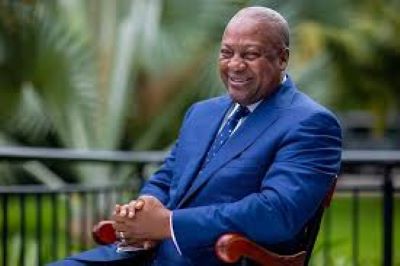
President John Mahama has unveiled an ambitious reform agenda aimed at transforming Ghana’s mining industry from a raw-material exporter into a value-driven industrial sector, urging stronger local participation, downstream processing and technology transfer.
Speaking on Wednesday at the Ghana Mineral Sector Local Content Summit in the port city of Takoradi, Mahama said the country must fundamentally rethink how it manages its mineral wealth if mining is to deliver long-term economic transformation.
‘For over a century, mining has been the backbone of Ghana’s economy,’ he told delegates including traditional leaders, mining executives, diplomats and policymakers. ‘Yet much of the high-value activity in our mining value chain still takes place outside our borders.’
Turning mineral wealth into national prosperity
The summit marks a key step in the government’s push to redesign local content policy within Ghana’s extractive sector, ensuring mineral revenues translate into domestic industries, skilled employment and technological innovation. Officials say the reforms aim to reduce dependence on commodity exports while positioning Ghana within global supply chains linked to the green energy transition.
Although Ghana remains Africa’s leading gold producer and among the world’s top six, Mahama noted that advanced engineering, refining, equipment manufacturing and specialised services continue to be dominated by foreign operators.
In 2023, the extractive sector generated nearly $6.6bn in export revenues, yet local participation in high-value segments remains limited.
‘We have been prolific producers,’ he said, ‘but we have not yet become full participants in the extractive value chain.’
Mahama cited international examples to demonstrate how resource-rich countries have successfully captured greater value from their natural resources.
In Botswana, strategic partnerships enabled stronger citizen participation and value retention in the diamond industry, helping convert mineral wealth into sustained national development.
Chile leveraged its copper dominance to build a globally competitive mining technology ecosystem, exporting expertise alongside minerals.
Indonesia, meanwhile, mandated domestic processing of nickel, repositioning itself at the centre of the global electric vehicle battery supply chain.
‘The lesson is clear,’ Mahama said. ‘Smart, enforceable and forward-looking local content policies do not deter investment; they create sustainable competitiveness.’
Mahama said Ghana must accelerate domestic processing capacity to ensure mineral resources support industrialisation rather than export dependence.
‘We must support the establishment of refineries and bullion infrastructure. We must promote mineral-based industrial clusters. We must facilitate downstream processing of our bauxite, manganese and lithium. We must align our mining strategy with the global green energy transition,’ he said.
He added that government aims to phase out raw ore exports within five years.
‘It is no longer acceptable for Ghana to export raw ores and import finished products,’ the president said.
Mahama outlined six strategic pillars guiding the reforms.
First, local content policies will evolve from procurement targets into transformational partnerships enabling Ghanaian firms to move from suppliers to manufacturers and innovators. Government is reviewing mining legislation to strengthen equity participation, technology transfer and knowledge sharing.
Second, value addition will be prioritised through refinery development, mineral-based industrial clusters and downstream processing.
Third, the government will expand skills development by strengthening institutions such as the University of Mines and Technology and technical universities, alongside apprenticeship programmes focused on automation, robotics, data analytics and renewable energy integration.
The fourth pillar focuses on digital transformation, with Ghana seeking to become a hub for AI-assisted exploration, IoT-enabled asset management and blockchain-based supply chain transparency.
Mahama said government is exploring the creation of a national mining innovation and research hub to institutionalise research collaboration and technological adaptation.
The fifth pillar promotes indigenous ownership. Government will support Ghanaian firms to transition from subcontracting roles to full ownership of large-scale mining operations.
He cited the Black Volta Gold Project, being developed by Engineers and Planners Limited, as a landmark example of a wholly Ghanaian-owned mining project expected to produce about 170,000 ounces of gold annually over more than 15 years.
The sixth pillar links local content to responsible mining practices. Mahama pledged stronger enforcement against illegal mining, expanded land reclamation programmes and greater roles for traditional authorities and local governments in monitoring compliance.
‘Mining must leave our communities better than it found them,’ he said.
Mahama stressed that transformation would require collaboration across government, investors and local entrepreneurs.
He assured international investors of policy stability and long-term partnerships while urging deeper collaboration that embeds skills and technology within Ghana’s economy.
‘If we get this right,’ he said, ‘our greatest export will not be raw gold or lithium, but Ghanaian talent, Ghanaian technology and a resilient mining economy.’
The Takoradi summit is expected to inform upcoming revisions to Ghana’s minerals and mining regulatory framework as the country seeks to align its extractive sector with global industrial and energy transition trends.
