


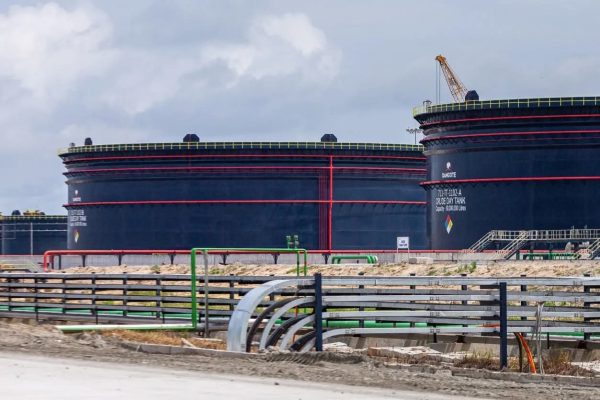
Dangote Petroleum Refinery & Petrochemicals says it is strengthening its role as a stabilising force in Nigeria’s energy market amid disruptions in global refining operations triggered by tensions in the Middle East.
The refinery reassured Nigerians that it remains committed to prioritising domestic supply as several refineries worldwide shut down or reduce output due to the ongoing conflict in the region.
According to the company, the crisis has tightened global petroleum product availability, with some countries taking protective measures. China, for instance, has reportedly banned the export of gasoline and diesel, a move expected to worsen the global supply squeeze.
Dangote Refinery said domestic refining capacity would help insulate Nigeria from the shock by ensuring that locally produced fuel meets national demand.
The conflict has also pushed global crude oil and freight costs sharply higher. Benchmark Brent crude has risen by approximately 26 per cent in a short period, reaching above $84 per barrel.
In response to the rising costs, the refinery announced a N100 per litre adjustment in its ex-depot price of Premium Motor Spirit (PMS), representing an approximately 12 per cent increase.
Despite the adjustment, the company said it had absorbed about 20 percent of the cost escalation to cushion the impact on the domestic market.
Dangote Refinery explained that it continues to source crude oil at prevailing international prices, whether from local producers or foreign suppliers. Nigerian crude, it noted, currently trades at a premium of between $3 and $6 above the Brent benchmark. When freight costs of about $3.50 per barrel are added, crude delivered to the refinery costs between $88 and $91 per barrel.
For comparison, the refinery said crude landed at about $68 per barrel when its ex-depot petrol price was N774 per litre.
The company added that while it receives roughly five crude cargoes monthly from the Nigerian National Petroleum Company Limited (NNPC), which it pays for in naira, the volume falls far short of the 13 cargoes required each month to meet Nigeria’s demand.
As a result, the refinery said it must source additional crude from international traders, often paying a premium and using foreign exchange obtained at open market rates.
It also noted that Nigerian upstream producers have not supplied crude in the volumes required under the Petroleum Industry Act (PIA), forcing the refinery to depend significantly on international traders.
Dangote Refinery stressed that as a private enterprise operating in a deregulated market, it must align its pricing with prevailing market realities to remain sustainable.
“Selling below cost would undermine our ability to procure crude, sustain production and guarantee uninterrupted supply to Nigerians,” the company stated.
Despite the challenges, the refinery said large-scale local refining continues to reduce Nigeria’s exposure to international supply disruptions, moderate demand for foreign exchange and help prevent severe product shortages during periods of global instability.
The company also disclosed that it is accelerating the deployment of compressed natural gas (CNG)-powered trucks to improve nationwide fuel distribution.
The rollout, scheduled to begin this month, is expected to reduce logistics costs, enhance delivery efficiency across the downstream sector and cushion the impact of global market volatility.
Dangote Refinery reaffirmed its commitment to transparency, operational excellence and the long-term goal of ensuring a stable and affordable energy supply for Nigeria.
