


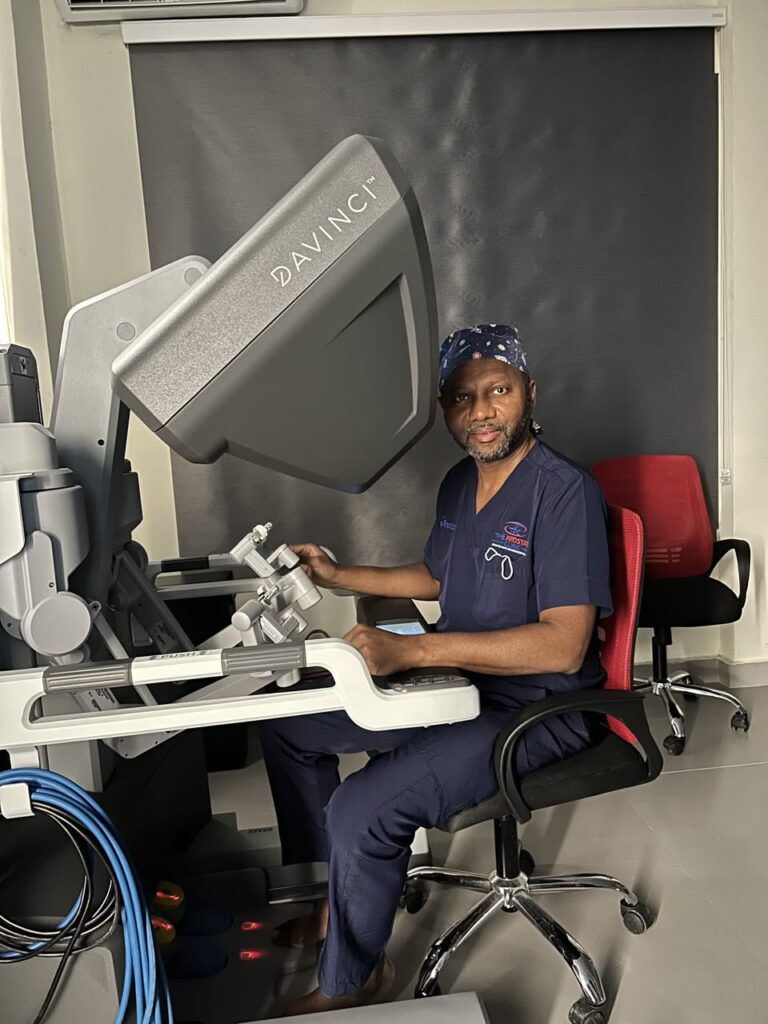
Imo State University (IMSU) has established a robotic surgery academy in partnership with the Imo Robotic Centre, aiming to train 500 surgeons and other surgical professionals within two years.
Prof. Kingsley Ekwueme, a consultant urologist, disclosed this in an interview with reporters on Sunday.
Ekwueme, who was recently appointed professor of robotic surgery at IMSU, described the initiative as Africa’s first dedicated robotic surgery academy. The academy is located on the university’s premises.
He said the partnership was established in August 2026 following a meeting between the university and its partners.
“We successfully performed the region’s first surgery in August.
“We followed up with multiple robotic surgeries at the Imo Robotic Centre, where many patients are already benefiting from this state-of-the-art technology, now available for the first time in southeast Nigeria.
“We also partnered with Imo State University after a successful meeting on Aug. 18 and launched the robotic surgery academy at the university.
“It is important to me and to the academic community at Imo State University that any erroneous claim about the first robotic surgery academy is debunked and the record set straight,” he said.
According to Ekwueme, the Imo Robotic Centre is providing advanced surgical services in the state.
“We have performed several successful surgeries, and patients are benefiting.
“Imo State University has partnered with the Imo Robotic Centre to establish the first robotic surgery academy. I refer everyone to the university’s publication of Aug. 19, confirming the academy’s establishment.
“A memorandum of understanding was subsequently signed, and a departmental building was assigned for the academy,” he said.
The surgeon stressed that developing local expertise to treat patients was key to reducing health-related capital flight.
“We are not only training surgeons; we are training the entire surgical team.
“This is important because we want to train teams to deliver safe and effective robotic surgery at their local centres,” Ekwueme said.
He added that the academy would support participating hospitals with equipment procurement and installation to expand access nationwide.
Ekwueme, clinical lead for urology in North Wales at Glan Clwyd Hospital in the UK, commended Gov. Hope Uzodimma’s administration for supporting the initiative.
He said local access meant Nigerians would no longer need to travel abroad or outside the region for complex procedures.
“We have bridged the gap. Nobody needs to travel farther than a few minutes down the road from home to have surgery,” he said.
“Plans are also progressing to complete an adjacent oncology centre and medical institute offering specialised cancer diagnostic services.
“We are finalising the oncology centre, which is next to the robotic centre and will offer advanced diagnostic and oncology services.
“An institute is being established through a partnership between the Imo State Government and the Imo Robotic Centre. It will provide advanced diagnostic and oncology services.
“I thank the vice-chancellor of Imo State University for appointing me professor of robotic surgery,” he said.
Ekwueme, a faculty member of the Royal College of Surgeons of Edinburgh, said his team had performed more than 145 robotic procedures in Africa.
“I believe the university’s recognition is the icing on the cake,” he said.
“In 10 years, I see every Nigerian having access to robotic surgery anywhere in Nigeria.
“I see a Nigeria where brain drain will be significantly reduced.
“I dare to predict a reversal of brain drain—a return to Nigeria,” he said.
He said procedures involving the prostate, kidneys, fibroids, hysterectomies, bowels and gallbladders could now be performed locally.
Ekwueme said robotic surgery could be used in several specialties, including urology, gynaecology, general surgery and selected cardiac procedures.
He listed prostate and kidney operations, fibroid removal, hysterectomy, ovarian procedures, bowel cancer surgery and selected gallbladder operations as procedures that could be performed with robotic assistance.
According to him, robotic systems give surgeons magnified, three-dimensional views of the operating field and instruments that allow precise movements in confined spaces.
These features, he said, could reduce surgical trauma, blood loss and recovery time for appropriately selected patients.
“The advantages of robotic surgery cannot be overstated,” he said.
He contrasted the approach with conventional open surgery, which often involves larger incisions and longer hospital stays and recovery periods.
However, Ekwueme said having robotic equipment alone would not guarantee good outcomes, stressing the importance of proper training and surgical proficiency.
“The surgeon also has to be proficient in using the robotic system. That is why the training we are developing is important,” he said.
He urged the Federal Government to provide tax waivers on imported equipment to reduce costs for patients.
“We know how to acquire affordable robotic systems. I advise public institutions to come and train with us.
“We will help them acquire robots,” he said.
Ekwueme expressed optimism that training 500 professionals through IMSU certification would help reverse medical tourism and transform African healthcare.
“I seriously believe that a medical revolution is happening in Nigeria at the moment.
“The world must pay attention because we are doing great things here,” he said.
He said the academy’s focus on training entire surgical teams was intended to help hospitals use the technology safely and effectively, rather than rely solely on having the equipment.
Ekwueme also said his team had performed what he described as West Africa’s first gynaecological robotic surgery through its programme at the prostate clinic. He added that the patient was discharged on the same day.
