


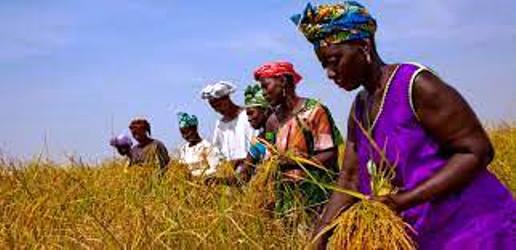
Stakeholders have pledged sustained support for smallholder women farmers to improve agricultural productivity, income and food security.
The stakeholders are the National Assembly (NASS), the International Budget Partnership (IBP) and ActionAid Nigeria.
They made the commitment at the ongoing Small-scale Women Farmers Organisation in Nigeria (SWOFON) campaign on “Accelerating Women Farmers’ Impact Towards Food Security” in Abuja on Thursday.
The event also featured the launch of the SWOFON-IBP Spark Programme Policy Brief, “Women Farmers’ Voice to Action”.
Dr. Yinka Babalola, Country Director of IBP, said the organisation remained committed to data, accountability and women farmers who work to feed the nation.
Babalola, represented by Nancy Zi, Lead, Learning, Monitoring and Evaluation, said women farmers’ participation in agricultural budget processes had improved significantly over the past eight years.
She, however, noted that the increased participation had not translated into better service delivery to farmers.
Babalola said women constituted an estimated 70 per cent of Nigeria’s agricultural workforce and contributed up to 80 per cent of the country’s food production.
“Decisions about agricultural budgets are made without them.
“Partnership between IBP and SWOFON since 2018 shows that women farmers in five states now attend budget hearings that once excluded them and submit Charters of Demands.
“Participation is a precondition for influence. It is not the same thing as influence.
“And any institution that mistakes women’s presence in the room for justice done to women in the field still has work to do,” she said.
She said findings from the policy brief showed that women farmers in Nasarawa, Niger, Jigawa, Anambra and Oyo lacked access to critical agricultural support.
According to her, the needs include affordable quality seeds and seedlings, fertilisers and agrochemicals, flexible credit, improved tools and mechanisation, climate-resilient inputs, extension services and market infrastructure.
“Based on the brief, agriculture received only 8.46 per cent of approved state budgets across the five states between 2021 and 2025.
“This was against the 10 per cent benchmark of the Malabo Declaration,” Babalola said.
She said 48.68 per cent of approved capital releases meant to turn women farmers’ labour into livelihoods were never delivered.
“Therefore, a smallholder women farmer Charter of Demands can be received in a governor’s office with warmth and photographs, and still not translate into anything meaningful,” she said.
Babalola urged governments to create precise budget lines for smallholder women farmers, ensure timely releases and fully execute projects and procurement to the last mile.
Bello Kaoje, Chairman of the House Committee on Agricultural Production and Services, assured of the committee’s commitment to strengthening Nigeria’s agricultural sector and improving opportunities for women farmers.
Kaoje, represented by Aggreh Agbeke, said gender-responsive agricultural policies must not only be developed but effectively implemented and adequately funded.
He said NASS recognised its roles in legislation, appropriation and oversight, adding that platforms such as the campaign enabled policymakers to hear directly from farmers.
“We know the challenges facing women farmers, ranging from limited access to land, finance, inputs, technology, markets and extension services.
“These require urgent attention to enhance productivity,” he said.
Kaoje said the Assembly remained committed to policies aimed at empowering farmers, particularly women farmers.
“The future of Nigerian agriculture rests on smallholder women farmers,” he said.
Blessing Akhile, Food Systems Adviser at ActionAid Nigeria, said the essence of the policy brief was to achieve a country where smallholder women farmers received the necessary support.
Akhile said it was also aimed at ensuring that policy implementation and budget releases addressed women farmers’ challenges to guarantee food security and empowerment.
