

• Home
  • Agric
  • Sci & Tech
  • Health
  • Environment
  • Hausa News
  • More
    • Business/Banking & Finance
    • POLITICS
    • Entertainments & Sports
    • International
    • Investigation
    • Law & Human Rights
    • Africa
    • ACCOUNTABILITY/CORRUPTION
    • Hassan Gimba
    • Column
    • Prof. Jibrin Ibrahim
    • Prof. M.K. Othman
    • Defense/Security
    • Education
    • Energy/Electricity
    • Entertainment/Arts & Sports
    • Society and Lifestyle
    • Food & Agriculture
    • Health & Healthy Living
    • International News
    • Interviews
    • Investigation/Fact-Check
    • LAW & HUMAN RIGHTS
    • Oil & Gas/Mineral Resources
    • PRESS FREEDOM/JOURNALISM/PR
    • General News
    • Presidency
  • About Us
    • Contact Us
    • Board Of Advisory
    • Privacy Policy
    • Ethics Policy
    • Teamwork And Collaboration Policy
    • Fact-Checking Policy
    • Advertising
  • Media OutReach Newswire
    • Wire News
  • The Stories
Facebook Twitter Instagram
Trending
  • 20:@20:50:20 – Inside the Dynastic DNA of Sultan Muhammad Sa’ad Abubakar’s Forebears
  • NAOWA calls for breast cancer screening, support
  • [JUST IN] NCDC reports 2 suspected isolated cases of Ebola in Northeast Nigeria
  • Women’s groups push for grassroots CEDAW action
  • Data gaps limit Nigeria’s AI growth — Smartcomply CEO
  • NSCDC Oyo creates units for disability inclusion
  • Lagos residents seek tighter sanitation enforcement
  • WHO urges early diabetes action in Africa
Facebook Twitter Instagram YouTube
AsheNewsAsheNews
  • Home
  • Agric

    LIFE-ND transfers rice mill to CADA

    October 31, 2026

    Ogun supports farmers with cashew seedlings

    October 31, 2026

    Delta stakeholders call for investment in jobs, agriculture

    October 31, 2026

    ANA: Insecurity threatens Nigerian literature

    October 31, 2026

    Ogun strengthens agriculture to improve food security

    October 31, 2026
  • Sci & Tech

    Data gaps limit Nigeria’s AI growth — Smartcomply CEO

    October 31, 2026

    ESDIAC launches affordable international calling platform

    October 31, 2026

    FUST Kabo secures accreditation for 20 courses, including medical programmes

    October 30, 2026

    Analyst applauds Adenuga’s contributions to society

    October 30, 2026

    Researchers tout biofertilisers, AI to advance Nigerian agriculture, energy

    October 30, 2026
  • Health

    NAOWA calls for breast cancer screening, support

    October 31, 2026

    [JUST IN] NCDC reports 2 suspected isolated cases of Ebola in Northeast Nigeria

    October 31, 2026

    Women’s groups push for grassroots CEDAW action

    October 31, 2026

    NSCDC Oyo creates units for disability inclusion

    October 31, 2026

    WHO urges early diabetes action in Africa

    October 31, 2026
  • Environment

    Lagos residents seek tighter sanitation enforcement

    October 31, 2026

    Nigeria’s menstrual health policy needs prompt implementation, WaterAid says

    October 30, 2026

    NiMet issues Friday-to-Sunday weather forecast

    October 30, 2026

    UN report: 252m hectares under restoration worldwide

    October 29, 2026

    Nigeria’s extreme heat exposes deepening inequality, by Abiemwense Moru

    October 29, 2026
  • Hausa News

    UNA signs MoU to launch air Bissau in Guinea-Bissau

    June 15, 2026

    Otti plans 250-room 5-star hotel in Umuahia

    April 11, 2026

    Anti-quackery task force seals 4 fake hospitals in Rivers

    August 29, 2025

    [BIDIYO] Yadda na lashe gasa ta duniya a fannin Ingilishi – Rukayya ‘yar shekara 17

    August 6, 2025

    A Saka Baki, A Sasanta Saɓani Tsakanin ‘Yanjarida Da Liman, Daga Muhammad Sajo

    May 21, 2025
  • More
    1. Business/Banking & Finance
    2. POLITICS
    3. Entertainments & Sports
    4. International
    5. Investigation
    6. Law & Human Rights
    7. Africa
    8. ACCOUNTABILITY/CORRUPTION
    9. Hassan Gimba
    10. Column
    11. Prof. Jibrin Ibrahim
    12. Prof. M.K. Othman
    13. Defense/Security
    14. Education
    15. Energy/Electricity
    16. Entertainment/Arts & Sports
    17. Society and Lifestyle
    18. Food & Agriculture
    19. Health & Healthy Living
    20. International News
    21. Interviews
    22. Investigation/Fact-Check
    23. LAW & HUMAN RIGHTS
    24. Oil & Gas/Mineral Resources
    25. PRESS FREEDOM/JOURNALISM/PR
    26. General News
    27. Presidency
    Featured
    Recent

    20:@20:50:20 – Inside the Dynastic DNA of Sultan Muhammad Sa’ad Abubakar’s Forebears

    October 31, 2026

    NAOWA calls for breast cancer screening, support

    October 31, 2026

    [JUST IN] NCDC reports 2 suspected isolated cases of Ebola in Northeast Nigeria

    October 31, 2026
  • About Us
    1. Contact Us
    2. Board Of Advisory
    3. Privacy Policy
    4. Ethics Policy
    5. Teamwork And Collaboration Policy
    6. Fact-Checking Policy
    7. Advertising
    Featured
    Recent

    20:@20:50:20 – Inside the Dynastic DNA of Sultan Muhammad Sa’ad Abubakar’s Forebears

    October 31, 2026

    NAOWA calls for breast cancer screening, support

    October 31, 2026

    [JUST IN] NCDC reports 2 suspected isolated cases of Ebola in Northeast Nigeria

    October 31, 2026
  • Media OutReach Newswire
    • Wire News
  • The Stories
AsheNewsAsheNews
Home»Environment/Climate Change»How Sokoto farmers face devastation as banditry, floods threaten food security
Environment/Climate Change

How Sokoto farmers face devastation as banditry, floods threaten food security

Abdallah el-KurebeBy Abdallah el-KurebeAugust 20, 2024Updated:August 30, 2025No Comments5 Mins Read
Share
Facebook Twitter LinkedIn Pinterest Email

Despite the trillions of naira expended in the fight against insecurity, including banditry in Nigeria, farmers in Sokoto State remain trapped in a desperate struggle, unable to cultivate their lands due to relentless banditry and floods. The once-thriving farmlands of Takpani, Alikiru, and Tsamiya villages have become inaccessible as bandits continue to terrorize the region, forcing farmers and their families to seek refuge elsewhere.

For over six years, farmers displaced from these villages have been living in Rahama Housing Estate in Gandi town, Rabah Local Government Area. These once-prosperous farmers now find themselves unable to work their lands, leaving them without the means to support their families.

Lives uprooted, livelihoods lost

Abubakar Musa, a farmer from Takpani village, recalls the days when he could cultivate his three farmlands, producing over a hundred bags of millet each season. Today, those farmlands lie abandoned, overrun by bandits.

“When I cultivated my farms during the farming season, and God gave me an increase, I could harvest over a hundred bags of millet,” Musa shared with a heavy heart. “But since we fled our villages to seek refuge in this camp, I no longer have access to my farms, and I can’t make money to take care of my family like before.”

Similarly, Ibrahim Takpani, another farmer from the same village, had over seven farmlands that he worked on. He and over six hundred others have been displaced from their homes due to constant banditry attacks.

“Most of the men from my village are farmers and cattle rearers with numerous farmlands and animals deserted due to the activities of these bandits,” Ibrahim lamented.

Umar, a rice farmer from Takpani village with over ten farmlands, used to harvest over three hundred bags of rice during a successful farming season. His crops provided a steady income that sustained his family. Now, like so many others, he has lost access to his land and, with it, his livelihood.

“The bandits have taken over our village, and we have no choice but to flee. We are now at the mercy of the government and kind-hearted people who help us survive”, he said.

The impact of insecurity on food security

The ongoing banditry in Sokoto State has led to a severe food shortage and a steep hike in food prices. A food security expert, who wished to remain anonymous, confirmed the dire situation to ASHENEWS.

“The recent food shortage can only be linked to the many farmlands in local governments that are currently not cultivated due to insecurity,” the expert explained. “As long as we have fewer farmlands cultivated, food production will be low, leading to food shortages in the state.

“If urgent and deliberate steps are not taken to ensure these uncultivated farmlands are put to use for agricultural activities, the issue of food shortage may not go away anytime soon, especially as the population continues to increase”, he said.

The displacement of farmers from their lands has ripple effects that extend far beyond individual livelihoods. The inability to cultivate land and produce crops is directly contributing to the escalating food crisis in Sokoto State, where staple foods such as millet, rice, and maize are becoming scarce and increasingly expensive.

Floods compound the crisis

In addition to the insecurity caused by banditry, natural disasters like floods are also taking a toll on Sokoto’s agricultural sector. In Sanyinna, Tambuwal Local Government Area, farmlands worth millions of naira have been submerged by floods.

The floods have also displaced hundreds of people and caused extensive damage to houses and livestock. It would be recalled that the Nigerian Hydrological Services Agency had predicted that in this year’s annual flooding outlook, 31 states with 148 LGAs would be within the high flood-risk areas, while 35 states, including the FCT and 249 LGAs, were considered within the moderate flood-risk areas. The remaining 377 LGAs were forecasted for the low flood-risk areas.

The volume of water which is now increasing has forced the temporary closure of the Sanyinna, Argungu, and Birnin Kebbi roads, as well as the Kwadarko bridge, disrupting transportation and isolating communities. Eyewitnesses say for about five decades they never experienced such a flood.
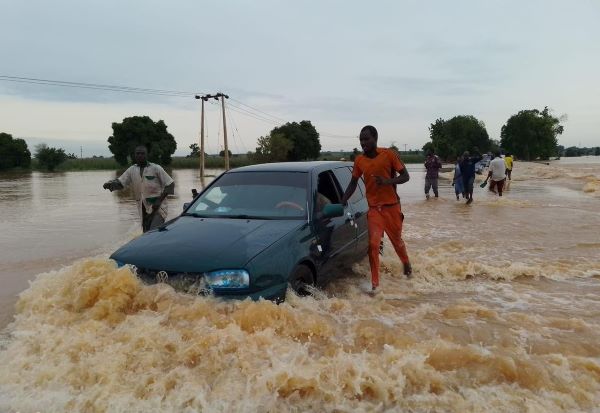
A commuter being guided

A resident of the village described the situation as devastating in a phone interview with ASHENEWS. “Dozens of houses and animals are underwater, and people have been displaced. We have never seen such floods in about five decades.”

Eyewitnesses, some of whom have lived in the area for over sixty years, described the flood as unprecedented in its magnitude. The community is now appealing to the government and relief agencies for assistance, including boats for safe crossing and basic necessities for the displaced.

A call for urgent action

The twin threats of banditry and floods are crippling Sokoto’s agricultural sector and pushing the region towards a deeper food crisis. The farmers who once fed their families and contributed to the state’s economy are now among the most vulnerable, relying on aid and uncertain of their future.

The state government, alongside federal authorities, must take immediate and decisive action to address the insecurity that has driven farmers from their lands. Additionally, comprehensive flood management strategies are essential to prevent future disasters from further decimating the already struggling agricultural sector.

As the rainy season continues and the bandits remain at large, the people of Sokoto are left to wonder when they will be able to return to their farms and rebuild their lives. Without urgent intervention, the dreams of these farmers may be washed away, just like their crops in the rising floodwaters.

banditry Farmers Flood Food security Insecurity Sokoto state
Share. Facebook Twitter Pinterest LinkedIn WhatsApp Reddit Tumblr Email
Abdallah el-Kurebe
  • Website
  • Facebook
  • Twitter
  • LinkedIn

Related Posts

Lagos residents seek tighter sanitation enforcement

October 31, 2026

LIFE-ND transfers rice mill to CADA

October 31, 2026

Ogun supports farmers with cashew seedlings

October 31, 2026

Leave A Reply Cancel Reply

20:@20:50:20 – Inside the Dynastic DNA of Sultan Muhammad Sa’ad Abubakar’s Forebears

October 31, 2026

NAOWA calls for breast cancer screening, support

October 31, 2026

[JUST IN] NCDC reports 2 suspected isolated cases of Ebola in Northeast Nigeria

October 31, 2026

Women’s groups push for grassroots CEDAW action

October 31, 2026
About Us
About Us

ASHENEWS (AsheNewsDaily.com), published by PenPlus Online Media Publishers, is an independent online newspaper. We report development news, especially on Agriculture, Science, Health and Environment as they affect the under-reported rural and urban poor.

We also conduct investigations, especially in the areas of ASHE, as well as other general interests, including corruption, human rights, illicit financial flows, and politics.

Contact Info:
  • 1st floor, Dogon Daji House, No. 5, Maiduguri Road, Sokoto
  • +234(0)7031140009
  • ashenewsdaily@gmail.com
Facebook Twitter Instagram Pinterest
© 2026 All Rights Reserved. ASHENEWS Daily Designed & Managed By DeedsTech

Type above and press Enter to search. Press Esc to cancel.