


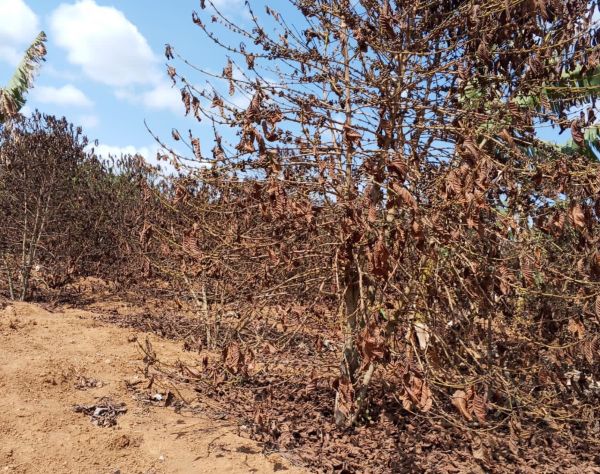
Uganda, Africa’s largest coffee producer and a regional East African food basket, is to register major reversals in volumes and export revenues, following a 5-month devastating drought that has hit the small nation this year. Uganda’s coffee production has been forecast to increase by 2.61% in the 2025/26 marketing year, reaching 8.8 million 60-kilogram bags, but with the effects of the drought, the country’s target will fall below the mark.
Uganda’s coffee exports have seen significant growth, with the country earning a record-breaking over $2bn billion in export revenue in the fiscal year 2023/2024 and overtaking Ethiopia, as Africa’s No. 1 producer and exporter. The record-breaking figures represent a 35.29% increase in value compared to the previous year (2022/23). Then Uganda exported 6.13 million bags of coffee, which was a 6.33% increase in quantity. The surge in both volume and earnings over the last 5-6 years underscores the effectiveness of enhanced production and post-harvest handling practices. A Government ag-report indicates that coffee exports are a crucial part of Uganda’s economic development, with approximately 1.7m households in the country depending on coffee production.
But large acreages of mid- and end-of-year (2026) expected yields and harvests of coffee and food crops have been hardest hit by a phenomenon that has been described as the La Niña dry weather conditions preceding a widely anticipated destructive flood-dominated El Niño weather condition coming up September 2026 to early 2027! Over 60 to 80 districts of Uganda, out of a total of 146, have experienced the highly damaging drought.
Mr. John Kakande, the Chairman of Masaka District, one of the hardest-hit districts yet one of the biggest food and coffee producers found in southern Uganda, says they need over half a million coffee seedlings to do gap filling [replace] recently planted but lost coffee trees to drought. He was quoted on the largest radio station, the Kampala-based Central Broadcasting Service (CBS), on September 14, 2026, as saying much of the food and coffee crop expected to be harvested beginning in September till the end of the year has been wiped out by a creeping and now slowly waning drought. “For coffee alone, we need over half a million seedlings to replace the dried-up trees [plantations]…. This drought has hit us so hard that we expect poor or no harvests at all, of both food and coffee crops….”
In the year ending April 2026, Uganda’s coffee exports totalled 8.8 million bags, fetching $2.4billion (UG Shillings 8.8 trillion). This represents a 28% increase in quantity and a 36% increase in value compared to the previous year.
Earlier in the month, Buganda Kingdom Prime Minister, Mr. Charles Peter Mayiga and Catholic Bishop of Masaka Diocese, Rt. Rev. Cerveris Jjumba, both described the drought as almost similar to a fire lit through a dry shrub bush. “The entire Buddu County of our kingdom [Greater Masaka or southern region where Masaka is found together with other nine districts of Bukomasimbi, Rakai, Lwengo, Kyotera, Sembabule, Kalungu, Lyantonde, Kalangala], some of which I toured, have registered serious losses…,” Katikiro Mayiga said in a CBS-recorded speech monitored in Kampala. Bishop Jjumba, in one of the recent church sermons, expressed fear over a looming famine as a result of the drought. Veteran journalist and big coffee farmer based in Masaka, Michael J. Ssali, confirmed the political, cultural and religious leaders’ reports.
Mr. Ssali told a platform where this AsheNews Correspondent is a member that entire coffee gardens are drying up in Masaka, with farmers at a great loss. Buganda Katikiro campaigns for greater coffee-growing through the Emwanyi Terimba (coffee is a sure way of wealth) campaign, and the last 10 years of Government support through the then State-run Uganda Coffee Development Authority (UCDA) to farmers, combined to raise Uganda to No. 1 largest coffee producer/exporter position on the continent. However, during the 2025 RAPEX [reduction in the number of state agencies and Government expenditure], the UCDA was abolished by Parliament. Coffee, Uganda’s No.3 revenue-earner after remittances by foreign workers and gold exports, has emerged as a household wealth-creation enterprise. It is now a fully-fledged Government Coffee Production and Development Department in the Ministry of Agriculture, Animal Industry and Fisheries (MAAIF). A MAAIF coffee performance report covering 12 months (February 2024-January 2025), says coffee totalled 6.44 million bags worth US$ 1.62 billion (Shs5.95 trillion) compared to 6.20 million bags worth US$ 984.60 million (Shs3.62 trillion) in the previous year (February 2023-January 2024). This represents an increase of 3.91% and 64.47% in quantity and value, respectively.
According to the report, Uganda’s coffee exports in January 2025 amounted to 550,341 60-kilo bags worth US$ 156.50 million (Shs575.1bn). This comprised 485,999 bags of Robusta valued at US $ 135.67 million and 64,342 bags of Arabica valued at US$ 20.83 million. This was an increase of 14.43% and 83.38% in quantity and value, respectively, compared to the same month last year. It’s important to note that Uganda’s coffee exports reached a record high of US$2.4billion. This was a substantial increase from the previous year’s US$940.1m.
On how to manage drought, a senior official at the State-run National Agricultural Research Organization (NARO)—who asked not to be named, based at the largest research institute of NaCRRI (National Crops Resources Research Institute) located in central Uganda—said NARO has Skeepon Technology, a Climate-Smart solution for improving crop survival and productivity under drought and heat stress conditions, which farmers across the country and elsewhere in the world should secure and apply to protect crops. The Japanese-developed anti-heat and drought-stress Skeepon Technology solution protects a diverse spectrum of crops. “Skeepon Technology is a Japanese agricultural innovation designed to help crops withstand drought and heat stress. It utilizes acetic acid, a safe and biodegradable substance, to activate plants’ natural defenses, allowing them to grow under limited water conditions for up to three months. This technology has been particularly beneficial for farmers in Uganda, where it has shown significant improvements in crop yields and overall plant health, making it a key component of climate-smart agriculture efforts.
But the dire drought dents Uganda’s big gains that upstaged Ethiopia from the No.1 position. Ethiopia, Africa’s current No. 2 largest coffee producer/exporter after Uganda, in its 2025/26 coffee production forecast, projects a yield of 11.56 million 60-kg bags (approximately 694,000 metric tons), marking a record output with strong regional variations and positive quality indicators. “Ethiopia’s coffee harvest for 2025/26 is expected to reach 11.56 million bags, a 9% increase over the previous season, driven by favorable weather, rejuvenated coffee trees, and improved agronomic practices. The total harvested area is projected to expand by 4% to 790,000 hectares, with over 450,000 hectares replanted with high-yield, climate-resilient varieties. Techniques such as stumping—deep pruning of ageing trees—have enhanced both yield and bean quality, with targeted areas like Gedeo Zone seeing up to threefold yield increases,” information online states.
A smallholder coffee and foodstuffs farmer in the eastern district of Mbale, renowned for producing the premium-selling Arabica coffee, Mr. Stephen R. Wananda, told ASHENEWS that the eastern region too has suffered extensive drought, which has badly impacted coffee and other crops. “Myself, I’ve recorded poor coffee berry formation due to lack of rainwater. We’ve had aspects of on and off rains, so sporadic; so light…. Largely it has been a long dry spell. Our coffee and food-crop yields are so low, a record poor performance in very many decades,” he explained. Mr. Wananda says this has caused food shortages and a spike in prices.
Regarding food production vis-à-vis the drought, the first agricultural season dry spells have resulted in crop losses ranging from 50 to 70 percent in most areas, with over 600,000 people affected. The government has initiated emergency food distribution to mitigate the crisis, but the situation remains critical as the drought deepens and food prices rise. Commercial food farmers and traders are counting losses, mostly in central, eastern, northern, and north-eastern regions. “Climate change is accorded little or no serious attention globally. But now humanity is faced with sure extinction…… due to the reality of long-term damage to nature…. We’ve recklessly treated it with nonchalance!” Wananda observed in a face-to-face-with-reality voice.
About drought in Uganda, the Government confirms its presence and widespread negative impacts, including cases of famine and starvation in some parts of the country. “The worst hit is Karamoja [a sprawling region in the north-east neighbouring South Sudan and Kenya] + Northern Uganda + the cattle corridor [a semi-dry region where much of southern Uganda and Karamoja are found], but now extending to Central (Masaka),” the Government confirmed in a recent statement released by the Office of the Prime Minister (OPM) Permanent Secretary, Mr. Alex Kakooza, on July 9, 2026. The OPM in Uganda is charged with managing disasters and human catastrophes like droughts. It revealed that at least 16 people had died from acute food shortages caused by prolonged drought in the Karamoja region. “Crop failures and severe food shortages contributed to the deaths. The government dispatched 22 tons of emergency food. Thirteen (13 tons) of these were maize and 9 tons were beans to Kaabong District sub-counties of Loduku and Loyoru, and arranged more for Kotido, Amudat, Napak, Moroto” [districts of Karamoja region].
The Famine Early Warning Systems Network (FEWSNET)—a global program established by the United States Agency for International Development (USAID) in 1985 to provide early warning and analysis of acute food insecurity around the world—projects that 2.5 to 2.99 million people will need food assistance between June 2026 and Jan 2027. According to Uganda’s Ministry of Water & Environment (MoWE) and the Uganda National Meteorological Authority (UNMA): “For the June-August 2026 season, the Government predicted drier and warmer-than-normal conditions across most of Uganda. MoWE Permanent Secretary, Dr. Alfred Okot, says a bigger part of the country will get below-average rainfall… “This is going to cause stress, especially to crops, animals and human beings,” he stated, while his official government advice states thus: “Embrace irrigation, water storage, plant drought-tolerant crops, reduce dependence on rain-fed agriculture.”
Parliament of Uganda’s position, issued over a month and a half ago, unanimously backed a motion by Hon. Anthony Akol calling it a humanitarian emergency, not just an agricultural challenge. The legislator tabled a motion that demanded “immediate relief food + seedlings, coupled with fast-tracking of US$38 million under the Northern Uganda Social Action Fund (NUSAF) IV ‘Disaster Risk Financing’ for West Nile, Acholi, Lango, Karamoja, Teso, Bunyoro, Elgon regions. In July alone, the Government issued a report to Parliament on the drought (current or then, last 5 days) impacts which stated the following: “Farmers in Greater Masaka, Sembabule, and Ankole regions were counting heavy losses of coffee, matooke (bananas), beans withering, milk prices soaring. 5,000 hectares of crops worth Uganda Shillings 200bn ($53m) [had been] destroyed.”
State Minister for Local Government, Justine Nameere, had visited Masaka and said the government had signed a new irrigation project with Masaka as beneficiary. The Uganda Government’s long-term solution to Climate Change drought impacts is irrigation, water harvesting and early warning systems.
From a global and continental perspective, world commodity market trends by AGRA and the UN Food and Agriculture Organisation (FAO) in August 2026 were characterized by rising food and agricultural commodity prices, amid tightening global supply conditions, strong demand, weather-related production concerns, and trade disruptions. Food security updates on East Africa indicated a continued deterioration driven by the combined impacts of climate shocks, conflict, displacement, high food prices, and weak household purchasing power.
Ugandan President Gen. Yoweri Museveni, a few weeks ago, visited the famine-hit Karamoja and unveiled a three-phase “food stabilization strategy” for the region to reduce its recurring dependence on emergency food relief amid prolonged drought and changing weather patterns. The strategy will focus on providing households with climate-resilient seed varieties and livestock in the short term, before transitioning them to irrigation-supported and commercial agriculture in the medium and long term.
Museveni announced this plan while officiating at the 11th Karamoja Cultural Event at Naitakwae Grounds in Moroto District, under the theme: “Unity in Culture, Strength in Peace, Prosperity through Tourism and Natural Resources.”
The President said the [anti-famine] strategy was prompted by repeated effects of drought and climate change, which have forced the government to repeatedly intervene with relief. He said the government is currently distributing food relief worth about Shs 45billion to drought-affected areas. “The immediate phase would focus on crops capable of producing food within a relatively short period,” he said, citing sorghum, green gram and white peas as crops that can mature within the region’s short and unpredictable seasons.
He cautioned residents against excessive dependence on maize, which he said takes relatively longer to mature and is less suited to Karamoja’s dry conditions.
The President also encouraged households to take up goat-rearing and bee-keeping as alternative sources of food and income, saying goats can survive on the shrubs and vegetation available in the region. Cassava and bananas, he added, could be grown in wetter parts.
Irrigation push
Museveni said the medium and long-term phases would seek to move households from subsistence to modern commercial agriculture, with irrigation at the centre.
He called for large-scale water infrastructure, including dams. “……, Karamoja is a fertile area, but it’s because of water body encroachment. Therefore, we are going to put up big projects to support irrigation in Karamoja, like big dams,” he said.
He warned against wetland encroachment, saying wetlands should be protected as part of the country’s water systems rather than converted into farmland.
Peace and development
Museveni also linked the region’s prospects for economic transformation to improved security following the disarmament program. He said the government had recovered about 41,000 illegal guns from Karamoja. He credited women for their role in the initial disarmament exercise and commended individuals who helped expose cattle raiding networks. He also praised efforts to support former Karacunas (ex-cattle rustlers/organized thieves) to abandon violence.
AGRA global market updates
The FAO Food Price Index (FFPI) increased by 1.9% from July to 133.3 points, with gains across all major commodity groups, led by sugar (+11.9%), cereals (+2.2%), dairy (+2.3%), meat (+1.0%), and vegetable oils (+0.6%).
Similarly, the IGC Grains and Oilseeds Index (GOI) rose sharply by 9.4% month-on-month and 21.7% year-on-year, driven primarily by strong increases in wheat (+9.6% m/m; +26.4% y/y) and soybeans (+11.0% m/m; +24.6% y/y), alongside gains in maize, barley, and rice. Global grain markets tightened further as forecasts for 2026/27 production were reduced due to adverse weather conditions, particularly in Europe, while disruptions to Black Sea exports added upward pressure on prices.
Food Commodity Prices Updates
Across Eastern Africa, staple food markets exhibited mixed trends in August 2026, reflecting improving supplies in some surplus-producing areas alongside localized market tightening elsewhere. Uganda’s closest neighbour and trading partner that consumes a lot of its food, South Sudan, continues to face one of the world’s most severe food security crises, with widespread Emergency (IPC Phase 4) outcomes, localized risks of catastrophe/famine (IPC Phase 5), severe acute malnutrition, and worsening conditions driven by conflict, economic decline, flooding, drought, and restricted humanitarian access.
AGRA also confirms Uganda faces persistent crisis (IPC Phase 3) conditions in Karamoja and among refugee populations due to poor harvests, high food and fuel prices, limited income opportunities, and growing humanitarian needs. “Across the region, anticipated El Niño-related weather extremes, including droughts and flooding, are expected to further undermine agricultural production, livelihoods, and market access, leaving millions vulnerable to acute food insecurity through early 2027,” AGRA states.
Update on El Niño Conditions
A powerful El Niño event is developing in the Pacific Ocean and is projected to become one of the strongest on record during the 2026/27 season, with NOAA estimating a greater than 90% probability of its continuation and a 69% chance of surpassing all El Niño events recorded since 1950. This is significantly increasing climate-related risks across Africa.
“In East Africa, recurrent droughts, heatwaves, and erratic weather continue to undermine crop and livestock production, while anticipated wetter conditions may increase flood risks and infrastructure damage rather than support recovery. Food security conditions remain particularly severe in conflict-affected countries such as Sudan, where millions face acute food insecurity and heightened famine risk.
An FAO/World Food Programme (WFP) Food Security Report on Africa says 31 countries require external assistance for food.
Across the African continent, conflicts, climate variability, high input prices, and displacement continue to affect agricultural production and food security.
Thirty-one African countries require external assistance for food, estimates the FAO. It warns that a growing number of countries are facing severe food insecurity, Africa being the most-affected region. The report highlights that conflict and insecurity remain the primary drivers of severe acute food insecurity, with weather-related shocks further exacerbating conditions in several regions. “According to the Crop Prospects and Food Situation Report – March 2026, a total of 41 countries worldwide require external assistance for food, of which 31 are in Africa, eight in Asia, one in Latin America and the Caribbean, and one in Europe.”
Thirty-one countries of the African continent are found to be in dire straits, encompassing adverse climatic conditions, geopolitical hindrances, conflicts and wars. These countries are Kenya, Somalia, Sudan, Burundi, Central African Republic, Chad, the Democratic Republic of Congo, Djibouti, Ethiopia, Malawi, Mauritania, Niger, Nigeria, South Sudan, Burkina Faso, Cameroon, Eswatini, Guinea, Lesotho, Liberia, Libya, Madagascar, Mali, Mozambique, Namibia, Senegal, Sierra Leone, Uganda, United Republic of Tanzania, Zambia and Zimbabwe.
A privately run food market intelligence firm, “The M-Omulimisa”, in its report released in early September 2026, shows data on an active movement [of levels of food delivered and their prices] across staple foods, horticulture, and exports. Key food crop prices. It focuses mainly on maize grain in Kampala and Busia (a Uganda-Kenya border market, one of the biggest exits of maize for export). “Beans: Nambaale type, a much sought-after Masavu type; Yellow beans; Groundnuts [Red]; Cassava chips; Super rice. It also looks at coffee and cocoa cash-crop export commodity prices. Kiboko, FAQ, Arabica parchment, Drugar, Cocoa, and Vanilla [dried] are the largest recent movers, while green pepper, Soya, Maize flour, and Super rice all rose strongly in the capital; meanwhile, millet dropped at farmgate.
