


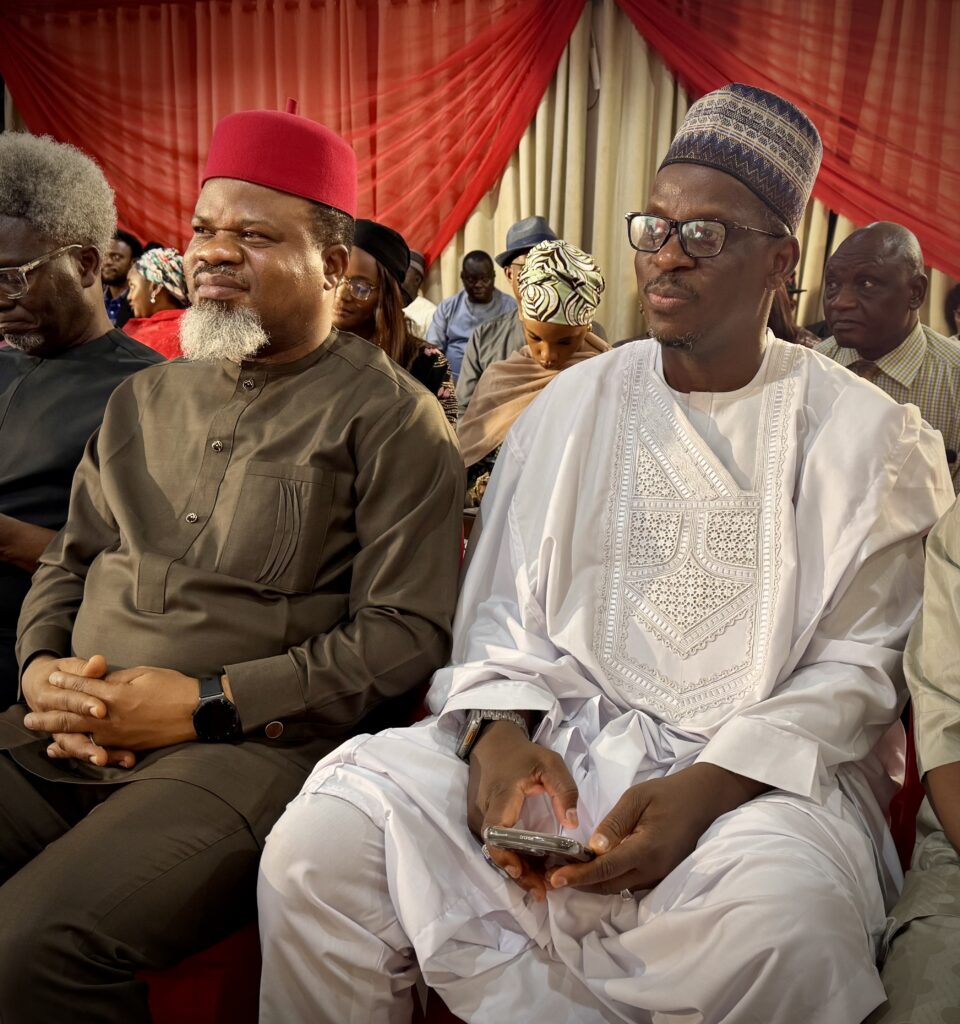
The Managing Director of the News Agency of Nigeria (NAN), Ali Muhammad Ali, says he looks forward to deeper collaboration with the Nigerian Institute of Public Relations (NIPR) to strengthen communication and reposition Nigeria’s narrative.
Ali said this in Abuja during the Monthly General Meeting (MGM) of the NIPR FCT Chapter, where he was also celebrated for the renewal of his tenure by President Bola Tinubu.
He described the renewal of his tenure as more than a personal milestone, saying it represented recognition of the collective work of communicators, reputation managers and custodians of public trust.
“I do not take this celebration lightly. Your support, your prayers and your belief in the work we do have fuelled me to do more.
“My renewal, in many ways, is a renewal of the mandate that all of us in this room carry.
“I accept this renewed mandate as a call to higher service, not just to an institution, but to the Nigerian people,” he said.
Ali said the role of public relations practitioners has become more critical in an era of misinformation and instant narratives, stressing the need for professionals to contribute to responsible communication.
He said he looked forward to deeper collaboration between NAN and NIPR to reposition the Nigerian narrative at home and abroad.
The managing director thanked the NIPR FCT Chapter for the recognition and expressed appreciation to its leadership for celebrating the renewal of his tenure.
Dr Christopher Isiguzo, President of the Congress of African Journalists (CAG), said Nigeria does not lack stories but lacks sufficient ownership of its narrative.
Isiguzo said this in a keynote address titled “Reclaiming Nigeria’s Sovereign Narrative: Developing a PR-Media Strategy to Rebuild the Nation’s Brand Identity.”
He said Nigeria has talent, enterprise, culture, intellectual capital and extraordinary human resilience, but its possibilities often have to compete for attention with narratives about corruption, insecurity, poverty, political instability and other challenges.
“Nigeria does not have a shortage of stories. Nigeria has a shortage of ownership of its own story.
“Nigeria has talent, enterprise, culture, intellectual capital and extraordinary human resilience.
“We are one of Africa’s largest concentrations of young, ambitious and creative minds.
“A credible national narrative cannot be built on propaganda, but neither can a nation build its future by allowing its weaknesses to become the only lens through which it is seen,” he said.
Isiguzo urged the media to hold power accountable while also reporting achievements in science, technology, research, entrepreneurship and other sectors.
He said the answer to negative coverage was more complete journalism rather than censorship.
He also called on PR practitioners to evolve beyond writing press releases and organising press conferences to become strategic managers of reputation, data, crises and stakeholder relationships.
According to him, PR practitioners should bridge the gap between government policies and citizens by helping people understand the purpose, benefits, risks and implications of government programmes.
Dr Ike Neliaku, President and Chairman of Council, NIPR, said Nigeria’s reputation has a direct impact on the country’s ability to attract affordable international funding.
He urged public relations practitioners to take responsibility for managing the nation’s reputation.
“Everybody in this room, and outside this room, the reputation of the Federal Republic of Nigeria is our business, because when the reputation is damaged, it affects all of us.
“So it is our responsibility as public relations people to understand the weight of what is involved.
“That’s why one of the few things we did in office when we came in was to establish the Nigeria Reputation Management Group, so that they can man the reputation gate of the Federal Republic of Nigeria,” he said.
Earlier, Mr Stanley Ogadigo, Chairman of the NIPR FCT Chapter, said the chapter is preparing for the World Public Relations Forum, its Annual General Meeting and Conference.
Ogadigo also announced plans for an “Own a Tree” campaign and the branding of at least four bus stops across the FCT as part of the chapter’s projects.
“We shall also be coming up with a campaign that will be named the Own a Tree campaign so that we will be able to sustain what we have started.
“We are also making arrangements to make sure that at least the FCT chapter has four bus stops across the FCT to brand,” he said.
Hajia Lami Tumaka, Chairman of the NIPR FCT Chapter Mentorship Committee, said the mentorship programme would provide professional, reputational and commercial value through improved training, career development and knowledge transfer.
Tumaka said institutional ownership was essential to ensure that the programme remained sustainable and was not dependent on individuals.
“You get professional value, you get reputational value and you get commercial value,” she said.
