


The Lagos State Government says its emergency responders saved an estimated ₦118 billion in property and rescued more than 1,900 lives in 2025.
It said it had intensified efforts to strengthen fire safety and emergency management.
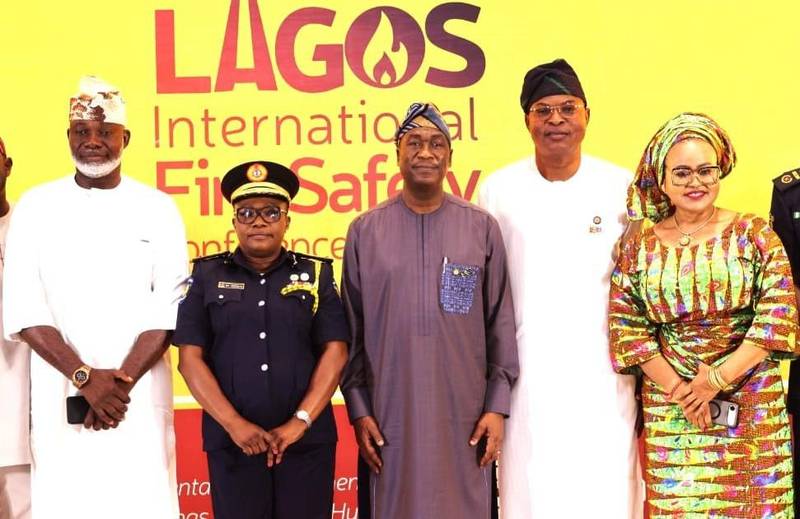
Gov. Babajide Sanwo-Olu disclosed this at the opening of the Lagos International Fire Safety Conference 3.0 held at the Marriott Hotel, Ikeja, on Monday.
The conference had the theme: “Preventing the Preventable: Strengthening Fire Safety in Buildings and Business Hubs”.
Sanwo-Olu was represented by his Deputy, Dr. Obafemi Hamzat.
He said the state added 11 new fire stations, inaugurated 62 modern firefighting vehicles, and rebuilt the Fire and Rescue Service Headquarters.
The governor also said the government recruited an additional 150 firefighters who are undergoing training.
According to him, the interventions are part of efforts to boost emergency response capacity and improve safety outcomes across the state.
“The state has intensified enforcement of fire safety regulations through stricter inspections and implementation of the Fire Safety Levy. Compliance must go beyond obtaining certificates to ensuring that safety equipment and systems remain fully functional,” he said.
Sanwo-Olu said the government had increased the number of fire stations to 29, with additional stations under construction at Yaba, Ikotun, and Oworonshoki.
He highlighted the effectiveness of the state’s coordinated emergency response architecture and stressed the need to prioritise prevention.
The governor also highlighted the introduction of the Fire Marshal Programme designed to train volunteers across homes, schools, markets, offices, worship centres, and factories.
He said: “The programme equips participants to identify fire risks early, coordinate evacuations, and collaborate with emergency responders before incidents escalate.”
He reaffirmed the government’s commitment to sustained investment in personnel, equipment, and systems to safeguard lives and property.
The governor urged property developers, business owners, and residents to prioritise prevention over regret.
In his remarks, the Chairman of the Lagos State House of Assembly Committee on Special Duties and Intergovernmental Relations, Mr. Olawale Age-Suleiman, reaffirmed the Assembly’s commitment to safety.
He described safety as a shared responsibility requiring collaboration among stakeholders and called for practical and lasting solutions to fire disasters.
Age-Suleiman urged participants to translate deliberations at the conference into actionable outcomes.
The State Commissioner for Special Duties and Intergovernmental Relations, Mr. Olugbenga Oyerinde, said the conference should challenge stakeholders to move beyond emergency response to addressing the root causes of fire incidents.
Oyerinde emphasised the need to apply lessons learnt, embrace innovations, and implement preventive measures to reduce risks.
He said the Lagos State Fire and Rescue Service saved billions of Naira in property in 2025.
According to him, the achievement reflects the dedication, professionalism, and continuous investment of the state government in strengthening emergency response, improving fire prevention strategies, expanding public education, and modernising operations.
Similarly, the Chief Executive Officer of Sadeco, Mr. Vincent Effiong, reaffirmed the organisation’s commitment to strengthening fire safety through innovation, technology, and collaboration.
Effiong stressed the importance of leveraging technology, promoting community engagement, and fostering cooperation among stakeholders to enhance early fire detection and emergency preparedness.
He said sustaining a strong safety culture required continuous capacity building, adherence to global best practices, and strategic partnerships between government, the private sector, and emergency responders.
The Controller-General of the Lagos State Fire and Rescue Service, Mrs. Margaret Adeseye, commended the commitment of the Sanwo-Olu administration to improving fire safety.
In her presentation entitled “Case Studies and Lessons Learned: Lagos Fire Incident Statistics Trends and Corrective Actions, Sanwo-Olu’s Seven-Year Scorecards”, Adeseye compared the state of the service in 2019 with its current capacity.
She described the transformation as remarkable and attributed the progress to sustained investment in infrastructure, equipment, personnel development, and operational efficiency.
