


Climate change: The small village of Lytton in British Columbia, Canada was once a pitstop for hikers and tourists taking in nearby scenic mountain ranges and rivers. But, in 2021, a devastating wildfire – fuelled by an unprecedented heatwave sweeping much of the Pacific north-west – destroyed nearly all of its houses and buildings, killing two of its 250 residents.
By Daisy Dunne
Amid the disaster, temperatures in Lytton reached 49.6C – the highest temperature ever recorded in Canada, smashing the previous record for the country by 4.6C.
Climate scientists studying the heatwave were left stunned by the record-shattering temperatures.
“Within our knowledge, this [heatwave] is basically impossible,” the late pioneering extreme weather scientist, Dr Geert Jan van Oldenborgh, told a press conference at the time.
Since then, the Earth has experienced more “record-shattering” extremes.
In 2022, temperatures in the UK reached 40.3C amid a scorching summer heatwave – 1.6C above the previous record. A year later, the national record in China was blown by 1.9C as temperatures hit 52.2C.
At the same time, leading climate scientists have been racing to understand why these events are happening, how they are linked to rapidly rising global temperatures and what this could mean for Earth’s future.
Below, Carbon Brief speaks to experts and assesses the latest scientific evidence to explore why climate change is causing record-shattering extreme heat across the world.
- What is ‘record-shattering’ extreme heat?
- Why are heat records being shattered by huge margins?
- How could record-shattering extreme heat increase in future?
What is ‘record-shattering’ extreme heat?
In this era of rapid human-caused climate change, the setting of new regional and national temperature records during heatwaves happens so frequently that it can sometimes feel commonplace.
However, every so often, a record is broken by a large margin – often driving unprecedented impacts, as well as alarm about what it might signify about the pace of climate change.
Researchers call this “record-shattering” or “record-smashing” heat, explains Prof Erich Fischer, a climate extremes scientist at ETH Zurich and a lead author of the most recent landmark assessment by the Intergovernmental Panel on Climate Change (IPCC). He tells Carbon Brief:
“I would define it as a class of record-breaking events in which the record breaks the previous one by a large margin.”
What that margin is depends on the event in question, he says.
For example, a new national temperature record that is a few tenths of a degree higher than the previous would not be considered record-shattering.
However, global average temperatures in 2023 were record-shattering – even though they were only 0.14-0.17C above the previous record in 2016.
This is because taking an average over a large area and timescale is more likely to minimise the influence of natural variability in the climate – making smaller upward trends more meaningful, Fischer explains:
“You would expect global temperature to increase rather smoothly, with some wiggles. It’s not like the temperature in our backyard, which goes crazy up and down.”
To quantify the size of record-shattering events at different timescales and in different geographic areas, scientists often use standard deviation. This is a measure of how spread out data is from the mean.
In what is known as a “normal distribution” of data, 68% of the data points will fall within one standard deviation of the mean, 95% will be within two standard deviations and 99.7% will be within three standard deviations.
So, for a specific heatwave, scientists calculate how many standard deviations that event is away from the average climate for that location. A record-shattering extreme event will be multiple standard deviations beyond the average.
The last few years have seen a wide variety of record-shattering heat extremes.
Record-shattering new national temperatures have been recorded during heatwaves across western Europe, including in France and the UK, as well as in China and Canada.
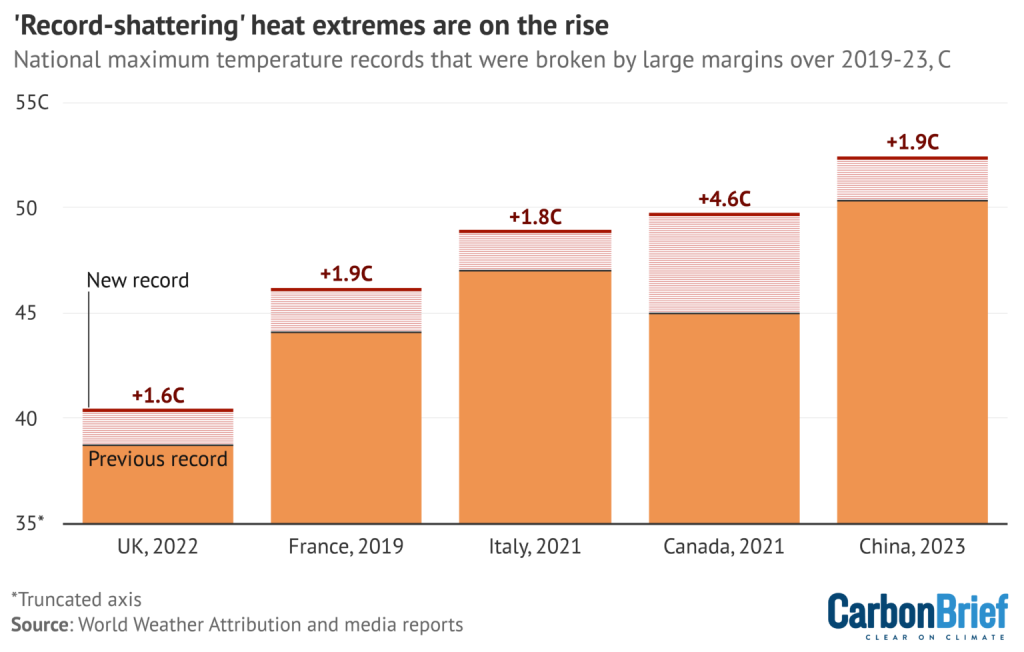
The Pacific north-west heatwave in 2021, when Canada’s temperature record was smashed in Lytton, is among the largest record-shattering heatwaves ever recorded – although there have been a couple of events that were more extreme in terms of standard deviations, research finds.
That research paper found that the Pacific north-west heatwave broke temperature records by just over four standard deviations, while the most extreme heatwave ever recorded, in south-east Asia in 1998, broke records by just over five standard deviations.
Other record-shattering heat events from recent years include a year-long marine heatwave in the north Atlantic Ocean beginning in March 2023, when sea surface temperatures were up to 5C hotter than normal.
The event caused deadly heat stress to hit nearly all of the Atlantic’s tropical reefs and contributed to a very active 2023 Atlantic hurricane season.
It is worth noting that understanding of such extremes is generally better for global-north countries than those in the global south.
Reasons for this include that temperature records in global-north countries are longer and more complete, plus there are more weather stations, too. Previous Carbon Brief analysis found that Africa has the lowest density of weather stations out of any continent, followed by South America and Asia.
This means that scientists do not have a full understanding of the geographic distribution of record-shattering heat, says Dr Robert Vautard, a senior climate scientist at the National Centre for Scientific Research at Institut Pierre-Simon Laplace in Paris and co-chair of the climate science working group of the IPCC. He tells Carbon Brief:
“We don’t know fully where record-shattering events are more expected than in other places…That is an area where I would expect progress in the coming years.”
Why are heat records being shattered by huge margins?
In the aftermath of the 2021 heatwave in the Pacific north-west, scientists were left scratching their heads about the kind of temperatures they were studying.
At the time, researchers at the World Weather Attribution service, a consortium of scientists studying the influence of climate change on extreme events, suggested that it might indicate the Earth had “crossed a non-linear threshold” – where even small increases in global temperature is causing much larger rises in extreme heat than scientists expected.
“It’s an extraordinary event,” van Oldenborgh, who co-founded the WWA, told a press conference, adding that it was “surprising and shaking” to find out that “our theoretical picture of how heatwaves would behave” in a warming climate “was broken” so dramatically.
Since then, several studies have looked into the possible causes of the extremes seen in the Pacific north-west heatwave and the occurrence of record-shattering heat more broadly.
The emerging consensus is that – while staggering and dangerous – these extremes are within the realms of what the world can expect as global temperatures continue to rise rapidly.
Vautard, who recently led a study in Environmental Research Letters looking into whether heat extremes are increasing in a way that is beyond what scientists anticipated, tells Carbon Brief:
“The study shows that this is really what we expect with climate change. There is not anything else that we don’t understand. It’s terrible, but we understand it.”
The reason why records are sometimes broken by large margins – rather than incremental increases – can be understood by considering the rapid rise in global temperatures, explains Fischer, who has also published papers looking into the phenomenon. He says:
“The rate of warming plays an important role. If you have, say, a one-in-50-year event – if it happens once and then reoccurs [on average] 50 years later, the climate in between has been warming very, very rapidly, so the difference in the magnitude of these two events is going to be much larger.”
In other words, every so often, a range of climate factors – both natural and human-caused – will combine to cause an extreme heat event.
Scientists use return periods to describe such events, with a larger return period indicating a more extreme event that is less likely to occur at any given time.
This was the case during the Pacific north-west heatwave, when a “blocking” weather pattern – a region of high pressure in the atmosphere – stalled over the region, creating a dome of unusually high temperatures. At the same time, temperatures were exacerbated further by the effect of dry soils.
Each time an event like this occurs, it is against a backdrop of human-caused climate change, which is making heatwaves more intense and more frequent.
As global temperatures continue to rise, their influence on extreme heat events gets larger and larger.
Therefore, when a very rare heat event combines with ever-increasing temperature rise, it can cause a record-shattering event, says Dr Clair Barnes, a climate statistician at Imperial College London, who was a co-author on the recent Environmental Research Letters study. She tells Carbon Brief:
“The heat extremes that we are seeing are not unexpected.”
How could record-shattering extreme heat increase in future?
In 2021, Fischer led a study published in Nature Climate Change that explored how record-shattering heat events could increase in future.
The research considered such events to be week-long heat extremes that break previous records by two, three or four standard deviations.
Events falling under the two standard deviations category include the 2003 European heatwave, which killed 30,000 people, and the 2010 Russian heatwave, which killed at least 5,000 people in Moscow.
The researchers looked at the probability of such events occurring under a range of future scenarios.
This included a future scenario where greenhouse gas emissions are extremely high (known as “RCP8.5”) and a scenario where global temperature rise is limited to below 2C by 2100 (known as “RCP2.6”). (Limiting global warming to “well-below 2C” is part of the long-term goal set by countries under the Paris Agreement.)
The research found that, under the scenario of very high greenhouse gas emissions, week-long heat events that break records by three or more standard deviations will be come between two and seven times more likely in the period 2021-50 and three-to-21 times more likely in the period 2051-80, when compared to the past three decades.
Conversely, if the world can limit global warming to 2C, which would involve stabilising the climate by reaching net-zero greenhouse gas emissions, the occurrence of record-shattering heat events will rapidly decrease, Fischer says:
“If you manage to stabilise the climate, record-shattering events would decrease. You would still see worrying heatwaves, but that record-shattering aspect would decline.”
This is because the rate of global temperature rise – the main driver of record-shattering extremes – would no longer be increasing.
Even slowing down the pace of global warming, by slashing global emissions, would reduce the probability of such events occuring, he adds:
“This is one of the few early benefits [of mitigating climate change]. I think it’s an important one, because usually we say we will only see benefits once we actually stabilise the climate, but here is one we will see even before we reach this.”
This is a clear example of where “mitigation can help out a lot with adaptation”, adds Vautard:
“Very often we are adapting to what we just saw – or what we saw over our lifetime. But record-shattering events are unthinkable.
“If we stop warming [the planet], the probability of record-shattering events will very rapidly go back to zero. That will help a lot with adaptation.”
