


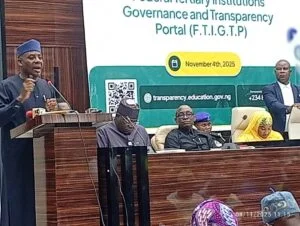
The Federal Government has launched the Tertiary Institution Governance and Transparency Platform (FTIGTP) to promote transparency, accountability, and good governance across Nigeria’s tertiary education sector, aiming to enhance public trust and operational efficiency nationwide.
Speaking in Abuja on Tuesday, Minister of Education Dr. Tunji Alausa described the platform as a “major milestone” in Nigeria’s efforts to restore confidence in the management of tertiary institutions.
Alausa explained that, for the first time, Nigeria will have a unified system providing real-time visibility into student enrolment, government funding, and other critical metrics across all tertiary institutions.
He said the platform would cover TETFund allocations, NELFund interventions, research grants, and institutional performance indicators, creating a single, integrated framework for monitoring and assessing tertiary education outcomes.
The minister added that the platform would end years of fragmented and inconsistent data collection, replacing multiple reporting formats with a unified, accurate, and accessible digital system.
Alausa emphasised that FTIGTP is not merely a data collection tool but a reform instrument designed to drive efficiency, results-based management, and stronger governance across Nigeria’s tertiary education sector.
“Institutions will now be required to submit data quarterly, with financial reporting tied to performance and eligibility for future government funding, ensuring accountability and better resource allocation nationwide,” he said.
“For many years, tertiary education data has been scattered across platforms, paper reports, and inconsistent submissions, limiting oversight and public trust,” he added, highlighting the need for a centralised, reliable information system.
According to the minister, FTIGTP will serve as a single nationwide source of accurate data, providing financial transparency, enhancing accountability, discouraging fund misuse, and fostering public confidence in Nigeria’s tertiary education system.
He called for full cooperation from vice chancellors, rectors, and provosts nationwide, stressing that the platform’s success depends on institutional compliance and a shared commitment to transparency and efficiency.
