


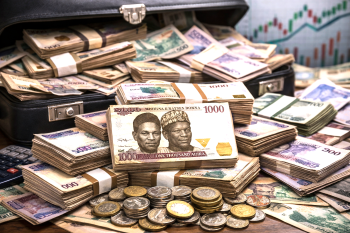
The Central Bank of Nigeria (CBN) has disclosed that the country’s broad money supply (M3) rose to ₦133.25 trillion in June 2026, up from ₦129.21 trillion in May. This represents a month-on-month increase of ₦4.04 trillion (3.11%), even as the apex bank maintained its benchmark interest rate at 26.5% during the 305th Monetary Policy Committee (MPC) meeting held May 19–20.
The latest money and credit statistics, released Wednesday, also show that M2—comprising narrow money (M1), quasi-money, demand deposits, and currency outside banks—increased to ₦133.24 trillion in June from ₦129.20 trillion the previous month. Year-on-year, the money supply grew by ₦16 trillion compared to ₦117.25 trillion recorded in June 2025.
CBN attributed the expansion primarily to increases in quasi-money and net domestic assets, suggesting that much of the liquidity growth is being driven by savings and time deposits rather than immediate spending money.
The data comes amid a sustained tight monetary policy stance by the CBN, which has kept the Monetary Policy Rate (MPR) unchanged at 26.5% to combat inflation and stabilize the naira. The apex bank’s “hawkish” posture is intended to reduce inflationary pressures by discouraging borrowing and encouraging savings.
However, the simultaneous growth in money supply suggests that liquidity is still expanding, raising questions about the effectiveness of transmission mechanisms in the Nigerian financial system.
Despite the rise in overall money supply, Nigerian businesses and households continue to face high borrowing costs. Lending rates remain elevated, with many commercial banks pricing loans above the 26.5% MPR, making credit inaccessible for most small and medium enterprises.
Economists say this disconnect highlights structural challenges in Nigeria’s monetary transmission channels, where policy rate changes do not always translate into equivalent movements in lending or deposit rates.
While the increase in money supply could signal growing economic activity, it also raises concerns about potential inflationary pressures if the liquidity is not channeled into productive sectors. With inflation already at double digits, the CBN faces the delicate task of balancing price stability with economic growth.
The coming months will test whether the central bank’s high-rate policy can effectively tame inflation without stifling economic recovery.
