


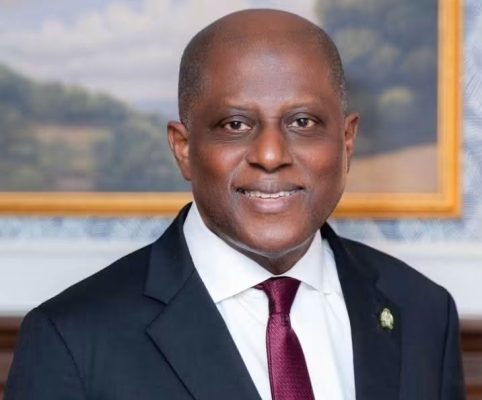
Nigeria has achieved the Central Bank of Nigeria’s (CBN) target of attracting $1 billion in monthly diaspora remittances, Governor Olayemi Cardoso has announced.
Cardoso disclosed this on Friday at the 61st Annual Bankers’ Dinner of the Chartered Institute of Bankers of Nigeria (CIBN) in Lagos, saying the apex bank would now target $1.5 billion in monthly remittance inflows by the end of the first half of 2027.
The milestone represents a significant increase in the flow of diaspora funds through formal channels, following reforms by the CBN aimed at improving transparency, market access and confidence in Nigeria’s foreign exchange market.
“When I stood before you last year, I spoke of our ambition to increase monthly remittances to $1 billion a month. I am pleased to report that this milestone has been achieved,” Cardoso said.
“We are now working towards increasing monthly remittances to $1.5 billion by the end of the first half of 2027.”
The governor commended licensed International Money Transfer Operators (IMTOs) for investing in technology, strengthening transparency and expanding formal remittance channels, particularly across Asia.
The CBN had reported that remittances through IMTOs reached $947 million in July 2026, the highest monthly inflow recorded through formal channels at the time. Between January and July, total inflows reached $3.8 billion, representing a 50.2 per cent increase over the corresponding period of 2025.
Cardoso attributed the broader improvement to foreign exchange reforms that have moved Nigeria away from the previous multiple-exchange-rate system towards a more transparent, market-driven framework.
He said the reforms had improved certainty for businesses, strengthened investor confidence, eased international payment obligations and encouraged more Nigerians abroad to use formal channels to send money home.
The CBN governor also said the naira had strengthened by about six per cent over the past year, while daily foreign exchange market turnover had at times exceeded $1 billion.
He added that turnover in the fixed-income market averaged N1.5 trillion daily, supported by a tradable benchmark yield curve extending to 10 years.
According to Cardoso, the next phase of financial-sector reforms would focus on deepening market liquidity, broadening participation and expanding the range of financial instruments available to businesses and investors.
He stressed, however, that a market-determined exchange rate should not be expected to remain static, noting that currency movements are influenced by economic fundamentals and global developments.
Cardoso said Nigeria was now better positioned to withstand external shocks than it was three years ago, citing stronger external buffers and the CBN’s readiness to deploy reserves when necessary to address disorderly market conditions.
The CBN is also planning to launch interbank repurchase agreement (repo) and overnight indexed swap (OIS) markets in the first quarter of 2027 as part of efforts to deepen liquidity and improve efficiency in the financial markets.
