


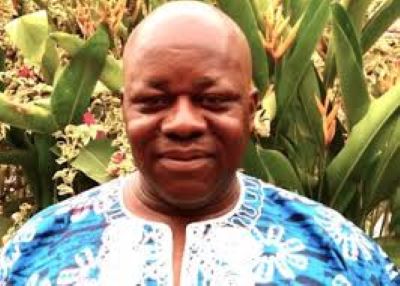
Yesterday, we got the sad news of the death of a great statesman, technocrat and chronicler of Nigerian politics and elections; Ahmadu Kurfi, Maradin Katsina and District Head of Kurfi. He has been a father, teacher and mentor for me over the years. Before I got to know Maradi, I had known his sons, Gambo, my school mate at Mallam Smith hostel in Barewa College and Mansur, my good friend, Ciroman Kurfi. My deepest condolences to the entire family.
I first got to know Maradi through his many books, starting with: “The Nigerian General Elections 1959 and 1979” which was one of the key sources I used while working on my doctoral thesis. It is rare to meet an individual as deeply knowledgeable and concerned about political development and civic culture as Maradi. I remember when I visited him in Kurfi some years ago, he explained to me his concern when he visited schools in his district and was asking students what they knew about their society. They knew virtually nothing. Trust him, his response was to start teaching them civics and it was his lecture notes that he published as “Know Your Country and Beyond”, Safari Books, 2011. The book covered topics such as Kurfi district, Katsina State, Nigeria, Africa, and the World, seeking to give a national, continental and world perspective to the young ones.
One of his most important books is: “The Barons”, 2005. It tells the story of the political drama beginning with the end of the Shagari regime in 1983 and ended with the ascent of Obasanjo to power in 1999. It gives a satirical account of the clandestine machinations employed behind the scenes by a very powerful group of individuals – the barons, who were mostly from the north of Nigeria, to capture political power, and exert influence over the traditional socio-economic and political institutions. Although names were not mentioned, it gives a detailed account of how these politicians “crafted” the Fourth Republic. It would be great if it could be re-published with the real names of the cast.
My favourite book is his Sixty Years Long March Towards Democracy: Nigeria’s General Elections 1951–2011, Safari Books, 2013. It is a compendium which reviews all the twelve general elections we had in Nigeria between 1951 and 2011. Ahmadu Kurfi is the most qualified person to write such a book because he has been a keen and informed observer of all of the elections. He had vast experience in public and electoral administration and his work career started way back in 1951. A graduate of the University of Hull in the United Kingdom, he became an assistant administrative officer in 1958 and was in charge of voter registration in the Abuja/Lapai Federal Constituency and electoral officer in Kontagora Federal Constituency in the 1959 general elections. He kept faith with electoral administration and was to become the Executive Secretary of the Federal Electoral Commission in 1979. I had the privilege of serving with him on the Electoral Reform Committee (2008) established by the Umaru Musa Yar’Adua Administration where we all appreciated his vast knowledge of electoral matters.
Throughout his life, Maradi remained devoted to the struggle for free and fair elections. We must celebrate him because Nigeria is a country where the people are committed to free and fair elections but the elite is disdainful of the people’s franchise and has a long history of subverting the people’s mandate. Although a member of the elite, Maradi has always been on the side of the people in terms of respecting the franchise of the citizens.
The compendium starts with a review of restricted franchise of the citizen in the 1951 and 1954 elections. In the North, the elections were indirect, conducted through five stages under the tutelage of the Native Administration system from the village through to the chiefdom. The outcomes were therefore largely determined by traditional rulers, as Maradi points out, including his own father who was then the Maradin Katsina. In the North, women were denied the franchise while in the South, mandate restriction was based on the tax status of individuals.
The book reviews the close connection between elections and political instability in Nigerian history. At this period when Nigeria’s unity is extremely fragile, it is important to read his account of the 1964 elections in which massive electoral fraud eventually led to the coup d’état and civil war that ravaged Nigeria. The elections were contested between the NPC led NNA alliance and the NCNC led UPGA Alliance. He points out that issues were already defined before the elections as NNA had “won” 66 seats before the elections. These seats were declared unopposed because the electoral officers simply disappeared after receiving the nomination forms from the ruling party in a context in which the law required that candidates must personally hand in their nomination forms to the electoral officer. The then President, Nnamdi Azikiwe was so disgusted that he declared that it was better for Nigeria “to disintegrate in peace not in pieces”. In the constitutional crisis that followed the boycott of the elections by the Eastern Region, political breakdown was prevented by a very delicate compromise of setting up a government of national unity that did not last.
At the analytical level, one of the most important lessons we learn from Ahmadu Kurfi is the way in which incumbency has been used to rig second round elections. While the elections of 1959, 1979 and 1999 were relatively free and fair, incumbents used state power to massively rig elections that were organised in 1964, 1983, 2003 and 2007. As he put it, state power was used to “deliver” votes for the ruling party. He devoted a whole chapter to explain the various forms of rigging that have characterised Nigerian elections over the period.
One of the most controversial aspects of the 1979 elections was the determination of whether the election had been won in the first round. The law stipulated that to win in the first round, the candidate must obtain at least one quarter of the votes cast in two thirds of the states in the country. There were at that time nineteen states in the country and FEDECO, the electoral commission was of the view that two thirds of nineteen is 12 two thirds of states. Mathematically, this amounted to 12.66. The candidate of the National Party of Nigeria, Shehu Shagari got a quarter of the votes cast in twelve states. For the thirteenth state, he only got two thirds of 0.66 and the returning officer was of the view that this was sufficient to declare him winner. This decision generated a lot of controversy as the opposition believed that to win, it was necessary to obtain two thirds of the 13th state, rather than two thirds of 0.66 of the state. The matter went to court and the decision of FEDECO was upheld.
What we learn from Kurfi’s work is that the general assumption was that FEDECO conspired to deny the candidate with the second highest votes, Obafemi Awolowo, the right to go to the Electoral College for a final decision on the winner. His own argument however was that this assumption was wrong. The law stipulated that in the event that no candidate got a quarter in two thirds of the states, the runoff in the Electoral College was to be between the candidate with the highest votes cast and the candidate who won the majority of votes cast in the highest number of states. While Awolowo had the second highest number of votes cast in the country, he scored the highest number of votes in seven states while Waziri Ibrahim of the GNPP scored a lower total no of votes but scored the highest number of votes cast in twelve states while Awolowo scored the highest number of votes cast in only seven states. If there was to be a runoff, it would have been between Waziri Ibrahim and Shehu Shagari. Kurfi’s view however was that a runoff would have been legal had Shagari not got the arithmetic two thirds but it would have been undemocratic because the law stipulated that the electoral college to make the final determination would have been the National Assembly sitting with members of the State Houses of Assembly rather than the electorate which I completely agree with.
Ahmadu Kurfi has written numerous memoranda suggesting key elements of an electoral reform agenda. Some of his most important recommendations are for the organisation of staggered elections for both the legislatures and executives, movement towards the increased use of technology in the voting process and the removal of restrictions in party registration. His numerous books remain required reading for all those who want to understand our history of elections and democratic challenges as well as those interested in protecting the electoral mandate of the Nigerian. Maradi gave so much to Nigeria, may his soul rest in perfect peace.
