


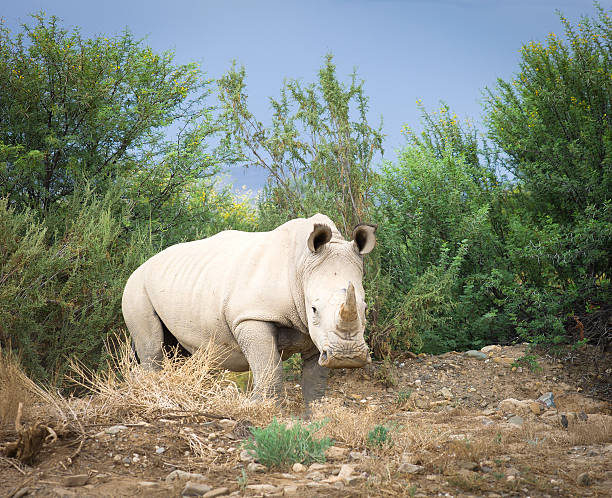
BioRescue, an international consortium of scientists and conservationists, succeeded in achieving the world’s first pregnancy of a rhinoceros after an embryo transfer. The southern white rhino embryo was produced in vitro from collected egg cells and sperm and transferred into a southern white rhino surrogate mother at the Ol Pejeta Conservancy in Kenya on September 24, 2023. The BioRescue team confirmed a pregnancy of 70 days with a well-developed 6.4 cm long male embryo. The successful embryo transfer and pregnancy are a proof of concept and allow us to now safely move to the transfer of northern white rhino embryos – a cornerstone in the mission to save the northern white rhino from extinction.
On September 24, 2023, the BioRescue scientists and veterinarians, led by the Leibniz Institute for Zoo and Wildlife Research (Leibniz-IZW), transferred two southern white rhino embryos into Curra, a southern white rhinoceros, selected as a surrogate mother at the Ol Pejeta Conservancy in Kenya. The oocytes used in producing the embryos were retrieved from Elenore, a southern white rhinoceros living in the Pairi Daiza Zoo in Belgium. The sperm used for fertilisation originated from the male Athos from the Zoo Salzburg in Hellbrunn, Austria. The oocytes from Elenore were fertilised in vitro by intracytoplasmic sperm injection (ICSI) and developed into blastoscysts at Avantea‘s laboratories in Cremona, Italy. For the embryo transfer in Kenya, the BioRescue scientists transferred two embryos to increase the chance of a successful outcome.
So far, the BioRescue team has performed 13 embryo transfers in rhinoceroses, three in Kenya and ten in Europe. Previously, an embryo transfer, which is a widely used technique in domestic species, has never been attempted in rhinos. BioRescue scientists developed the necessary techniques, by building on decades of their own research.
Currently, there are only two northern white rhinos left in the world: The female Najin and her daughter Fatu. Additionally, living cells from 12 different northern white rhino individuals are stored in liquid nitrogen. The last two females currently live in Kenya, at Ol Pejeta Conservancy, where they are guarded and cared for day and night. Since 2019, the BioRescue conservation science programme produced and cryopreserved 30 northern white rhino embryos. These are currently stored in liquid nitrogen at minus 196 degrees Celsius in Berlin, Germany, and Cremona, Italy, awaiting embryo transfer into southern white rhino surrogate mothers. The successful transfer of a southern white rhino embryo is a proof of concept that allows to take this crucial step – an embryo transfer with a northern white rhino embryo – for the first time.
The embryo transfer in this subspecies is entirely new ground as a veterinary and scientific procedure, and all protocols, methods and pieces of equipment had to be newly developed from scratch. As it is the established routine with all BioRescue procedures, the embryo transfers are accompanied by an ethical assessment conducted by Padua University. This was also the case in September, when all participants of the embryo transfer filled out a questionnaire that proposed any possible scenarios during the procedure, and attendant risks to animals and participants.
The vasectomised, sterile teaser bull Ouwan mated with Curra on September 17 and 18, signalling the ideal timing for the embryo transfer, which took place on September 24. After the procedure until November 2023, Curra was monitored on a daily basis in the enclosure at the Ol Pejeta Conservancy. During this period, Ouwan showed no further interest in Curra, a first sign of a successful embryo transfer resulting in pregnancy. The BioRescue team was scheduled for November 28 to perform a pregnancy check in Curra, but the teaser bull Ouwan was found dead on November 22 and Curra was found dead on November 25. Apparently, extremely heavy rains led to a flooding of the surrogate enclosure and set free dormant clostridian bacteria spores. The dissection of the animals revealed a severe systemic infection by a clostridian bacterial strain and resultant intoxication by the bacterial toxin. It also revealed that Curra was pregnant with a 70 days old male foetus that was 6.4 cm long. Tissue samples of the foetus were collected and transported to the Max Delbrück Centre for Molecular Medicine and the Leibniz-IZW in Berlin, Germany. In January 2024, it was confirmed through the analysis of the foetus DNA that the pregnancy resulted from the embryo transfer.
When the BioRescue team arrived in Kenya on November 28, the preliminary results indicated an intoxication with the clostridian bacterial strains Paraclostridium bifermentans and Paenicolostridium sordellii. Immediately after the incident, the BioRescue team, including Kenya Wildlife Service, Wildlife Training Research Institute, Ol Pejeta Conservancy and Safari Park Dvůr Králové formed a crisis team on site and established fast and effective measures to protect all current semi-captive rhinos including the last two northern white rhinos Najin and Fatu. The measures included a vaccination programme, quarantine of affected areas and fencing of new emergency enclosures.
The next steps in the BioRescue research programme included the selection and preparation of a new teaser bull. The bull will allow the scientists to know when a possible surrogate female is ready to receive an embryo implantation. The team also has to select the next surrogate mothers. After these steps, which will take several months, an embryo transfer with a northern white rhino embryo will be attempted.
The BioRescue research programme is supported by the German Federal Ministry of Education and Research (BMBF) over a time-period of six years with up to around 6 million Euros.
Quotes:
Thomas Hildebrandt, BioRescue project head, Leibniz-IZW
“The embryo transfer technique is well established for humans and for domesticated animals such as horses or cows. But for rhinos, it has been completely uncharted territory and anything from the approach over procedure protocols to required equipment had to be invented, developed, tried and tested to be safe for use. Together with the team and many professional partners, I developed the devices that can actually find and access the required location where to insert the tiny embryo into a 2-ton animal. It took many years to get it right and we are overwhelmed that we now have proof that this technique works perfectly. It is bitter that this milestone is confirmed under such tragic circumstances with the death of the surrogate Curra and her unborn calf, but I am certain that this proof of concept is a turn of the tide for the survival of the northern white rhino and the health of Central-African ecosystems. It comes just in time to achieve a pregnancy for northern white rhinos: we want the offspring to live together with Najin and Fatu for years to learn the social behaviour of its kind. Although embryos can be stored in liquid nitrogen for a very long time, we are in a rush to bring a northern white rhino baby to the ground – with this proof of concept it can become a reality in two to three years. BioRescue is only so successful because we were capable to form such a great team called the BioRescue Consortium. Most likely this is one of the significant differences to other challenging conservation approaches.”
Frank Göritz, head veterinarian in the BioRescue project, Leibniz-IZW
“The veterinary team always strives to ensure the safety of the animals – and all humans – during procedures such as an embryo transfer in rhinos. This is a highly advanced procedure and far beyond the routine for wildlife veterinarians. The embryo transfer with Curra on September 24 was smooth and without any complication, as any of the BioRescue procedures in Kenya have been until now. As the responsible anaesthesiologist you always fear that one day something does not go according to plan with an anaesthesia for example. But witnessing the death of an animal you have worked with for so long for reasons that are beyond your control is depressing. We try to take control of every factor that affects the well-being of the animals, but in nature you cannot control everything and sometimes your plans are thwarted by heavy rains and a disease. It is very sad, but we try to look forward and to see it as a milestone for the BioRescue mission.”
Susanne Holtze, scientist in the BioRescue project, Leibniz-IZW
“BioRescue follows alternative scientific approaches for creating new offspring for the northern white rhinos and ensuring the highest genetic diversity of their future population. These strategies include advanced assisted reproduction and stem-cell associated techniques as well as – in the future – editing lost genetic information discovered in museum samples back into the gene pool of the sub-species. But all of these strategies converge at producing embryos in vitro and successfully transferring them into surrogate mothers to create a pregnancy. This is why the embryo transfer technique is so pivotal to the mission and the success is such a milestone for our project.”
Jan Stejskal, the BioRescue project coordinator, Safari Park Dvůr Králové
“With this successful embryo transfer, the BioRescue team has fully opened the way to the first northern white rhino calf to be born through artificial reproduction. As always, first we wanted to prove that our approach works with southern white rhino genetic material, as it is more available. By mastering this step, we can now use a northern white rhino embryo for the first time in embryo transfer. Our current success also shows the great potential that zoos have in saving endangered species, as all the embryos that led to this success have been produced thanks to the extensive collaboration of European zoos. When we as scientists and zoo experts work together with conservationists in the field, we are much more powerful than when we work separately.”
Cesare Galli, CEO of Avantea Laboratories
“All endeavours have setbacks, and we have had our share of setbacks, but we are here today to proclaim that we have done something never done before. We can today confirm that DNA testing proves that the embryo we transferred into the uterus of the southern white female rhinoceros, Curra, had developed into a healthy well well-developed male foetus. This demonstrates that the process of in vitro maturation of oocytes, ICSI, embryo culture and cryopreservation performed by Avantea in Cremona, Italy is successful in producing embryos that will successfully mature in surrogate females. This information not only testifies to the viability of the process but shortens the length of time required to verify success, and no longer requires the birth of a calf. In the horse, the closest domestic relative to the rhinoceros, fetal losses are more frequent in the first 50 days than at any other period of pregnancy. The development of this foetus would indicate that the chance of a successful birth would have been greater than 95%. Because of this development, we feel that embryo transfer work can switch to the use of genetically pure, Northern White rhinoceros embryos without hesitation, fully one year earlier than anticipated.”
Barbara DeMori, Director of the Ethics Laboratory for Veterinary Medicine, Conservation and Animal Welfare, Department of Comparative Biomedicine and Food Science
“BioRescue has established a blueprint for ethical monitoring of international conservation research projects. All steps of the BioRescue project are constantly scrutinised for compliance with animal welfare standards, scientific quality and safety for the people involved. There are events we cannot control, but with BioRescue we have established the highest ethical standards possible in conservation research projects. Continuous ethical monitoring is routinely made to avoid risks both to people and animals, while opinions and perceptions of the public and stakeholders are included in the assessment process. The continuous development of successful ethical monitoring procedures of BioRescue can severely benefit other conservation research projects saving endangered species.”
Dr. Erustus Kanga, Director General of the Kenya Wildlife Service (KWS)
“Kenya Wildlife Service (KWS) is delighted to have been part of this journey for the last 13 years since the northern white rhinos (NWR) were brought to Kenya in the year 2009, and for being part of the great initiative of the BioRescue consortium over the last four years. The application of novel assisted reproductive techniques in an effort to save the northern white rhino from extinction has borne fruit with major milestones having been achieved in optimization of the embryo transfer procedures in rhinos. As the government agency responsible for wildlife in Kenya, we have received the great news of proof of concept with the successful embryo transfer undertaken on Kenyan soil at Ol Pejeta Conservancy.
The Government of Kenya through KWS, will continue to offer the required leadership and support to ensure the success of the NWR recovery efforts as we get into the next steps of undertaking embryo transfer using the highly valued NWR embryos. This is a great milestone in the preservation of the northern white rhino genetic lineage. It will contribute to the long-term vision of reintroduction of the NWR to their former range states as part of the global heritage.”
Patrick Omondi, Director/CEO of the Wildlife Research and Training Institute (WRTI)
“Now, after nearly four years of dedication to a common course by the BioRescue Consortium comprising scientists and conservationists from Kenya, Europe and Asia, a significant breakthrough has been made. The application of advanced assisted reproduction techniques provides hopes of preventing the extinction of the iconic Northern White Rhinoceros subspecies (Ceratotherium simum cottoni) from extinction. The collaborative partnerships demonstrated by the BioRescue Consortium have provided opportunities for increased specialised knowledge and expertise sharing. The successful embryo transfer in a rhinoceros, the first to be accomplished globally, provides proof of concept and allows the consortium to move to the next steps of transferring the already developed pure NWR embryos to the SWR surrogates at Ol Pejeta Conservancy. As an Institute, we look forward to the application of assisted reproduction techniques to other endangered species in Kenya and the world.”
Justin Heath, CEO of the Ol Pejeta Conservancy
“This is a huge milestone for all those who dedicate their lives to protecting endangered species, and I am particularly proud of the Ol Pejeta team for their unwavering care and dedication to the wildlife in our conservancy, especially the last two known northern white rhinos Najin and Fatu. To have lost the surrogate Curra and teaser bull Ouwan is a large blow to the BioRescue team, Ol Pejeta and the Kenyan people. It was inspiring how the combined team reacted to ensure the risk was isolated, including vaccinating, immunising and translocating within days.
While bittersweet, to have had the world’s first pregnancy in a rhino after a successful surrogate transfer on Ol Pejeta Conservancy is a point of great pride for us all. We look forward to welcoming future surrogates’ rhino calves under the foothills of Mount Kenya very soon.”
Catherine Vancsok, Scientific Advisor of the Pairi Daiza Foundation
“Directly helping the northern white rhino survive in Kenya shows the crucial role zoological institutions play in the preservation of species. The Pairi Daiza Foundation has several projects running where financial means, human effort and scientific research coincide to help deliver conservation results. The procedures to extract oocytes from Elli, the adult female southern white rhino female residing at Pairi Daiza, were an essential step in the conservation chain. The BioRescue team, the Pairi Daiza veterinarians and zookeepers made sure the herd of southern white rhino’s welfare was guaranteed at every moment. The in situ setback is unfortunately part of a long route that all of the teams involved have to experience to deliver ground-breaking conservation success. The Pairi Daiza Foundation trusts in the strength of human cooperation and scientific process to get nature, and the northern white rhino, back on its feet“.
Miriam Wiesner, Zoo Veterinarian Salzburg Zoo
“From the early beginning, Zoo Salzburg supports the assisted reproduction of Southern White Rhinos and the project of BioRescue. We significantly want to contribute to the preservation of Northern and Southern White Rhinos from extinction. For us as a zoological institution, it is important to show, that we can actively engage in conservation and protection of species. We are pleased, that our breeding male “Athos” is the father of the transferred embryo!”
Source: AlphaGalileo
