


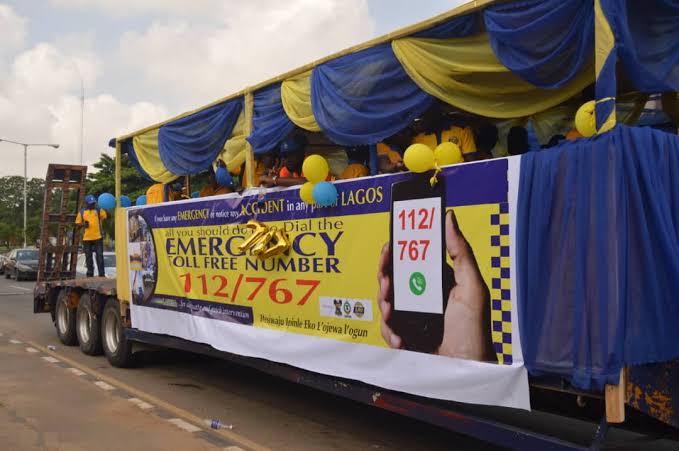
Many Lagos residents remain unaware of the state’s emergency lines, raising concerns about delays in activating emergency response during life-threatening situations.
The concern emerged after passengers on a Bus Rapid Transit (BRT) bus witnessed two men lying on the Lagos expressway near Dopemu-Yo Junction.
The men, believed to be a motorcycle rider and his passenger, were reportedly victims of a hit-and-run incident.
As the BRT passed the scene, passengers expressed shock that emergency responders had not immediately arrived at the location.
Some passengers also questioned the effectiveness of the state’s emergency response system, while others took pictures of the victims.
However, the conversation changed when a passenger asked whether anyone knew the state’s emergency number.
The passengers were informed that residents could dial 767 or 112 during emergencies, including road crashes, fires, building collapses and other situations requiring urgent intervention.
One of the passengers, Mr David Abiodun, immediately dialled 767 and eventually reached an operator.
Abiodun said he provided the location of the incident around the Dopemu under-bridge area and explained what the passengers had witnessed.
According to him, the operator said the emergency centre was already aware of the incident following an earlier call.
He said the operator also informed him that an ambulance was being deployed to the scene.
The experience prompted other passengers to ask for the emergency numbers, with some repeating “767” and “112” after being informed.
The incident highlighted a key challenge facing the emergency response system — the existence of emergency lines does not necessarily mean that residents know or use them.
The Lagos State Government lists 767 and 112 as toll-free emergency lines for residents.
The Lagos State Command and Control Centre (LSCCC) says the lines connect callers with trained operators who coordinate responses by relevant emergency agencies.
The centre’s General Manager, Mr Femi Giwa, said the LSCCC serves as the state’s central emergency coordination hub.
Giwa said calls could trigger the mobilisation of agencies including the Lagos State Emergency Management Agency (LASEMA), Lagos State Fire and Rescue Service and Lagos State Ambulance Service.
Other agencies that could be mobilised include the Rapid Response Squad and Lagos State Traffic Management Authority.
He said the system was designed to connect residents witnessing emergencies with agencies responsible for rescue, medical assistance, fire response, security and traffic management.
However, awareness of the emergency lines remains a challenge.
A Lagos State Government household survey cited in a state report found that 56 per cent of respondents were aware of 767 and 112, while 44 per cent were unaware of the numbers.
The survey also reported that only 11 per cent of respondents had successfully called the emergency numbers.
The state government has undertaken several campaigns to improve public awareness of the lines.
In November 2025, the LSCCC conducted a public awareness road show in Ikeja to sensitise residents on the use of 767 and 112.
The campaign started at the Alausa Secretariat and ended under the Ikeja Bridge, with officials distributing information leaflets to motorists, traders and passersby.
Giwa said the campaign was aimed at educating residents on the proper and responsible use of the emergency lines.
In March 2026, the LSCCC also sensitised more than 1,000 students at State Junior High School, Oyewole, Agege, on the emergency numbers.
The students were encouraged to share the information with their parents and communities.
The centre also informed the students that the emergency lines could be dialled without airtime and warned against prank calls.
Earlier in February, on World Emergency Number Day, Giwa urged residents to know and properly use 767 and 112.
He also announced plans for wider advocacy and sensitisation in schools, markets and public institutions across the state.
There are also documented cases of emergency responses following calls through the numbers.
In August 2024, LASEMA said it activated its response team after receiving a distress call over a road traffic accident around Mangoro.
The agency said its team arrived at the scene within minutes, treated an injured victim and evacuated the remains of a deceased person.
In another road crash involving two BRT buses around Dopemu in 2024, LASEMA said it received a distress call through 767/112 and activated its response team.
The agency said other relevant agencies also responded, while injured passengers were taken to hospital.
These incidents demonstrate the intended emergency response chain: a member of the public reports an emergency, the call centre receives and assesses the information, relevant responders are alerted and intervention follows.
However, the process depends on members of the public knowing how and when to make the call.
The Nigerian Communications Commission (NCC) also operates 112 as a toll-free national emergency number, connecting callers with relevant emergency response agencies.
The NCC says its Emergency Communication Centres connect distressed callers with agencies including the police, fire service and ambulance services.
For Lagos residents, knowing 767 and 112 can therefore provide a direct link to emergency responders during road crashes, fires, building collapses and other life-threatening situations.
The Dopemu incident showed that while emergency infrastructure and response agencies may be available, public awareness remains critical to activating the system promptly.
For residents who witness emergencies, the first step may be as simple as dialling 767 or 112.
