


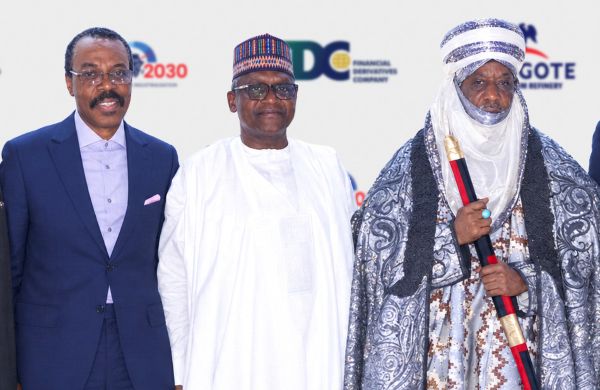
The Emir of Kano, Muhammadu Sanusi II, has urged individuals, entrepreneurs and businesses in Kano State to consider investing in the ongoing Initial Public Offering (IPO) of Dangote Petroleum Refinery and Petrochemicals Limited.
Sanusi made the call on Thursday at the Dangote Refinery “People’s IPO” sensitisation roadshow in Kano, where he described equity ownership as a potential vehicle for long-term wealth creation and wider participation in productive economic activities.
He said Kano’s long history of commerce, entrepreneurship and investment made its residents well positioned to participate in the capital market.
The former Governor of the Central Bank of Nigeria said he had followed the evolution of the Dangote Group from its early years, recalling his interaction with Aliko Dangote while working as a Credit Risk Management Officer at United Bank for Africa in the late 1990s.
According to Sanusi, Dangote’s transition from trading and importation into large-scale manufacturing reflected a deliberate effort to build productive capacity in Nigeria and reduce dependence on imported goods.
“Somebody needs to produce the petrol for your cars, somebody needs to produce the cement for your houses, somebody needs to produce the food that you eat. We are importing these things from Asia, Europe and America. Our strategy is to produce those things here,” he said.
Sanusi described the refinery as a major industrial project capable of changing Nigeria’s dependence on imported petroleum products, noting that the country had historically exported crude oil while spending substantial foreign exchange importing refined products.
He said the refinery was helping to alter that pattern by increasing domestic refining capacity and opening opportunities for Nigeria to export refined petroleum products.
The Emir also cited the refinery’s growing role in international fuel markets, noting that its aviation fuel exports to Europe had increased amid disruptions to supplies through the Strait of Hormuz.
Data from commodities analytics firm Kpler and other industry reports have shown that Dangote has become an increasingly important supplier of jet fuel to European markets following disruptions to Middle Eastern supplies.
Addressing criticism over the refinery’s market position, Sanusi argued that competition could be increased by encouraging more investment in productive industries.
“There is no monopoly if a monopoly is not protected by law. Anybody who wants to build a refinery, anybody who wants to raise $22 billion, invest and go through what Aliko went through is welcome to do so,” he said.
He said Nigerians should focus more on investing in productive ventures capable of creating jobs, generating value and expanding economic opportunities.
On the IPO, Sanusi said shareholders would have a direct ownership interest in the company and benefit from its financial performance.
“It is the shareholders who own it. It is the shareholders who take the returns. It is the shareholders who own the profits,” he said.
However, he cautioned prospective investors against committing money meant for essential obligations to the share offer.
“Do not take your children’s school fees and put in shares. Do not sell your house that you live in and put in shares,” Sanusi said.
He advised investors to commit only funds they could afford to set aside for the long term, citing amounts such as ₦10,000, ₦20,000 and ₦30,000 as examples of money that could be invested without jeopardising essential household needs.
The Dangote Refinery IPO opened on September 14, 2026, with 4.1 billion ordinary shares offered at ₦525 each and a minimum subscription of 10 shares, valued at ₦5,250. The offer is scheduled to close on October 13.
Sanusi urged Kano residents and Nigerians generally to approach the offer with a long-term investment perspective while making decisions based on their individual financial circumstances.
