


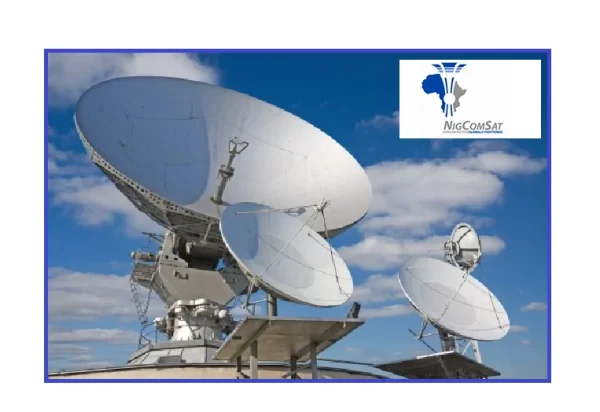
The Nigerian Communications Satellite Ltd. (NIGCOMSAT) says continuous upgrades in technology are critical to keeping Nigeria’s defence and security architecture ahead of evolving threats from insurgents.
NIGCOMSAT Managing Director Jane Egerton-Idehen made the statement during a webinar with journalists on Tuesday.
Egerton-Idehen said technology must support intelligence, collaboration and real-time decision-making. She noted that insurgents, bandits and other security threats are constantly evolving, making it necessary for Nigeria to regularly assess and strengthen its security systems.
“As security threats evolve and find new ways to evade our systems, we must continuously assess our capabilities, identify gaps and strengthen our technology to remain resilient,” she said.
The managing director, however, cautioned that technology alone cannot resolve Nigeria’s security challenges, stressing that effective intelligence and collaboration are equally important.
“The technology itself does not solve the problem. It is the tool you use to gather intelligence and take action in real time,” she said.
According to her, security agencies must continuously identify gaps within their systems and develop alternative capabilities to strengthen operational resilience.
She said satellite technology has supported Nigeria’s defence operations for years, particularly in difficult terrains where terrestrial communication networks are unavailable.
“NIGCOMSAT has partnered with the Nigerian military, including the Army, Navy and Air Force, to support their communication needs,” she said.
Egerton-Idehen explained that satellite connectivity allows military personnel to maintain secure communications across land, air and maritime environments, including areas without terrestrial coverage. NIGCOMSAT has supported military ground operations, aviation and maritime activities where secure and reliable communication is critical.
She said security is prioritised in the organisation’s infrastructure because of the sensitive nature of its clients and communications. The agency works with the Defence Space Administration and cybersecurity professionals to strengthen its systems against cyber threats.
Egerton-Idehen listed NIGCOMSAT’s security measures as including phishing protection, password security, identity management, authentication and zero-trust architecture. Disaster recovery and business continuity are also built into the infrastructure to ensure communication can continue if parts of the system fail.
“The question is, if this part goes down, is there another pathway through which you can still pass the traffic or communicate?” she said.
She added that NIGCOMSAT carries out software updates, firmware upgrades and cybersecurity awareness programmes to strengthen its network against evolving threats. Resilience, she said, requires multiple options because no security system can guarantee complete protection against every possible disruption.
“There will be no perfect system; that is why you create diversity, continuity and resilience, while continuously assessing and evolving the system,” she said.
Egerton-Idehen said NIGCOMSAT is pursuing a multi-orbit strategy involving geostationary and Low Earth Orbit satellites to strengthen its capacity. A geostationary satellite orbits Earth at the precise altitude and speed needed to match the planet’s rotation.
She noted that NIGCOMSAT-1R, the organisation’s current geostationary satellite, is due to reach the end of its life in 2028. It will be replaced with two new assets, including a broadband geostationary satellite planned for 2028. A dual-band satellite planned for 2029 will serve defence and military clients, while another will adopt software-defined technology.
These planned satellites, she said, will enable NIGCOMSAT to continuously upgrade its infrastructure and respond to the country’s evolving needs.
Also speaking, Mr Dave Davis, Senior Technical Director, Global Government at iDirect, said resilient communications are essential because military networks will inevitably face attempts to disrupt them.
“Resilience is not about preventing every attack because attacks will happen. It is about how quickly you can recover and continue communicating,” Davis said.
He noted that Nigeria’s challenging operational environment requires communications capable of supporting land forces, maritime operations and aviation. iDirect has experience supporting counterinsurgency, intelligence, surveillance and reconnaissance, situational awareness, and command-and-control operations.
According to him, Nigeria should avoid relying on a single communications technology, as the failure of one system could disrupt military operations.
“No single technology will solve everything. Resilience comes from combining different capabilities, orbits, frequencies and communication pathways,” he said.
Such layered communications would enable military commanders to maintain connectivity when particular networks are disrupted or attacked. Rapid access to reliable intelligence, he added, can give commanders a decisive advantage during operations.
“You lose communications, and you lose control of the battlefield. Secure, resilient communications are therefore fundamental to effective command and control,” he said.
Davis identified Network Management Systems as a critical area for investment, saying Nigeria needs flexible platforms capable of incorporating emerging technologies. Such systems should evolve alongside new technologies, allowing additional capabilities to be integrated without replacing the entire communications architecture.
He stressed that Nigeria’s defence communications need continuous investment, technological flexibility and multiple layers of resilience. The objective should be to ensure military commanders can maintain secure communications and access timely intelligence even when individual systems are compromised.
The experts agreed that Nigeria’s response to insurgency requires more than acquiring new technologies. They stressed the need for continuous adaptation, secure infrastructure, intelligence and coordinated systems.
