


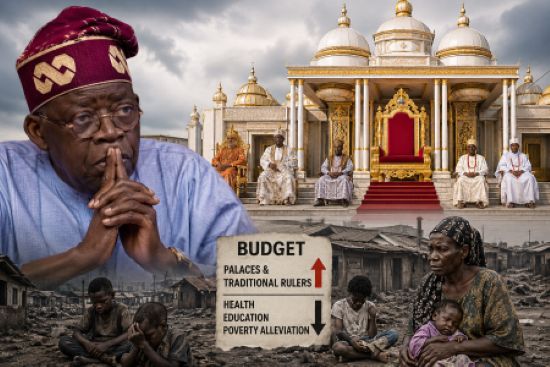
Nigeria stands at a moral crossroads. While millions of citizens struggle to afford a single meal, the federal government has earmarked ₦22.15 billion in the 2026 budget to construct, renovate, and furnish 106 palaces for traditional rulers across the country. This extravagance comes at a time when petrol prices have surged from ₦161 to over ₦1,200 per litre, electricity tariffs have tripled, and the cost of a healthy meal has ballooned from ₦515 to ₦1,611 within two years.
The dissonance is not just economic—it is ethical.
The pain of reform without relief
President Bola Tinubu’s administration has rightly been credited for bold macroeconomic reforms: floating the naira, removing fuel subsidies, and tackling long-standing fiscal inefficiencies. Yet, as the IMF and local policy think tanks like Agora Policy have noted, the gains from these reforms have not trickled down to ordinary Nigerians. Poverty remains stubbornly high at 46%, with over 31 million people foods insecure. Families are borrowing to survive; small businesses are shutting down; and vulnerable groups—women, children, the elderly—are bearing the brunt of policies that were supposed to renew hope.elibrary.imf+4
In such a climate, spending billions on palaces and presidential luxuries is not just insensitive—it is indefensible.
The palace paradox: Constitutional breach or political patronage?
Former Vice President Atiku Abubakar has described the ₦22.15 billion palace allocation as a “constitutional aberration” and a “blank cheque for corruption.” He is right. The 1999 Constitution assigns responsibility for traditional institutions to state and local governments—not the federal executive. Yet, the Budget Office has provided no public list of the 106 palaces, their locations, or the procurement process for the contracts.
This opacity raises urgent questions: Who benefits? Who is accountable? And why must struggling citizens subsidize royal renovations while their own homes lack electricity, clean water, and security?
A pattern of misplaced priorities
The palace allocation is not an isolated incident. It follows a pattern of high-profile, low-impact expenditures that have drawn public outrage:
₦150 billion for a new presidential Airbus jet, acquired in 2024 despite widespread hardship.
₦20.03 billion spent on maintaining the presidential fleet in just 18 months, with 71% consumed by the new jet.
N22.15 billion for palaces, while basic infrastructure decays and social safety nets remain underfunded.
These are not investments in national development. They are symbols of a governance culture that prioritizes image over impact, privilege over poverty alleviation.
A plea for pro-poor budgeting
The government must urgently reorient its spending priorities. Nigerians do not need more palaces—they need:
Affordable healthcare and functional primary education
Subsidized transport and stable electricity
Job creation and support for small businesses
Transparent, accountable governance that reflects the people’s suffering
The 2026 budget must be rewritten—not to fund luxury, but to fund life.
A call to conscience
To President Tinubu and his aides: history will not judge you by the size of your jet or the number of palaces you build. It will judge you by how many children you fed, how many jobs you created, and how many lives you lifted from despair.
The time for symbolic spending is over. The time for servant leadership is now.
