


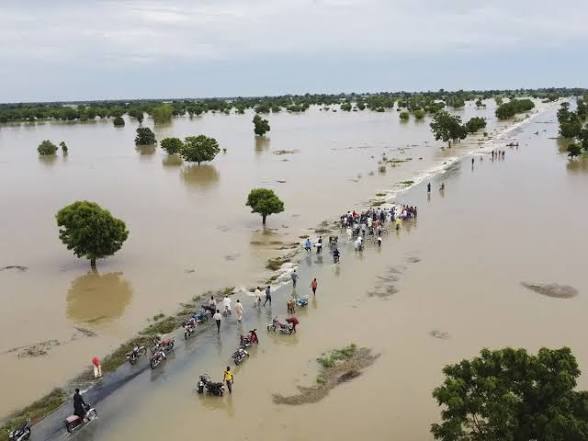
Borno, Yobe and Adamawa state governments have mapped out response strategies and evacuation plans to mitigate the effects of impending floods.
In separate interviews with reporters on Wednesday, officials said the initiatives were based on predictions by the Nigerian Meteorological Agency (NiMet) and the Nigeria Hydrological Services Agency (NIHSA) about likely floods in parts of the states.
Yagana Ali-Abadam, Director of Administration at the Borno State Emergency Management Agency (SEMA), said the state government had constituted a flood preparedness committee comprising relevant stakeholders.
She listed the stakeholders as the Nigerian Meteorological Agency (NiMet), the National Emergency Management Agency (NEMA), the Borno State Environmental Protection Agency (BOSEPA), and the Nigerian Red Cross Society (NRCS).
Ali-Abadam said the move formed part of a broader disaster risk reduction strategy designed to minimise the effects of flooding across the state.
According to her, residents of flood-prone communities in Dikwa have recently been evacuated to safer shelters to reduce their exposure to recurring seasonal floods.
She added that the agency was providing food items and other relief materials to victims of previous floods in Kala Balge, which experiences annual flooding linked to the release of water from neighbouring Cameroon.
Ali-Abadam further disclosed that extensive drainage clearance had been carried out in Maiduguri to prevent blockage of waterways and improve water flow during the rainy season.
She said major flood-prone areas, including Ajilari Cross, Kopa and Bulumkutu-Dala, had received targeted interventions such as drainage clearance and construction of improved drainage infrastructure.
“Aajilari Cross, Kopa and Bulumkutu-Dala remain some of the most vulnerable areas during the rainy season. We are currently expanding drainage systems and clearing blocked waterways to reduce the impact of flooding,” she said.
The director also said awareness and sensitisation campaigns were ongoing across the state through media engagement and community outreach programmes.
In Yobe State, Dr Ibrahim Jalo, Director of Search and Rescue Operations at the Yobe State Emergency Management Agency, said the agency had deployed real-time river monitoring and digital community reporting platforms in flood-prone areas.
“We have also identified safe locations for timely evacuation in case flooding occurs in high-risk areas,” he said.
Jalo said the agency had engaged critical stakeholders, including security agencies, relevant ministries, persons with disabilities groups and humanitarian partners, to strengthen disaster response.
He added that Local Government Area Early Warning and Action Committees had been activated and trained to improve grassroots emergency response.
The director said the state government had directed the agency to prepare relief materials targeting 50,000 households and food items for 10,000 households.
He added that 7,400 sandbags had been earmarked for embankment activities in vulnerable communities.
According to him, emergency response materials are being positioned in Damaturu, Potiskum and Geidam to ensure quick access during emergencies.
Jalo said the agency had mapped out community leaders and emergency contacts to improve communication and reduce response time during disasters.
He identified 12 high-risk flood areas, including Gujba, Damaturu, Bursari, Geidam, Yunusari, Fika, Potiskum, Jakusko, Bade, Gulani, Karasuwa and Machina.
Jalo appealed to residents to heed early warning information and cooperate with emergency officials during possible evacuations.
In Adamawa State, the government has activated Flood Response Committees in all 21 local government areas and embarked on the desilting of major water channels in Yola North, Yola South, and Jimeta.
The Executive Secretary of the Adamawa State Emergency Management Agency (ADSEMA), Dr Celine Laori, listed high-risk flood areas as including Fufore, Yola South, Girei, Yola North, Demsa, Numan and Lamurde.
According to her, safe locations have been identified in each of these areas.
On the awareness campaign, Laori said the agency was collaborating with radio stations to broadcast jingles in Hausa, Fulfulde and other local languages, while town hall meetings were ongoing in the affected areas.
“We are telling people to avoid building on waterways, clear their drainages, and relocate early when they receive warnings. Early warning is key to saving lives,” she added.
Laori said the agency had procured relief materials, including food items, tents, mattresses and drugs, for emergency response.
