


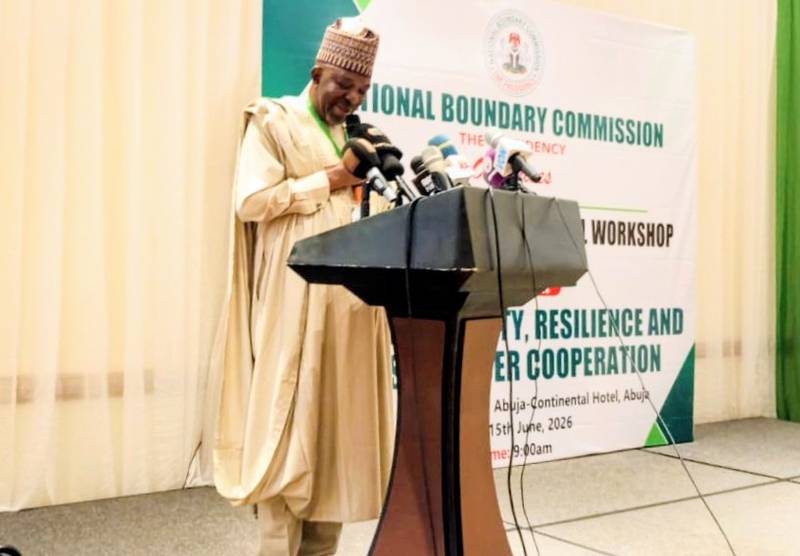
The National Boundary Commission (NBC) has taken steps to develop practical strategies for strengthening border security, promoting resilience, and enhancing cross-border cooperation.
The Director-General, Mr. Adamu Adaji, stated this at a one-day high-level workshop on border security in Abuja on Monday.
Adaji explained that the main goal was to define and establish borders that are secure, resilient, and beneficial to the people they serve.
He highlighted issues such as transnational threats, irregular migration, smuggling, and the pressures of climate and economic challenges.
According to him, borders are not merely lines of separation; they are also critical frontiers for cooperation, stability, and national prosperity.
He noted that the NBC has established platforms across Nigeria’s international borders to facilitate structured engagement among border communities and traditional institutions.
He identified other institutions involved, including local government authorities, security agencies, and civil society organizations, working with their counterparts across Nigeria’s borders.
This approach aligns with the African Union Convention on Cross Border Cooperation, which emphasizes the importance of local cross-border cooperation in community engagement.
Adaji stated that the workshop brought together key stakeholders whose policies and programs influence border realities.
He identified these stakeholders as state governments, whose communities are directly affected; security and intelligence services, which work tirelessly to safeguard Nigeria’s sovereignty; and various Ministries, Departments, and Agencies whose policies impact border communities.
“We must move beyond reactive measures and adopt coordinated, forward-looking approaches that integrate security, governance, and socio-economic inclusion.
Properly managed borders can become gateways for trade, cultural exchange, and regional integration. Our task is to strike the right balance between vigilance and openness,” he said.
In his remarks, the Minister of Defence, retired Gen. Christopher Musa, emphasized that effective border management and territorial defense require clearly demarcated borders, sustained cooperation with neighboring countries, and strong institutional coordination.
Represented by his Special Adviser, retired Rear Adm. Olusanya Bankole, Musa argued that traditional approaches alone are no longer sufficient.
“The focus on early warning and response mechanisms is critically important, as it shifts our posture from reactive to proactive engagement. Anticipating threats before they escalate is central to maintaining national stability.
“Using drone technology and other innovative tools for smart border management is also essential.
“In an era of rapid technological advancement, we must harness these capabilities to enhance border definition, surveillance, situational awareness, and operational effectiveness,” he said.
The minister reiterated the Federal Government’s commitment to strengthening border governance, improving security architecture, and promoting resilience in border communities.
Also speaking, Rear Adm. Abdullahi Ahmed, Commandant of the National Defence College, stressed the importance of cooperation among nations and neighboring communities in border management.
He noted that no country can manage border challenges in isolation, emphasizing that border security involves not only patrols and policies but also building resilience within communities.
On his part, the Emir of Machina, Yobe State, Alhaji Bashir Bukar, highlighted the need for strong engagement with traditional institutions.
Bukar, speaking on behalf of traditional rulers, described traditional institutions as “vital communication channels” within communities.
