


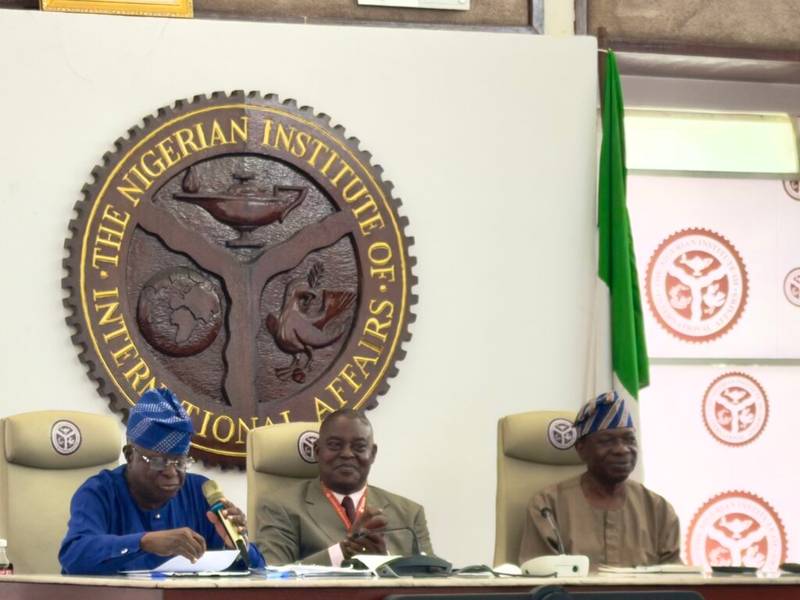
Professor of Political Science Femi Otubanjo has warned that nuclear weapons have evolved from being mere instruments of warfare to becoming major causes of international conflicts and crises.
Otubanjo, a Research Professor at the Nigerian Institute of International Affairs (NIIA), delivered a foreign policy lecture organized by the institute on Tuesday in Lagos.
The lecture was titled, “Nuclear Weapons: From Instrumenta Belli to Causae Bellorum.”
He outlined the consequences of nuclear war, including mass casualties, nuclear winter, environmental devastation, and psychological trauma. He added that such conflicts could lead to economic collapse, political disorder, and threaten the survival of organized human civilization.
Otubanjo emphasized that although discussions about nuclear weapons often seem distant to many Africans, these weapons pose an existential threat to all humanity. No region would be spared the devastating effects of a total nuclear war.
He called for increased public awareness and international commitment to nuclear restraint, warning that humanity cannot afford complacency regarding this grave threat.
The professor traced the historical development of nuclear weapons from the Manhattan Project and the atomic bombings of Hiroshima and Nagasaki to the Cold War arms race and current nuclear rivalries.
Since 1945, he explained, nuclear weapons have held a unique position in international politics due to their destructive capacity, deterrence, and political influence.
“The emergence of nuclear weapons transformed the strategic environment of the 20th century and continues to shape the international system in the 21st century.
Their existence altered power distribution, encouraged deterrence doctrines, and generated unprecedented fears about humanity’s survival,” he said.
Otubanjo argued that while nuclear deterrence has helped prevent direct military confrontations among major powers, controversies surrounding nuclear acquisition, deployment, and prevention have increasingly led to conventional wars, diplomatic crises, sanctions, and military interventions.
He stated that nuclear weapons have shifted from being tools of war (instrumenta belli) to causes of war (causae bellorum).
As an example, he cited the long-standing tension between the U.S. and Iran, noting how nuclear issues have become sources of international friction and conflict.
“Relations have remained tense since the 1979 Iranian Revolution, with Iran’s nuclear program a major point of contention.
U.S. policy has consistently aimed to prevent Iran from acquiring nuclear weapons while limiting its regional influence,” he explained.
Otubanjo pointed out that disputes over Iran’s nuclear ambitions have sparked diplomatic crises, sanctions, negotiations, and security concerns, illustrating how nuclear issues increasingly cause conflicts rather than solely serve as warfare tools.
He discussed nuclear strategy through deterrence theory, balance of power theory, and national interest theory.
Deterrence theory suggests states avoid aggression when the costs outweigh gains, a concept especially influential during the Cold War with the doctrine of Mutual Assured Destruction (MAD).
Balance of power theory explains why states seek military capabilities to prevent domination by rivals, while national interest theory emphasizes state survival, security, and prosperity as foreign policy goals.
He described a nuclear weapon as an explosive device releasing enormous energy from atomic reactions, far more destructive than conventional explosives.
He identified two main types: fission bombs (atomic bombs) and fusion bombs (hydrogen bombs).
Fission bombs derive their power from splitting heavy atomic nuclei like uranium-235 or plutonium-239, whereas fusion bombs are significantly more powerful, relying on fusing light nuclei.
Otubanjo attributed the absence of nuclear war since 1945 to three factors: deterrence and MAD, hierarchy of national interests, and the catastrophic consequences of nuclear conflict.
He explained that nuclear-armed states understand that a nuclear war would destroy all involved parties and thus is not a rational policy choice.
“Modern nuclear warheads have destructive capacities ranging from 100 to 800 kilotons, with the Soviet Union’s Tsar Bomba reaching 50 megatons—about 3,300 times the power of Hiroshima’s bomb,” he said.
Quoting military theorist Carl von Clausewitz, he warned that war is politics pursued by other means and that a war destroying everything would serve no political purpose.
Otubanjo also highlighted that leaders prioritize national survival, exercising restraint in nuclear decisions.
He warned that even a limited nuclear exchange could kill millions, while a full-scale war might trigger global famine, societal collapse, and the destruction of modern infrastructure.
“The survivors of a nuclear war, if any, would envy the dead,” he quoted former Soviet leader Nikita Khrushchev as saying.
