


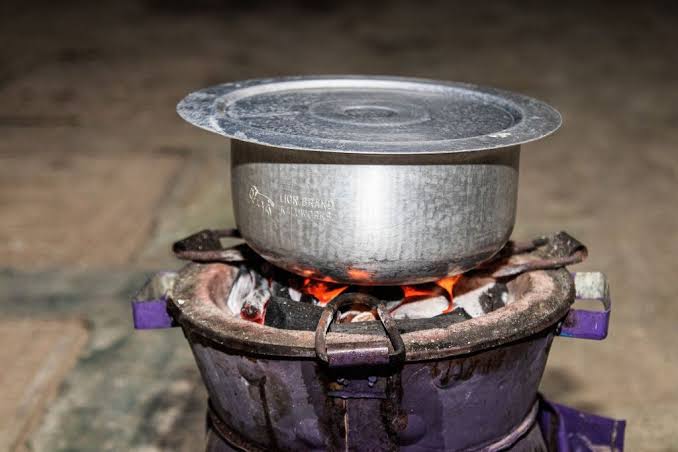
The rising prices of cooking gas have forced many households and businesses in the Federal Capital Territory (FCT) to adopt traditional fuels such as charcoal and firewood.
Reports indicate that cooking gas prices in the FCT have sharply increased in recent months, rising from about N1,200 per kg to N2,000 per kg.
Industry operators attribute the increase to supply shortages, higher depot costs, foreign exchange pressures, and rising transportation expenses.
Consumers and vendors of this essential commodity, who spoke to reporters, said the rising costs have compelled many households and businesses to seek cheaper cooking alternatives.
Mrs. Mayo Akinpelu, a food vendor in Gwarimpa, Abuja, said she stopped using cooking gas after repeated price hikes made it too expensive for her business.
According to Akinpelu, she switched to firewood and charcoal because they are cheaper and easier to purchase in small quantities.
“Refilling my gas cylinder became difficult because the price kept rising. I could no longer afford it and still make a reasonable profit. Right now, 12.5kg of LPG costs N25,000.
“Firewood and charcoal are not as convenient as gas, but they help me reduce costs and keep my business running,” she said.
She added that, although customers sometimes complain about delays, these alternative fuels have become her only practical option amid rising gas prices.
Another food vendor in Dutse, Bwari Area Council, Ms. Victory Samson, said the increase has significantly reduced her profit margin and affected her business.
“It has affected a lot; my profit margin has decreased. The government should help bring the price back to normal,” Samson said.
In Kubwa, a business owner, Mrs. Grace Oluwatimilehin, expressed shock at the latest increase after recently buying gas at a lower rate.
“I filled my cylinder at N1,600 per kg last time, but when I went back yesterday, the price had risen to N2,000 per kg.
“I now use electric hot plates for cooking and sometimes rely on charcoal and firewood instead of gas,” she said.
Mrs. Abike Ojo, a mother of one, said the continuous rise in gas prices is putting severe pressure on her household budget.
“The last time I bought gas, it was N1,500 per kg, but my most recent purchase cost N2,000.
“If prices keep rising, I may stop using gas entirely because it has become too expensive,” she said.
She appealed to the government to intervene, warning that the rising cost of gas could further increase household expenses.
Reacting, a gas vendor in Kubwa, Mr. Bamishile Bolanle, confirmed that gas now sells for N2,000 per kilogram.
“The increase has affected business because people’s purchasing power has dropped significantly.
“From what we observe, the major issue is product scarcity, although we do not know the exact cause,” Bolanle said.
Another gas vendor in Dei Dei, Mr. Alfred Orshio, said the price increase has led to a noticeable decline in customer patronage.
“Earlier this year, we sold gas for N1,200 per kg. It later rose to N1,400, then N1,800, and now N2,000.
“I cannot blame customers for buying less. Filling a 12kg cylinder now costs about N25,000,” Orshio said.
A charcoal distributor in Kubwa, Mrs. Amina Yakubu, said demand for charcoal has increased as more people switch from gas.
“Patronage has increased recently, and I believe it’s because of the rising cost of cooking gas.
“I buy a bag of charcoal for N6,500 and sell it for N8,000,” Yakubu said.
Another charcoal vendor, Mrs. Saratu Ibrahim, also reported increased demand, saying her stock now sells much faster than before.
“Business is moving very fast. What used to take more than a week to sell now takes just two days.
“Many people have also joined the charcoal business.
“I was the first seller on this street, but now there are more than five charcoal vendors here,” she said.
Mr. Taninu Ibrahim, a firewood seller, said demand has increased significantly as more households and food vendors abandon cooking gas for cheaper alternatives.
Ibrahim noted that the surge in demand has also pushed up firewood prices.
“More people are buying firewood because cooking gas has become too expensive for many families and small businesses.
“Before, customers bought six pieces of firewood for N1,000. Today, the same amount buys only four pieces,” he said.
He attributed the increase to rising demand and transportation costs, adding that patronage remains strong despite higher prices.
As cooking gas prices continue to rise, residents and business owners are increasingly adopting alternative cooking methods, raising concerns about affordability and the rising cost of living in the FCT.
Stakeholders urged government intervention to stabilize prices, while vendors warned that persistent scarcity and weak consumer purchasing power could further reduce gas consumption and business activities.
