


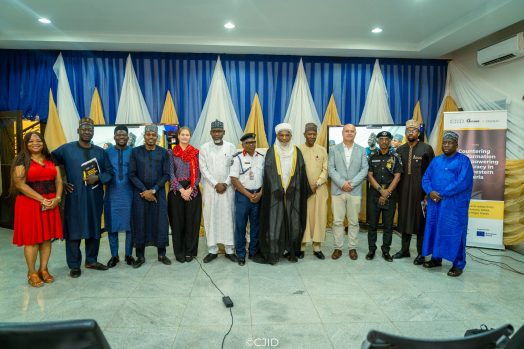
The European Union (EU) and the Centre for Journalism Innovation and Development (CJID) have launched an 18-month project aimed at combating disinformation and bolstering democratic resilience in five states across northwestern Nigeria. The initiative, titled Countering Disinformation and Empowering Democracy in Northwestern Nigeria, was officially inaugurated on Tuesday in Sokoto.
The project targets Sokoto, Zamfara, Katsina, Kebbi, and Niger states, regions identified as particularly vulnerable due to a combination of insecurity, poverty, low literacy levels, and the rapid dissemination of false information online.
During the launch, Xenia Stoll, Political Officer at the EU Delegation to Nigeria and ECOWAS, emphasized the seriousness of disinformation as a threat to stability. She stated, “Disinformation and information manipulation are not only communication issues. They are used as tactics for destabilizing societies and inciting violence and conflict.”
CJID Board Chairman and former Vice Chancellor of the Federal University Kashere, Prof. Umaru Pate, highlighted the fragile information environment in the region. He pointed to structural challenges such as population displacement, economic hardship, youth frustration, and porous borders that make the area highly susceptible to manipulation.
Prof. Pate noted that while radio remains influential, WhatsApp has become a primary platform for local conversations, often facilitating the rapid spread of false narratives. “Rumours, inflammatory content, fabricated security alerts, and hate-driven misinformation often spread faster than facts,” he said. “In fragile and polarized contexts, disinformation increasingly contributes to fear, mistrust, communal tensions, democratic erosion, and insecurity.”
Prof. Pate described the initiative as a shift from reactive responses to building long-term community resilience. “Its goal is not simply to respond to individual instances of misinformation but to help communities become more informed, less vulnerable to manipulation, and better equipped to respond peacefully during moments of tension,” he said.
Building on CJID’s extensive experience in information integrity, the project leverages platforms like DUBAWA, which has trained thousands of journalists, researchers, educators, and civic actors in fact-checking, digital investigations, and open-source intelligence across West Africa. The Kwame Karikari Fact-Checking and OSINT Fellowship will also support capacity development among journalists and fact-checkers in northern Nigeria.
CJID Executive Director Akintunde Babatunde outlined the project’s planned activities, including media literacy training, journalism capacity building, open-source intelligence (OSINT), AI-assisted verification, local language engagement, and community mobilization. Specific efforts will involve training teachers as media literacy educators, enhancing verification skills among journalists and broadcasters, establishing campus fact-checking networks, and expanding outreach via radio and WhatsApp campaigns.
The Sultan of Sokoto, Muhammadu Abubakar, expressed his support through his representative, Muhammad Kilgori, the Sa’in Daula Usmaniyya of the Sultanate Council. Kilgori emphasized the importance of ongoing collaboration beyond the project’s duration and reaffirmed the Council’s commitment to promoting information integrity and peaceful coexistence in the region.
The initiative involves journalists, civil society organizations, security agencies, community leaders, educators, and digital influencers working together to counter the spread of harmful and misleading narratives in northwestern Nigeria.
