


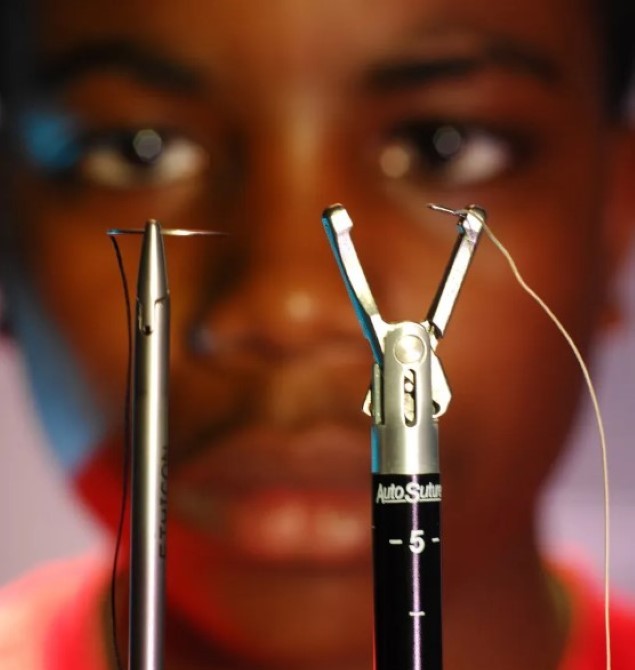
Tony Hansberry II was only 14 when he came up with a surgical technique that would draw attention far beyond his Florida school and internship program. During a summer placement at the University of Florida’s Center for Simulation Education and Safety Research in Jacksonville, he developed a new way to close the vaginal cuff after a hysterectomy, later called the “Hansberry Stitch”.
His idea came from rethinking how an Endo Stitch laparoscopic suturing device could be used. Instead of the traditional horizontal stitching pattern, Hansberry tested a vertical suturing method that he believed could make the procedure safer and more efficient.
Reports on the project said the method made suturing faster and easier, with one account stating it could be completed in about one-third of the usual time.
The technique was designed to improve the closure process after hysterectomy, a surgery in which the uterus is removed. Medical write-ups on the invention said the approach could help reduce surgical time and lower the risk of complications, especially for less experienced surgeons.
The project also earned him recognition from physicians and medical observers who saw it as an unusually advanced contribution from someone so young.
Hansberry’s early success was only the beginning of a broader path in medicine. He later advanced toward a career in the field and is now described as a U.S. Army captain, underscoring how a teenage innovation helped launch a remarkable professional journey.
