


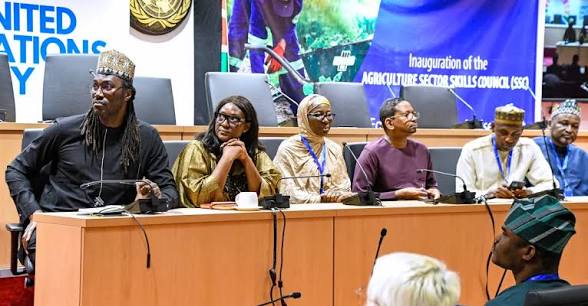
The World Agriculture Forum Nigeria (WAF) has inaugurated its Country Council to drive transformative dialogue and action on agriculture, food systems, and rural development for enhanced food security.
Speaking at the inauguration in Abuja, the Executive Director of the World Agriculture Forum, Dr MJ Khan, described the establishment of the Nigeria Country Council as timely and strategic.
Dr Khan, who was represented by Mr Lekan Ofem, Director of Strategy and Head of Country Councils and Stakeholder Engagement, said the event signals a renewed commitment to transforming agriculture into a powerful engine for economic growth, social inclusion, and environmental sustainability.
“The establishment of this council marks not just an inauguration, but a renewed commitment to turning agriculture into a driver of economic growth, social inclusion, and environmental sustainability,” he said.
Khan stated that the Nigerian Country Council was created to foster national collaboration, empower farmers, promote local innovations, and advance sustainable development and climate resilience.
He added that the council aims to boost agribusiness, trade and technology, serve as a national knowledge hub, and catalyse public-private partnerships.
“Sustainable progress requires strong collaboration between government and the private sector. This council will act as a bridge to unlock investments and drive impactful initiatives,” he said.
“Let us build a resilient, inclusive and prosperous agricultural sector that creates jobs, ensures food security and contributes meaningfully to national development.”
In his address, Dr Musa Umar, Director in the Office of the Permanent Secretary, Federal Ministry of Agriculture and Food Security, said the inauguration was timely.
He noted that agriculture remains central to food security, economic diversification, rural development, industrial growth, employment generation, and social stability.
“As a government, we are committed to building a resilient, productive, inclusive and viable agricultural system that can feed our people, create jobs, attract investment, and position Nigeria as a major player in regional and global food systems,” Umar said.
He added that the government is shifting focus from subsistence farming to agribusiness-driven productivity through value chain development, mechanisation, irrigation expansion, access to quality inputs, post-harvest management, storage, agro-processing, and market linkages.
“Let us move beyond conversations to coordinated action so that policy translates into productivity and productivity into prosperity,” he said.
Earlier, the Country Director of World Agriculture Forum Nigeria, Dr Alexander Isong, said the organisation aims to bridge the gap between production and value addition while improving agricultural output.
He emphasised that food security rests on four pillars: availability, access, utilisation, and stability.
Isong noted that reducing post-harvest losses by just 20 per cent could recover millions of tonnes of food and inject significant revenue back into the economy.
“Agriculture must move from fragmented production systems to coordinated, market-linked ecosystems,” he said.
Also speaking, Mrs Folashade Tinubu-Ojo, Iyaloja General of Nigeria, who was represented by Chief Mrs Adimchinaka Onwukwe, described food security as a national priority.
She stressed the need to empower women, who form a large part of the agricultural workforce, and to engage youths by making agriculture more innovative, technology-driven, and commercially attractive.
