


For ten days, the ancient city of Kaduna pulsed as Nigeria’s conscience. The question on every lip was clear: how do we move food security from glossy policy papers to the dinner plates of 250 million citizens?
Answers began to take shape at Nigeria Public Relations Week (NPRW) Croc-City 2026, held from April 16–25, where policymakers, farmers, communicators, and citizens forged what may become the most consequential agricultural blueprint in a decade — the Kaduna Food Security Declaration.
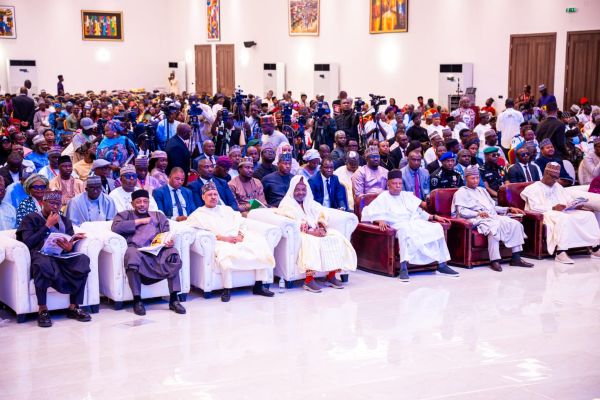
Convened by the Nigerian Institute of Public Relations in partnership with the Kaduna State Government, the National Conversation held from April 21–22 at the newly commissioned Brigadier General Abba Kyari Banquet Hall was far from a talk shop. With Vice President Kashim Shettima, Speaker Tajudeen Abbas, four cabinet ministers, and over 1,000 delegates from across the 36 states and the FCT, the gathering confronted a stark truth: “Where there is no food, there is no peace. Where there is no peace, there is no farming. Where there is no farming, there is no future.”
From policy paper to public plate
The theme captured the urgency: “Food Security: From Policy Paper to Public Plate – The Imperatives of Public Relations.” As the NIPR President noted, “We do not suffer from policy drought. We suffer from implementation famine and a trust deficit.”
The Declaration draws a clear line: communication is no longer an afterthought—it is a strategic infrastructure, as critical as fertiliser, feeder roads, and tractors.
The Kaduna Declaration: 44 points, one verdict
After days of rigorous debate on “Can Nigeria Feed Itself in the Next Decade?” delegates answered in the affirmative—but with caution—the verdict: conditional optimism. Nigeria has the land, water, and human ingenuity; what it lacks is coordinated will.
Insecurity: The gun before the hoe
“No agricultural policy can succeed where farmers cannot safely access their fields.” The Declaration calls for insecurity in farming corridors to be declared a national emergency, with specialised agro-ranger units deployed and the Kaduna Peace Model scaled to rural communities.
With 30–50 percent of harvests lost annually due to poor storage and bad roads, delegates described the situation as “economically wasteful, morally unacceptable, and strategically dangerous.” The proposed remedy is a National Post-Harvest Loss Reduction Programme aimed at halving waste within five years through cold chains, storage clusters, and improved rural roads.
To bridge the gap between promise and plate, participants proposed a Presidential Council on Food Security Implementation, empowered to track bottlenecks and publish an Annual State of Food Security Report.
Youth, technology, and perception
With the farming population ageing, agriculture must be repositioned as a tech-driven, profitable venture to attract young Nigerians.
Fake news is starving the nation
Mantra: Rumour is the New Locust
“Rumour triggers panic buying. Panic buying creates artificial scarcity. Scarcity drives inflation.” Delegates endorsed a National Food Information Ecosystem, including real-time price dashboards, community radio, and rapid-response units to counter misinformation.
Women feed Nigeria, but remain invisible
The Declaration challenges entrenched stereotypes, noting that while women produce and process most of Nigeria’s food, they remain underrepresented. It calls for gender-inclusive communication, land reforms, and messaging in local dialects.
Despite a livestock value chain exceeding $32 million, the sector remains underutilised. The Declaration advocates modern grazing reserves, ranching systems, improved data, and conflict-sensitive investments.
Talk to the farmer in his language
Mantra: One Message for All Is a Message for None
Delegates emphasised localised communication through community radio, hotlines, and traditional institutions, positioning traditional rulers as Community Food Security Anchors.
“No food strategy is complete without comprehensive crop and livestock insurance.” Expanded agricultural insurance is seen as critical to protecting farmers against climate shocks and conflict.
The verdict from the floor
In a live poll, delegates agreed that Nigeria can feed itself within a decade—but only if security, infrastructure, and political will translate from communiqués into concrete action.
The Kaduna call to action: Five non-negotiables
- Declare insecurity in farming zones a national emergency and deploy agro-rangers.
- Launch a National Post-Harvest Loss Reduction Programme immediately.
- Establish a Presidential Council on Food Security Implementation with annual public reports.
- Institutionalise the Kaduna Food Security Conversation as an annual pre-planting event.
- Convene a High-Level National Food Security Summit to produce a binding National Food Security Compact.
As Croc-City 2026 drew to a close, one message resonated across Government House:
“Communication must accompany implementation. It cannot replace it.”
Kaduna has spoken. The ball—and the plate—are now in the public’s hands.
Zubair Abdurrauf Idris is a public affairs analyst and Board Member, Nigeria Electricity Management Services Agency (NEMSA). He writes from Abuja.
