


The Federal Government has reiterated that it has no immediate plans to approach the International Monetary Fund (IMF) for loans, even as the country’s debt profile continues to expand and new borrowing arrangements emerge.
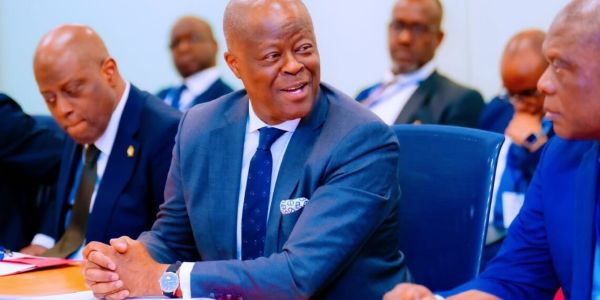
Minister of Finance and Coordinating Minister of the Economy, Wale Edun, disclosed this on Thursday during a press briefing on the sidelines of the IMF-World Bank Spring Meetings in Washington, D.C.
Edun said Nigeria is prioritising alternative financing strategies and structural reforms over IMF support, despite mounting fiscal pressures.
“Nigeria has no plans at the moment to approach the IMF or any other source,” he stated.
Rising debt amid fiscal strain
ALSO READ Tinubu signs N68.32trn 2026 budget, extends 2025 capital spending to June
His remarks come against the backdrop of Nigeria’s rising debt burden. Recent data from the Debt Management Office (DMO) shows that total public debt climbed by about N14 trillion to N159.27 trillion as of the fourth quarter of 2025.
External debt alone stood at N74.43 trillion, accounting for nearly 47 per cent of total public debt. In dollar terms, this rose to $51.86 billion in December 2025, up from $48.46 billion in September and $45.78 billion a year earlier.
The Federal Government holds the bulk of this exposure, with N66.27 trillion, while states and the FCT account for N8.16 trillion.
Fresh borrowing and recent loan inflows
Despite ruling out IMF financing, Nigeria has continued to access funding from other multilateral and commercial sources:
- The National Assembly recently approved a fresh $6 billion external borrowing plan to support budgetary and developmental needs.
- Nigeria has also secured multiple disbursements from the World Bank in recent months, including policy-based and sectoral support loans targeted at economic stabilisation, power sector reforms, and social protection.
- Additional financing has come through the African Development Bank (AfDB), particularly for infrastructure, agriculture, and climate-resilience programmes.
- The government has also relied on Eurobond issuances and domestic borrowing to plug fiscal gaps, although high global interest rates have raised debt servicing costs.
These inflows reflect a strategy to diversify funding sources while avoiding the policy conditionalities often associated with IMF programmes.
Debt sustainability concerns persist
Edun acknowledged that many African countries, including Nigeria, face increasing debt vulnerabilities, largely driven by the high cost of commercial borrowing.
He noted that elevated risk premiums imposed on African economies continue to inflate borrowing costs, diverting scarce revenues toward debt servicing at the expense of critical sectors such as health and education.
“The premium they pay for commercial debt is part of the reason for the distress… a significant share of revenue goes to debt service rather than development,” he explained.
According to him, nearly half of African countries are either already in, or at risk of, debt distress.
Push for reforms and cheaper financing
The minister stressed that Nigeria’s long-term strategy centres on structural reforms aimed at improving revenue generation, enhancing efficiency, and reducing dependence on expensive debt.
He added that Bola Ahmed Tinubu has been advocating for a reassessment of how global credit rating agencies evaluate African economies, particularly in relation to risk premiums.
Key policy directions highlighted include:
- Expanding private sector participation to drive growth
- Leveraging technology, including artificial intelligence, to improve public sector efficiency
- Diversifying revenue streams beyond oil
- Strengthening fiscal discipline and expenditure efficiency
Balancing independence and fiscal reality
While the government’s stance signals a desire to maintain policy independence and avoid IMF conditionalities, analysts note that Nigeria’s growing debt stock and rising servicing costs will require careful fiscal management.
With global financial conditions still tight and borrowing costs elevated, the challenge will be to sustain development financing without pushing the country closer to debt distress.
