


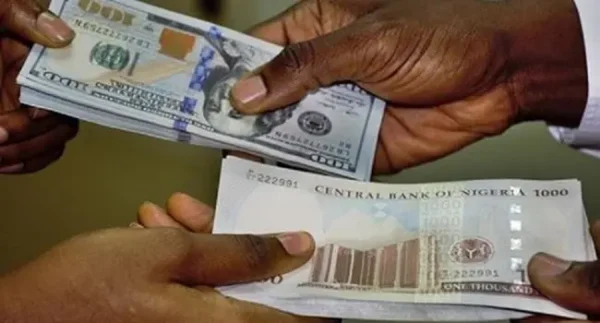
The naira strengthened in the parallel market on Wednesday after the Central Bank of Nigeria (CBN) reduced its benchmark interest rate, the Monetary Policy Rate (MPR), by 50 basis points.
Data from street foreign exchange traders showed the naira appreciated by N10, with the dollar quoted at N1,390 on Wednesday morning, compared to N1,400 on Tuesday — a 0.7 percent gain in the black market.
The rebound followed two days of losses in the parallel segment and five consecutive sessions of decline at the official window. The recent pressure had been linked to weaker weekly FX inflows, which tightened liquidity across the market.
ALSO READ Real reason Naira hasn’t appreciated to ₦1,000/$ — VP Shettima explained
At the official market, however, the currency extended its slide on Tuesday. The naira depreciated by N6.13 to close at N1,355.37 per dollar, down 0.5 percent from N1,349.24 recorded on Monday at the Nigerian Foreign Exchange Market (NFEM).
CBN Governor, Olayemi Cardoso, said members of the Monetary Policy Committee (MPC) approved a measured cut in the MPR to 26.5 percent. He explained that the decision was supported by nearly a year of moderating inflation, stronger external reserves and improving macroeconomic indicators, creating room for cautious policy easing.
Market analysts say the rate cut could bolster investor confidence if supported by sustained FX liquidity and stable reserves.
Lukman Otunuga, Senior Market Analyst at FXTM, noted that the decision may have a stabilising and potentially positive impact on the naira, which has appreciated about 6 percent year-to-date.
“Growing confidence in Nigeria’s economy amid lower rates, improved FX liquidity and rising reserves — which recently climbed to a 13-year high — should provide a solid foundation for the naira,” Otunuga said.
He added that despite the 50-basis-point cut, real interest rates remain elevated when adjusted for inflation, and Nigeria’s benchmark rate is still among the highest in Africa — a factor that could continue attracting foreign portfolio inflows.
Adebowale Funmi, Head of Research at Parthian Securities, said the impact on the fixed income market is expected to be modest, as investors had largely priced in the easing cycle.
She cautioned that developments in the global oil market remain a key risk. According to her, a sustained decline in oil prices could widen Nigeria’s fiscal deficit and increase government borrowing needs.
“This suggests that interest rates may still be maintained at levels attractive enough to support government funding requirements,” she said.
While the naira’s recovery in the parallel market signals short-term optimism, analysts warn that lasting stability will depend on consistent FX inflows, disciplined monetary management and performance in the external sector — particularly oil receipts, which remain a major source of foreign exchange earnings for Africa’s largest economy.
