


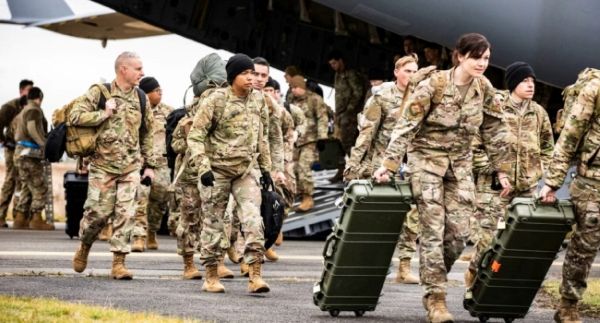
The Defence Headquarters (DHQ) has confirmed the arrival of about 100 United States military personnel and equipment in Nigeria, stating that the team landed at an airfield in Bauchi as part of a bilateral security cooperation arrangement.
Defence spokesperson, Samaila Uba, disclosed in a statement on Monday that the deployment followed a recent agreement between Nigeria and the United States on military support and collaboration.
According to him, the Federal Government had formally requested assistance covering training, technical support, and intelligence sharing for personnel of the Nigerian Armed Forces. He said the partnership is intended to provide access to specialised capabilities that would improve deterrence against terrorist threats and strengthen the protection of vulnerable communities nationwide.
Uba emphasised that the visiting personnel are technical specialists assigned strictly to advisory and training roles, not combat operations. He added that all activities would be conducted under the authority and operational control of the Nigerian government in close coordination with local military commands.
He noted that joint training engagements and intelligence-focused cooperation initiatives would commence shortly, aimed at improving the ability of Nigerian troops to identify and neutralise extremist groups seeking to destabilise the country. He reiterated that the military remains committed to degrading and defeating threats to national sovereignty and citizen safety while maintaining transparency about the cooperation framework.
The deployment comes amid heightened diplomatic and security tensions following criticism by Donald Trump, who accused Nigeria of failing to protect Christians from militant attacks and designated the country a “Country of Particular Concern.” Nigerian authorities rejected the claim, arguing that insecurity affects citizens of multiple faiths.
Trump had also ordered airstrikes in northern Nigeria on Christmas Day, which he said targeted Islamic State-linked fighters. Both sides later described the action as collaborative. After consultations in Abuja, the head of US Africa Command, Dagvin Anderson, confirmed that a small contingent of US officers was operating in Nigeria to support intelligence efforts.
Despite official assurances, critics have questioned the arrangement, warning that it could undermine territorial integrity. DHQ, however, maintained that the partnership centres on capacity building, professional military education, intelligence exchange, logistics support, and strategic dialogue conducted within existing bilateral frameworks and with full respect for sovereignty.
Nigeria continues to battle multiple armed groups, including Boko Haram and its splinter faction, Islamic State West Africa Province, alongside criminal networks involved in kidnapping and illegal mining. Data from the United Nations indicates that the protracted violence has resulted in thousands of deaths in recent years.
