


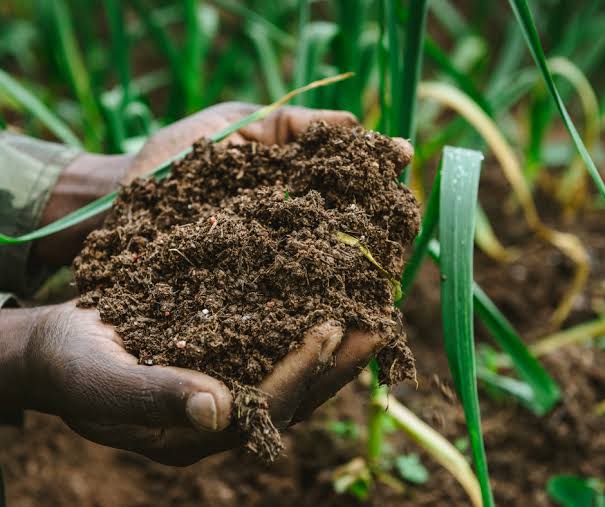
The Minister of State for Agriculture and Food Security, Sen. Aliyu Abdullahi, says soil remains the backbone of Nigeria’s agricultural sector.
The minister stated this on Thursday in Abuja during the 2025 World Soil Day celebration, themed “Healthy Soils for Healthy Cities.”
Abdullahi noted that soil supplies 95 per cent of the country’s food and provides 15 of the 18 essential elements required for plant growth.
“Soil supports crop growth and livestock production, purifies water, regulates climate, sequesters carbon, mitigates greenhouse gas emissions and provides habitat for beneficial microorganisms, thereby supporting ecosystem services and biodiversity.
“However, our soils are currently facing unprecedented threats from degradation, erosion and pollution, which adversely affect crop yields, food quality and ultimately, food security,” he said.
The minister lamented that 33 per cent of Nigeria’s soils are already degraded, adding that it could take up to 1,000 years to regenerate just 2–3 cm of soil.
He said the World Soil Day event provided an opportunity to raise awareness and advocate for sustainable soil management practices, including crop rotation, agroforestry, conservation agriculture, reduced tillage, organic amendments and integrated nutrient management.
“Observing World Soil Day enables us to educate the public, especially our farmers, about soil conservation and its benefits.
“It also allows us to promote sustainable agricultural practices, support the ministry’s initiatives on soil health, encourage research and advocate for policies that safeguard our soils,” he added.
Abdullahi restated the ministry’s commitment to restoring and preserving soil health to ensure sustainable agriculture, food security and improved livelihoods.
He recalled that the ministry, in October, launched the Nigerian Farmers’ Soil Health Scheme (NFSHS) with the participation of nearly 600 farmers, dignitaries and partners. He described the initiative as a major step toward President Bola Tinubu’s Renewed Hope agenda for food security and sovereignty.
“I urge everyone to work together to safeguard our soils for future generations and prioritize soil health to ensure food sovereignty and climate resilience for all Nigerians,” he said.
In a goodwill message, the Vice President of the Nigeria Institute of Soil Science (NISS), Prof. Olumuyiwa Jayeoba, said rapid urbanization across Nigeria continued to place pressure on soil resources through erosion, poor waste management and other environmental challenges.
He said the event emphasized the essential truth that public spaces, food security, clean water systems and public health are inseparable from soil health.
Jayeoba reaffirmed NISS’s commitment to promoting responsible soil management in both rural and urban areas.
Also speaking, Dr. Alain Traore, Programme Director of the Soil Values Programme, underscored the importance of healthy soil for healthy cities.
“Together, we are reinforcing the message that the health of our soil is inseparable from the health of our people.
“As we celebrate today, we must also confront the challenges before us, such as land degradation, nutrient loss, erosion, deforestation and others,” he said.
Traore noted that these challenges negatively affect farmers by reducing productivity. He urged farmers to adopt improved practices and encouraged young people to explore soil science and agribusiness as emerging opportunities.
