


Last Thursday, in the historic university town of Oxford—some 48 miles northwest of London—the Oxford Centre for Islamic Studies (OCIS) marked its 40th anniversary in grand style, with His Majesty King Charles III presiding over the celebration.
By Danladi Bako
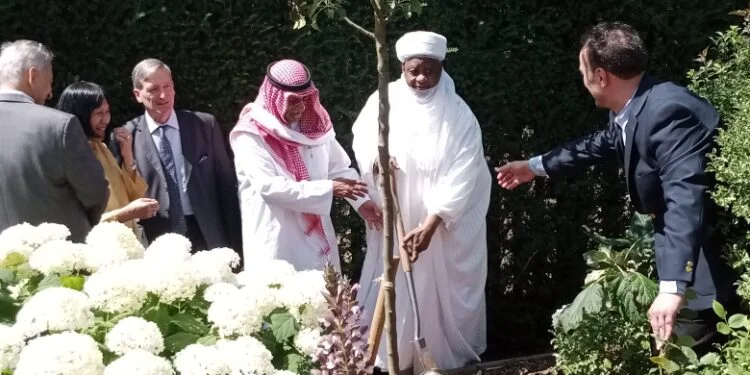
The event featured a keynote address by the monarch and culminated in the Centre’s Annual General Meeting of its Board of Trustees, followed by a symbolic tree-planting ceremony in the Centre’s gardens.
Among the global dignitaries in attendance was His Eminence, the Sultan of Sokoto, Muhammad Sa’ad Abubakar III, who lauded the Centre and its leadership for four decades of remarkable achievements. He acknowledged the Centre’s intellectual contributions and its role in fostering dialogue, scholarship, and understanding across religious and cultural divides.
Sultan Abubakar praised the foresight and vision of the Centre’s founders, expressing hope that the rest of the world—particularly developing nations—would draw inspiration from their legacy.
“I am deeply impressed by the intellectual rigor, community service, and global relevance the Centre has come to represent over the years,” he said.
Since its humble beginnings in a wooden hut on St Cross Road in 1986, the Centre has grown into a world-renowned institution, now located on an expansive campus on Marston Road in the heart of Oxford. It has become a beacon of learning, known for its rich academic programmes, diverse fellowships, and research initiatives.
The Centre has welcomed visits and lectures by renowned global figures, including former South African President Nelson Mandela and former UN Secretary-General Kofi Annan. Its scholarly activities span lectures, seminars, fellowships, and publications, with a strong focus on the social and intellectual history of the Muslim world, socio-economic development, and interfaith understanding.
The Centre’s Board of Trustees reflects its global and inclusive character. Chaired by Saudi Prince Turki Al-Faisal, the board includes such eminent personalities as Sultan Nazrin Shah of Malaysia (Vice Chairman), Sheikh Mohammed Al Sabah, former Prime Minister of Kuwait, and British figures like Rt Hon Dominic Grieve KC (former Attorney General of England and Wales), Sir Martin Donnelly KCB (former Permanent Secretary at the Department for International Trade), and Dr Catherine Swales of the University of Oxford.
Notably, Sultan Abubakar is the only African serving on the Centre’s leadership, further amplifying its diversity and global outlook.
Director Dr Farhan Nizami, in highlighting some of the Centre’s recent milestones, pointed to its growing portfolio of publications, including the Journal of Islamic Studies and the Makers of Muslim Civilisation series. He also announced the launch of the new exhibition, Lines of Faith: Astronomy and the Art of the Astrolabe in the Islamic World, which underscores the Islamic world’s contributions to science and art.
The past year has seen two landmark lectures hosted by the Centre—Lord Neuberger’s “Threats to the Rule of Law” and Professor Philippe Sands’ “On Genocide: Then and Now”—further cementing its place as a centre for critical global discourse.
Through a wide range of fellowships, including the King Charles Fellowship, Nelson Mandela Fellowship, Globe Fellowship, and Sultan Bin Abdulaziz Fellowship, the Centre continues to promote interdisciplinary study and global exchange.
Today, OCIS stands as a symbol of intellectual excellence, interfaith dialogue, and global cooperation. With the continued commitment of its Grand Patron, King Charles III, and the enduring leadership of global figures like Sultan Sa’ad Abubakar, the Centre looks poised to surpass even the successes of its first 40 years in the decades to come.
Nasir Danladi Bako PhD, OON, is Kogunan Sokoto
