


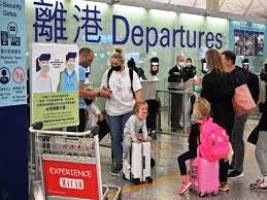
Those leaving say the city is becoming no different from mainland China.
Expats have been leaving Hong Kong en masse in 2022 because they are frustrated by the city’s response to the Omicron wave, expats have told Insider.
On top of facing daily disruptions and travel restrictions, they also feared a loss of freedoms.
During the pandemic, Hong Kong relied heavily on mainland China for policy responses and support.
After seven years of living in Hong Kong, New York native Marty Forth finally had it.
The academic arrived in the bustling city at the southern tip of China in 2015 and fell in love with its uniqueness. “It’s a city with a very strong Chinese sense of place and history, yet still a very modern, progressive, clean, and safe city that’s a hub for finance, travel, and innovation,” he said.
Forth soaked up every minute of his first four years in Hong Kong. Even when a bout of turbulent mass protests in 2019 almost brought the city to its knees and sparked months of widespread chaos, Forth stayed on.
Then came the COVID-19 pandemic that ripped through Hong Kong in multiple waves. Over the last two years, the city has constantly oscillated between last-minute openings and closures of public venues, though caseloads stayed relatively few and far between.
And while other countries relaxed their Covid regulations to move toward co-existing with the virus, Hong Kong instead intensified its policies as the Omicron variant blew up in the city this year. Its rapid-fire introduction of restrictions prompted residents and experts to call the approach downright illogical.
“The government switched and changed its policy so many times and the decisions are made based on fear, not on evidence. Freedoms have been curtailed as a result,” Forth told Insider.
So on March 8, Forth boarded a one-way flight to New York with his partner and their son. He’s one of the hundreds of thousands of expatriates who have deserted the Chinese territory this year.
Once a paradise for foreigners looking to live and work in the heart of Asia, Hong Kong is now bleeding talent at a historic pace. In the first half of 2022, the city’s total population fell by 110,000 – almost double the population loss from the entirety of last year.
Expats leaving Hong Kong told Insider that the government’s haphazard response to Omicron was the final straw for them. They also said it made them realize how Hong Kong, a city that they once loved, was becoming just like any other urban hub in mainland China, which is why they bade it goodbye.
“You feel a little bit of guilt leaving your friends you’ve made over seven years behind,” Forth said.
“But the Hong Kong we’re leaving behind isn’t the one we moved to anymore.”
Daily disruptions and travel restrictions
Hong Kong’s pandemic response has been guided by Beijing’s COVID-zero strategy, with the aim of achieving “zero infections” in the city.
In mainland China, Beijing’s tactic was to eliminate any trace of the virus through extreme restrictions. Local authorities would introduce sudden lockdowns on buildings, neighborhoods, or even entire cities to combat unexpected outbreaks.
These restrictions quickly turned into administrative and healthcare nightmares for hubs like Shanghai and Xi’an, where residents had to stay put in their homes for weeks while authorities scrambled to find ways to provide them with food and medicine, while also isolating the infected.
Meanwhile, Hong Kong residents were largely spared such harsh lockdowns in the first two years of the pandemic. With strict travel restrictions and widespread use of masks, the city enjoyed a relatively low number of COVID-19 infections for two years by acting quickly to suppress infections and snuffing out new clusters.
Then came Omicron, and cases in Hong Kong surged. More than 75,000 new infections were logged in a single day in February — nearly twice as many as New York City’s worst-ever day of recorded Covid infections.
And so, Omicron and its deluge of infections sent Hong Kong’s restriction cycle into overdrive.
Health workers wearing personal protective equipment (PPE) treat patients in a holding area outside the accident and emergency department of Princess Margaret hospital in Hong Kong on March 11, 2022 as the city is facing its worst-ever Covid-19 coronavirus outbreak and has since seen overflowing hospitals and morgues, shortages of medics and ambulances and a frantic expansion of the city’s spartan quarantine camp system.
Overwhelmed hospitals in Hong Kong had to treat patients on the street in March.
‘There’s a subtext here where it’s more about control.’
The restrictions grew more and more haphazard. For instance, one couldn’t gather in groups of more than two people — later changed to four — but could take group photos as long as everyone in them was masked. Breaking this rule could land an offender up to six months in prison. The authorities also instructed people to limit private gatherings to two households but said they wouldn’t check on anyone.
Restaurants had to abide by a 6 p.m. dining curfew, later extended to 10 p.m. and then midnight. Only those who received at least one dose of recognized COVID-19 vaccines could dine in, even though authorities had already been giving out booster shots at the time. The rule was different for bars and clubs, where patrons had to take antigen rapid tests before entering them.
Hong Kong clamped down on travel, too. Returning residents would have to pay for hotel rooms to quarantine themselves for at least a week, or at times, up to three weeks, depending on the government’s policies at the time. Flight routes into Hong Kong could be canceled at any time if a plane was found to have carried Covid-positive passengers. For Hong Kong-based expatriates thinking of visiting their family and friends elsewhere, such regulations meant having to prepare for the possibility of not returning to the city as planned.
There were also other one-off decisions by Hong Kong’s government made that alarmed expatriates.
In an infamous move in January, Hong Kong ordered pet shops and owners to surrender their hamsters over fears that they might carry the coronavirus. This led to the culling of more than 2,000 hamsters.
For venture capital investor Belinda Pham, 26, the hamster culling was a reminder of the myriad stories she’d heard of mainland Chinese authorities killing Covid patients’ pets — a grim hallmark of Beijing’s bulldozer pandemic strategy.
“This is maddening, but it’s unfortunately one of the many absurdities we saw in China,” she told Insider. Originally from Paris, Pham left Hong Kong in the spring to further her career in Vietnam. She said she felt lucky to be able to leave the city and find another job elsewhere.
The situation worsened in February when Hong Kong authorities stoked controversy by deciding to isolate Covid-infected persons — including children — from their family members.
A child recovers from COVID-19 in a makeshift hospital ward in Hong Kong.
A child recovers from COVID-19 in a makeshift hospital ward.
After separating around 2,000 children from their parents over six weeks, the city’s Hospital Authority said in late March that it had scrapped the policy, per the Guardian.
James, a 37-year-old British marketing professional, told Insider that his circle of expatriate friends called the forced separation of children from their parents a “gulag move.”
“That caused expats to spiral into a wave of panic and I started to see so many people leaving. ” James said. He asked that Insider not use his full name to ensure his job security.
Even though Hong Kong’s chief executive Carrie Lam announced in March that the city would lift some travel and domestic restrictions, her government also made it clear that the city would still stick closely to Beijing’s “COVID-zero” plan.
“Quarantine will remain because that’s still a very important tool… today we may have Omicron, who knows what’s the next variant,” Bernard Chan, who heads Lam’s de facto cabinet, said in March of the relaxations, per the Financial Times.
Pham said she felt exhausted from listening to Hong Kong’s government defend its position at a time when so many other countries chose to start living with the virus. “Now there’s a political implication in everything. You can feel it day to day, it’s all over the news,” she said.
“It feels like we’re all in a boat without a skipper, and China is driving us,” she added.
James concurred. “There’s a subtext here where many people don’t think it’s just about the virus, but more about control,” he said.
“Hong Kong is not for expats anymore,” he added. James relocated back to his hometown in the UK in early June.
The pandemic gave Beijing a chance to exert more control over Hong Kong, expats say
Beyond the Hong Kong government’s Omicron response, expatriates said the pandemic also opened up a chance for Beijing to exert its authority over the territory.
Once a British colony, the UK ceded Hong Kong to Chinese control in 1997. The territory currently enjoys autonomy from Beijing but is expected to fully return to mainland Chinese rule in 2047.
English teacher Matthew Cox had always felt that Hong Kong was special. He arrived in the city in 2017 and was immediately taken by how the city was so cosmopolitan yet so traditionally Asian at heart.
This allure carried him through his toughest days in the city.
In 2019, a series of violent pro-democracy protests rocked the city. Hong Kong residents went onto the streets every weekend, bringing public transport to a standstill and forcing many commercial venues to close. They fought for pro-democracy ideals and urged Beijing to recognize Hong Kong’s autonomy — at least until the territory fully returns to Chinese rule.
During the 2019 protests, Cox’s only day off was on Sunday, and he went for weeks without being able to meet friends or unwind outside. But the turmoil didn’t faze Cox. In fact, the protests were core to how he described Hong Kong — “a city with Chinese culture but with the freedoms of a European nation.”
However, as the COVID-19 pandemic dragged on, he began to worry. In May 2020, as Hong Kong was combating the initial waves of the coronavirus, Beijing unilaterally passed the highly-controversial National Security Law to crush dissent in the territory. The legislation came into force on June 30, 2020, giving Hong Kong authorities the power to round up individuals they suspected of instigating secession from China or collusion with foreign forces.
Independent media outlets were forced to close, journalists became political prisoners, and China’s infamous online censorship began creeping into Hong Kong. Local news companies also announced “partnerships” with Chinese state media.
A diptych of protestors in Causeway Bay and empty streets in Causeway Bay
Pro-democracy protestors thronged the streets of Causeway Bay in 2019. The same streets were completely empty in February as COVID-19 swept through the city.
The timing of the law was key for Beijing, which “likely judged that the spread of COVID-19 would limit the risk of large-scale protests in Hong Kong in response to the new legislation,” according to an analysis by public policy think-tank Brookings Institution in July 2020.
Cox assumed that Hong Kongers would fight back. “A lot of people felt that once Covid was over, they would really stick to this law and not push it aside. But people have forgotten it now, and once Covid is finished, Hong Kong won’t return to how it used to be,” he said.
As a foreigner in Hong Kong, Cox admits that the new law didn’t have much of an impact on him personally. “But we see how it’s affecting the locals, and how they don’t have a voice anymore,” he said.
“A lot of people see that it has become a Chinese city, already more and more freedoms are being taken,” he said.
Hong Kong firms are trying to attract and retain talent, but some expats have already lost faith
Companies in Hong Kong have pledged more perks to lure and retain talent in an attempt to stem the expatriate exodus. Some firms are resorting to bumping salaries for new hires far past the usual rate, said John Mullally, regional director for human resource firm Robert Wallers.
“The general usual kind of increase one gets when moving around is about 15%, now it’s 25%, so it’s quite the bomb,” Mullally said. “You do obviously have salaries that have 35% or 40% increases as well. Realistically, it isn’t that sustainable, but that’s what companies have to do in order to populate their desks.”
Mullally said maintaining Hong Kong’s status as a financial hub while restricting travel will be a “difficult circle to square,” but that the city’s reputation is far from irretrievable.
“You underestimate Hong Kong at your peril. You should never underestimate its ability to adapt and change the world around it, and figure out a way to get things done,” he said.
Some industries are already feeling the talent drain. A fifth of Hong Kong’s international schools have struggled to hire enough teachers for the new academic year, and expat educators are reluctant to move to the island even with top-end salaries offered, the Financial Times reported.
Forth is not convinced that things will improve. Even though the Hong Kong government has pledged to ease restrictions, he said the city’s constant flip-flopping over policies has eroded his trust in its ability to govern effectively. For now, Forth is content with staying in New York and sees no possibility of him moving back to Hong Kong.
When asked by reporters in April about the Hong Kong government’s approach to controlling the spread of COVID-19, Lam said the government would not relent on the constant tweaking of policies so as to curb the spread.
“The right decisions have to be made trying to strike a balance between the public health considerations, the socio-economic development needs and the people’s tolerance and acceptance level,” said Lam, who stepped down on July 1 and passed leadership to her successor John Lee.
Lee, on the other hand, has promised to focus on reopening Hong Kong to travelers, and in early August cut hotel quarantine for incoming travelers from seven days to three, though arriving passengers still have to stay home for another four days after. He also axed the controversial travel ban on flights carrying passengers infected by COVID-19.
But his history as both a driving force behind the National Security Law and the security chief responsible for the crackdown on protests has eradicated hopes that the city’s freedoms will return under him.
In his appointment speech on July 1, Lee promised to restore Hong Kong’s status as a global financial hub but made no mention of how its COVID policies have dented its reputation.
More than a month after Lam stepped down, Beijing’s policies under her remained mostly intact.
As of August, gatherings of more than four people are still prohibited, including in bars and clubs. Daily new COVID-19 cases continue to hover at around 4,000 — a far cry from the government’s zero-case aspirations.
Before handing the reins to Lee, Lam said in June that the government would not give in “a single inch” to businesses’ requests to ease restrictions, per the South China Morning Post.
To Forth, Lam’s announcement means that the Hong Kong government would continue to be fickle-minded about its Covid regulations. “They keep changing the policies, you never know when they’re going to clamp down again,” he said.
“How can they come back and recover their reputation from this? How can I come back to Hong Kong with this?” he said.
With reports by Insider
