


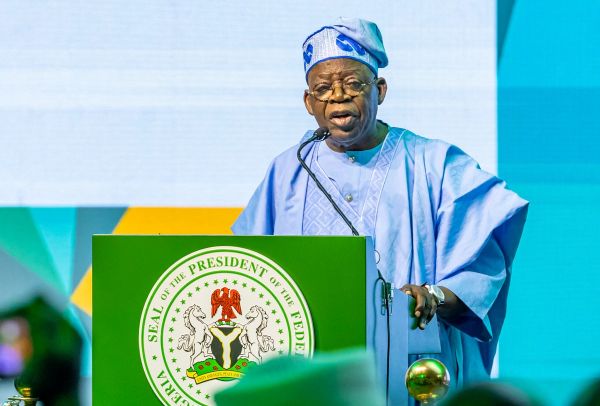
President Bola Tinubu has directed the Federal Ministry of Youth Development to turn the outcomes of the 2026 National Youth Conference into concrete government action, with measurable results and clear accountability.
Tinubu gave the directive on Monday at the conference’s closing ceremony at the State House Conference Centre in Abuja. Speaker of the House of Representatives Tajudeen Abbas represented him.
The ministry announced this in a statement signed on Monday by Nwachukwu Christian, Assistant Director, on behalf of the Director of Information and Public Relations.
Tinubu directed Youth Development Minister Ayodele Olawande to work with relevant ministries, state governments, private-sector organisations and development partners to develop a nationwide implementation framework for the conference’s recommendations.
He said the framework must set out clear priorities, assigned responsibilities, realistic timelines and measurable indicators to support effective implementation and accountability across government institutions.
Tinubu also said young Nigerians must play an active role in implementing and monitoring the decisions. Their involvement, he stressed, should go beyond consultation to meaningful participation in government decision-making.
“The real test of this Conference begins after today. I do not want the recommendations of this Conference to become another report gathering dust on government shelves,” he said.
He added that young Nigerians should have meaningful roles in implementing decisions that affect their future, so their voices can influence government policies and programmes.
Acknowledging the challenges facing young Nigerians, Tinubu cited unemployment, rising living costs, limited educational opportunities, inadequate access to finance and insecurity as concerns requiring sustained attention and practical interventions.
He said his administration understood these concerns and that its investments in education, skills development, innovation and entrepreneurship were intended to expand opportunities for young people.
Initiatives such as the Nigerian Education Loan Fund, the Three Million Technical Talent programme, YouthCred and the Nigerian Youth Academy were among the interventions aimed at empowering young people, he said.
Tinubu stressed, however, that skills training must lead to employment, innovation must attract investment, and young entrepreneurs must have better access to financing to establish and grow sustainable businesses.
He commended the ministry’s conference planning committee and participating young Nigerians, saying they had shown their capacity to contribute meaningful ideas and practical solutions to national development.
Earlier, Olawande said the conference had produced an 18-point action agenda covering six priority areas. It followed nationwide virtual consultations and in-person discussions involving young Nigerians.
He said the conference provided a platform to strengthen youth participation in national decision-making and ensure young people’s concerns informed government policies, programmes and development priorities.
“For the first time in the history of this country, the youth can feel the government, see the government, and touch the government,” he said.
Olawande said the recommendations would be pursued through relevant executive, legislative and judicial channels, while the ministry would engage stakeholders to secure institutional support.
He thanked Tinubu for providing the platform, describing the conference as an opportunity for young Nigerians to move beyond expressing concerns and contribute directly to solutions.
Delivering the keynote address, Finance Minister and Coordinating Minister of the Economy Taiwo Oyedele urged young Nigerians to help shape the country’s economic future through constructive engagement and innovation.
Oyedele warned that negative perceptions and distorted narratives about Nigeria could discourage investment, weaken economic confidence and undermine employment, entrepreneurship and sustainable development.
“A factory that is not built means jobs that are not created,” he said, urging participants to embrace constructive engagement, innovation and practical solutions to national challenges.
He said economic progress must translate into tangible benefits through increased investment, production, job creation and shared prosperity, improving Nigerians’ livelihoods.
The statement said the conference, convened by the Tinubu administration, brought together young Nigerians from across the country and the diaspora to discuss national issues and make recommendations.
It said the conference focused on youth participation in governance, economic development and nation-building, with its outcomes expected to guide policies and programmes affecting young Nigerians.
“With Tinubu’s directive, attention is now focused on developing an implementation framework to translate the recommendations into concrete government actions, with youths expected to participate in the process,” the statement said.
