


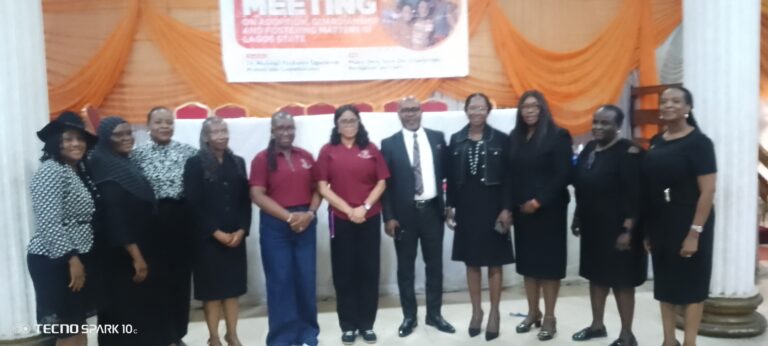
The Lagos State Government says automating its child adoption process will strengthen accountability, improve service delivery and safeguard children’s best interests.
The Commissioner for Youth and Social Development, Mr Mobolaji Ogunlende, disclosed this at the Stakeholders’ Meeting on Adoption, Fostering and Guardianship Matters, held on Tuesday in Lagos.
The meeting’s theme was “Automation of the Child Adoption Process in Lagos State.”
Ogunlende said the initiative would modernise adoption administration through proper documentation, application tracking, accessible records and effective case monitoring.
“The automation of the child adoption process in Lagos State is more than a technological intervention. It represents an important shift in how we administer, regulate and deliver adoption services,” he said.
He said the system would strengthen institutional accountability, identify administrative bottlenecks and ensure responsibilities were properly discharged.
“Digitalisation must never become a substitute for professional judgement, human compassion or the legal safeguards that govern child adoption,” he said.
Ogunlende stressed the need to protect sensitive adoption records, children’s identities and personal information from unauthorised access and misuse.
He urged stakeholders to help develop a secure, accessible and sustainable system that would keep children’s best interests paramount.
The ministry’s Permanent Secretary, Mrs Toyin Oke-Osanyintolu, said the meeting aimed to advance discussions on automating the state’s child adoption process.
She said the initiative would modernise adoption services, making them more efficient, accessible, transparent and accountable. It would also address administrative delays and improve record management.
“Through automation, we envisage a system that will provide a more structured approach to the management of adoption applications, documentation, assessments, approvals and other relevant stages of the process,” Oke-Osanyintolu said.
She said the system would enable the ministry to maintain accurate records, monitor applications and ensure cases were handled promptly and in a coordinated manner.
“Technology must support our processes without compromising the safety, dignity and best interests of the child,” she said.
She urged stakeholders to contribute actively to the proposed framework, stressing the need to protect children’s identities, maintain the confidentiality of records and comply with existing laws.
Dr Modupeola Sahid-Adebambo, Director of the Adoption Services Department, said automating the process would improve efficiency, transparency and accountability.
“With the introduction of automation, many of the processes can now be done online, which will make it a lot easier for applicants,” she said.
She said each applicant would receive a unique identification number to track applications, identify previous adoption records and prevent duplication.
“Applicants are now restricted to one child per approval,” Sahid-Adebambo said, explaining that the system would prevent them from using the same approval to identify multiple children from different orphanages.
She said orphanages would be required to notify the ministry digitally when an applicant identified a child. This would prevent multiple families from being matched with the same child.
Sahid-Adebambo said automation would complement existing child-protection safeguards, including an application designed to capture children’s data and monitor formal care homes.
Applicants considered unprepared for adoption could be referred for further counselling or therapy, with input from orphanages and family courts, she added.
She urged stakeholders to provide feedback to address implementation challenges, stressing that successful automation required collective participation and continuous improvement.
In a goodwill message, Lagos State Chief Judge Justice Kazeem Alogba described the initiative as a welcome development.
She said it would advance children’s best interests by supporting timely adoptions and providing accurate records of adoption cases.
“The automation will help us not only to serve the best interests of children on time, but also to have records of what has happened and where to go from there,” she said.
Justice Adebayo Oyebanji, Head of the Family Court, said in a goodwill message that the system would improve record-keeping and enable the judiciary to track children in care institutions and identify those awaiting adoption.
Represented by Mrs Adejumoke Olagbegi, Chief Magistrate (Administration) of the Lagos State Judiciary, Oyebanji stressed the need for stronger collaboration among the judiciary, police, social workers and the Ministry of Youth and Social Development to protect children.
She said the initiative would also improve access to adoption records and service delivery through technology.
Mr Bamikole Ajayi, Business Development Lead at Identiko Integrated Solutions Ltd., said the initiative would support the ministry’s adoption process.
Identiko Integrated Solutions Ltd. designed the child adoption automation application.
Ajayi said the system would capture the entire adoption process, including the child’s release, court decisions and relevant documentation.
He explained that although a child’s release could be initiated through the system, the family court process had yet to be integrated. Reports and outcomes of court proceedings would be entered into the system for proper documentation, he said.
“This will enable us to see the total life cycle or process of any particular child,” Ajayi said.
He said the system would provide details about each child, including their age, orphanage and prospective adoptive family.
The application would make adoption records and relevant documents accessible in one system, he added.
The event featured interactive sessions where stakeholders discussed suggestions, recommendations, challenges facing the adoption process and possible solutions.
