


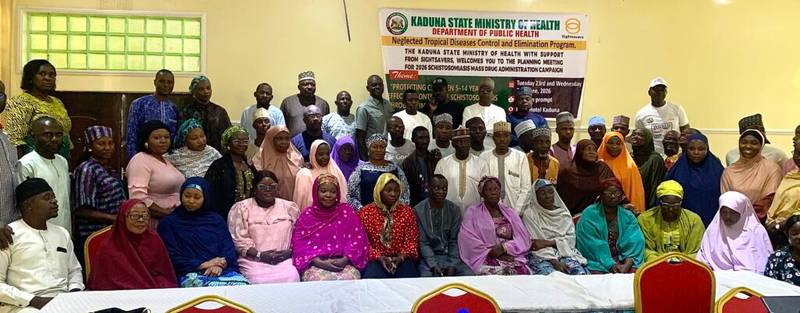
The Kaduna State Ministry of Health has urged stakeholders involved in the administration of Praziquantel, a deworming medicine used to treat schistosomiasis (also known as bilharzia), to ensure its effective and appropriate use.
The Logistics Officer of the Kaduna State Neglected Tropical Diseases (NTDs) Control and Elimination Programme, Abdulkarim Dauda, made the call during a two-day stakeholders’ planning meeting on schistosomiasis.
Dauda said the medicines were donated and would be provided free of charge to affected communities.
“It is therefore important that every stakeholder involved in this process ensures that the medicines are used strictly for the purpose for which they were donated and that they reach the intended beneficiaries,” he said.
He explained that the medicines were supplied through the support of the World Health Organization (WHO) to aid the prevention, control, and eventual elimination of the disease, particularly among children aged five to fourteen years.
He added that the drugs move through a distribution chain from the national level to the state, then to local governments, health facilities, and finally to communities.
“We are fully prepared. The medicine is currently available at the Kaduna State Central Medical Store. Starting next week, the medicines will be distributed to local government stores,” he said.
Dauda further stated that after the training of health workers, the medicines would be supplied to health facilities and later issued to Community Drug Distributors (CDDs).
He added that the CDDs would go from house to house to administer treatment to eligible children in targeted communities, stressing the need for strong community participation and ownership for the success of the programme and the elimination of schistosomiasis.
Suleiman Ibrahim, Deputy Director of Community Orientation and Mobilisation at the National Orientation Agency (NOA), described the programme as very important for addressing health challenges in riverine communities.
He explained that the NOA has a critical role to play in supporting the intervention through community mobilisation.
Ibrahim added that the NOA’s extensive presence across all local government areas positions it strategically to support awareness creation and community mobilisation.
He said their responsibility is to educate people about the programme, explain the importance of taking the medication, and create demand for the intervention.
“When communities are properly informed, they are more likely to participate and take advantage of the medicines provided during the campaign,” he said.
Bossan Bitruce, Health Secretary for Chikun Local Government, who participated in the planning meeting, emphasised the importance of the programme.
He said the local governments had been given their target populations.
