


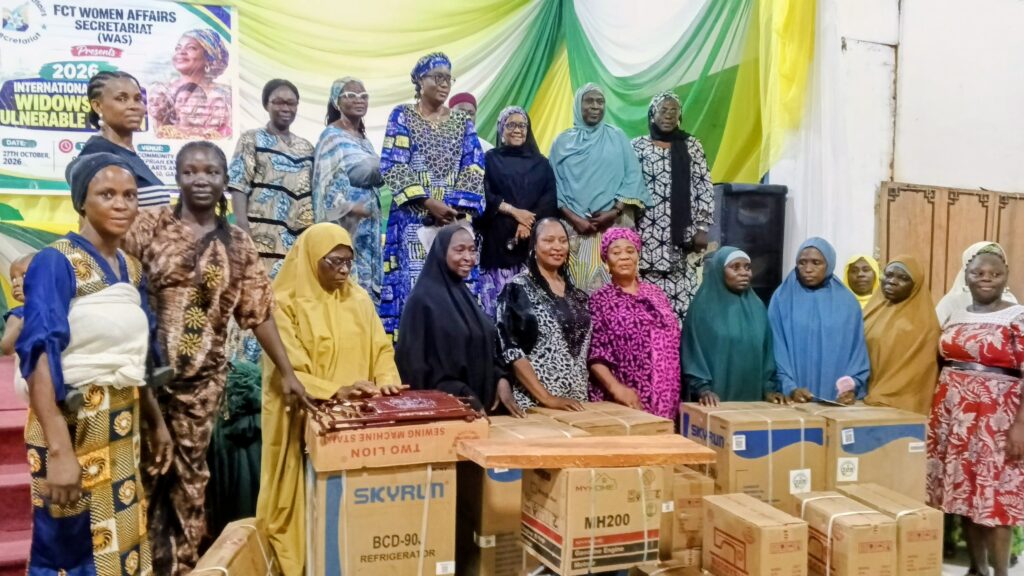
The Federal Capital Territory (FCT) Women Affairs Secretariat has distributed trade equipment and cash grants to widows and vulnerable women across the territory to promote economic self-reliance and alleviate poverty.
The distribution took place on Tuesday in Abuja during the commemoration of the 2026 International Day for Widows and Vulnerable Women.
As part of the initiative, 20 women received sewing machines, 20 received grinding machines, 20 were given hair dryers and 10 received refrigerators. Another 20 beneficiaries received cash grants of N50,000 each to support their small businesses.
Speaking at the ceremony, the secretariat’s Permanent Secretary, Asma’u Mukhtar, said the intervention reflected the administration’s commitment to helping women overcome financial hardship.
“Widowhood is a difficult experience. Beyond the emotional pain of losing a spouse, women are confronted with financial hardship, the responsibility of raising children alone, difficulties with inheritance and sometimes discrimination.
“Our vulnerable women need more than sympathy; they need support, encouragement, protection and opportunities to improve their livelihoods,” Mukhtar said.
She urged the secretariat’s directors and staff to ensure that interventions reached rural communities across the FCT’s six area councils.
Mukhtar also cautioned beneficiaries against selling the equipment for quick cash.
“The beneficiaries should ensure judicious use of these items. They are intended to help you improve your lives, not to be sold for quick cash.
“Your present circumstances do not define your worth or determine what your future can become. You deserve dignity, respect and the opportunity to live productive lives,” she said.
Earlier, the Deputy Director of the Women Development Department, Mrs Aina Sani, said supporting vulnerable groups was a collective responsibility involving government, communities and families.
Sani said many women experienced severe hardship similar to that faced by widows, even while their spouses were alive, justifying the secretariat’s expanded scope of intervention.
“We recognise that losing a spouse can be a painful experience, but many vulnerable women face circumstances that make it difficult to provide for their families.
“Even small interventions like this, when properly planned and delivered, can make a meaningful difference,” she said.
She encouraged beneficiaries to remain resilient, saying the programme’s success would be measured by the positive changes it brought to women’s lives across the FCT.
For many beneficiaries, the initiative was more than a donation: it restored hope, promoted social inclusion and offered a path towards financial independence.
Mrs Hope Ochei, a mother of three who received a refrigerator, described the support as timely and a source of relief for struggling families.
Ochei, who makes local beverages such as zobo and tiger nut drink, said the refrigerator would help her business grow.
“My current freezer isn’t working well anymore. This new one will help me improve my business. When customers come, they will get chilled, refreshing drinks to satisfy them, which is my top priority.
“Some of us are vulnerable women who faced hard times growing up, including rape victims. Because of what happened in the past, many felt secluded. But initiatives like this empower us to stand up, claim our rights and make our voices heard in society.
“By providing these tools, they have wiped away tears and solved 70 to 80 per cent of the problems in many homes,” she said.
Another beneficiary, Mrs Dorcas Ends, a mother of four who received a grinding machine, said she was excited to start a local grinding service.
“I am so happy. This grinding machine will move my life forward. I will use it to grind tomatoes, pepper, beans and other items. It will help me earn and save money to cater to my family’s needs,” she said.
Mrs Hauwa Usman, who received a sewing machine, commended the Women Affairs Secretariat, saying the equipment would transform her household’s economic circumstances.
